
Netanyahu invokes foreign interference claims amid election fallout
 4 Min Read
Netanyahu's allegations of foreign election interference intensify tensions as Palestinian Arab representatives denounce investigations and defend their political participation.
-
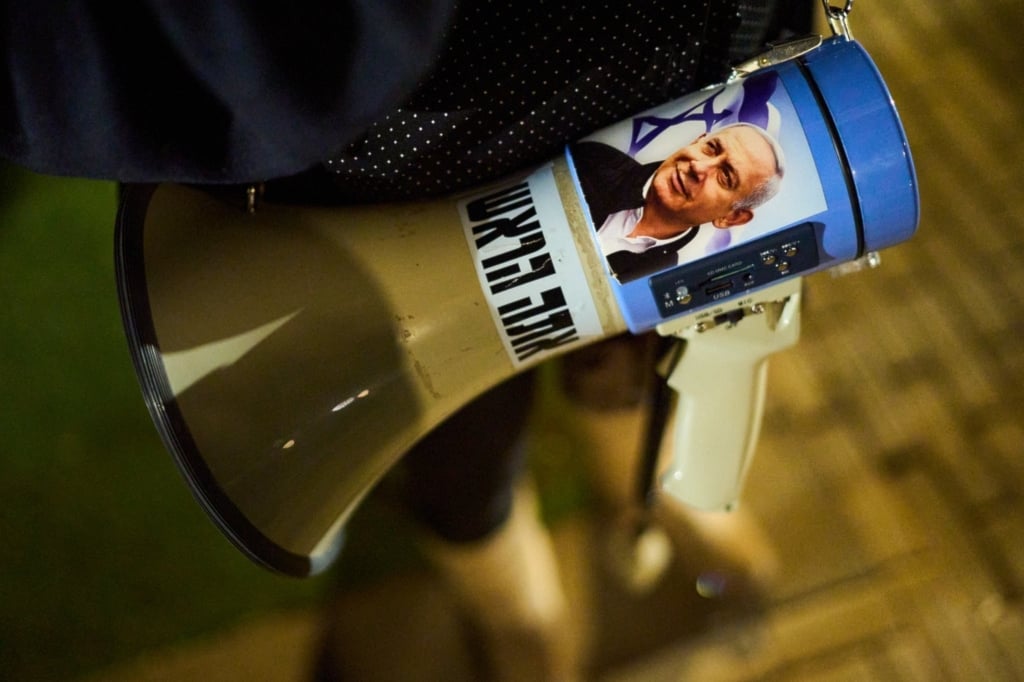
An image of Israeli Prime Minister Benjamin Netanyahu decorates a sticker on a bullhorn during a protest outside Gadi Eisenkot's residence, Sunday, Nov. 1, 2026, in occupied Palestine. (AP)
Israeli Prime Minister Benjamin Netanyahu has intensified allegations of foreign interference in the October 27 elections, raising what he described as "serious suspicions" that foreign states spent considerable sums to influence the vote.
Speaking in a video released on Wednesday, Netanyahu said, "There are serious suspicions that foreign states have spent considerable sums to influence the outcome of the elections in Israel."
The accusations come as Israeli President Isaac Herzog begins consultations over the appointment of a candidate to form the next government, amid an increasingly contentious political struggle over the election results and the role of Palestinian Arab political representatives.
Netanyahu and his far-right allies have directed accusations at Arab political figures whose parliamentary support could prove decisive in enabling main opposition leader Gadi Eisenkot to assume the premiership.
The allegations have therefore unfolded against a broader political backdrop: the possibility that Arab political participation could reshape the balance of power and remove Netanyahu's camp from government.
Read more: Lapid rules out Netanyahu-led unity government after US election
Joint List condemns targeting of Ayman Odeh
The Joint List, a coalition of three Arab political parties, denounced what it described as "political persecution" following reports that outgoing lawmaker and former bloc leader Ayman Odeh would be investigated over alleged foreign election funding.
"The targeting of Ayman Odeh is political persecution, and we will not allow the Arab public's vote to be delegitimised," the coalition said in a statement.
It further noted that "Netanyahu is clinging to power and refusing to acknowledge the will of Arab citizens who voted overwhelmingly against his government."
The investigation forms part of a broader probe into alleged foreign interference promoted by Netanyahu's Likud party, according to several Israeli media reports.
Odeh, a veteran political figure who previously led the left-wing Hadash party, is among the prominent representatives of the Palestinian Arab community in the occupied territories.
The accusations have emerged following record turnout among Arab voters, making their political representation particularly significant in the post-election negotiations.
Shin Bet investigation and allegations of foreign funding
According to reports citing unnamed officials, the Shin Bet is investigating whether Odeh received hundreds of thousands of shekels, approximately $100,000, from an unspecified foreign entity.
The allegations have not been accompanied by publicly established evidence in the supplied reporting.
The investigation has also exposed tensions between Netanyahu's government and Attorney General Gali Baharav-Miara. On Tuesday, she rejected a Shin Bet request to interrogate other Arab party leaders, citing the absence of evidence.
The decision angered Netanyahu's allies, who have repeatedly clashed with the attorney general.
Netanyahu has also pointed to the arrests of several individuals found carrying envelopes of cash on election day, incidents that authorities characterized as localized.
He accused political leaders of receiving money from Qatar, despite similar allegations previously being directed at aides working for Netanyahu himself.
The allegations have consequently raised questions about the consistency with which claims of foreign financial influence are being pursued and whether the investigation is being used to exert pressure on political opponents.
Election committee finds no evidence undermining results
The Central Elections Committee said it had audited 9,069 polling stations following complaints but found no evidence that would call the integrity of the election results into question.
This finding stands in contrast to Netanyahu's escalating claims of foreign interference and adds significance to the political dispute surrounding the post-election process.
Yair Golan, a left-wing leader in the main opposition alliance, accused Netanyahu's camp of abusing state institutions to challenge the political outcome.
"The police are arresting political activists without court warrants, the Shin Bet is attempting to question senior elected officials without presenting any evidence, while the outgoing government refuses to recognise the election results," Golan said.
His remarks appeared to refer to the arrest late Tuesday of Abed Abu Shehadeh, a Palestinian Arab journalist related to politician Sami Abu Shehadeh.
The journalist was being questioned on charges of "contact with a foreign agent", according to rights group Adalah, which is representing him legally.
The case adds another dimension to concerns surrounding the treatment of political activists and representatives following the election.
Read more: Trump announces US to end $4 bln aid to 'Israel' by year-end: Fox News


