
No solution exists against Hezbollah's FPVs, Israeli officer admits
 3 Min Read
The Israeli occupation forces admit that no solution exists against Hezbollah's drones, particularly FPVs.
-
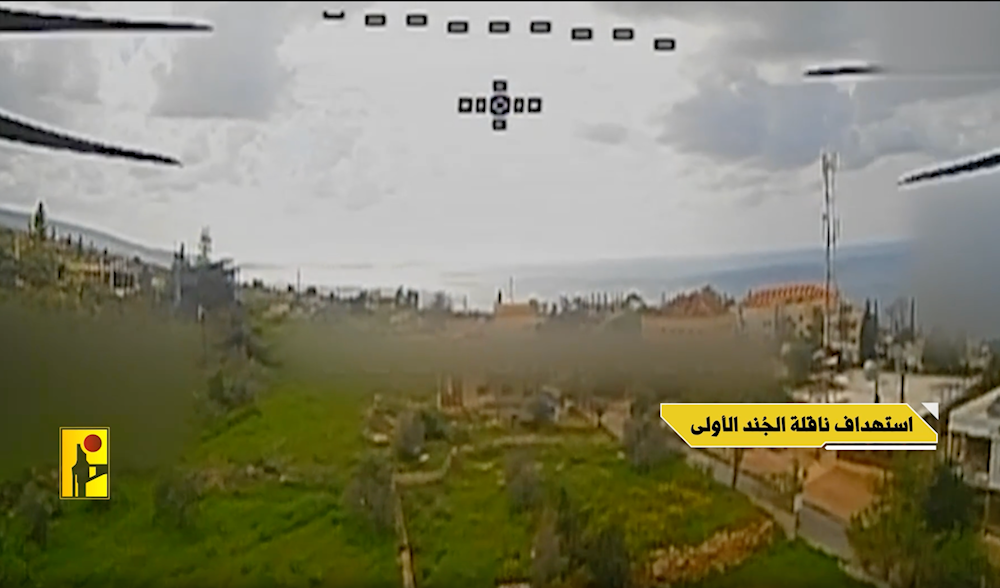
Footage shows the Islamic Resistance targeting two Israeli armored personnel carriers and a Humvee in the town of Al-Bayyada in southern Lebanon using attack drones, March 28, 2026 (Military media)
The Israeli military currently lacks an effective operational solution to counter the drone capabilities of Hezbollah, an Israeli military officer admitted, adding that existing systems have not achieved the level of effectiveness required to address the threats posed along the Lebanese front.
According to the officer, the Israeli Air Force carried out tests approximately two weeks ago on a newly developed system designed to intercept drones. However, the results were "unsatisfactory", with no significant operational breakthrough achieved.
'Israel' unable to challenge drones
Meanwhile, Israeli media, including Army Radio, reported that senior military officials have acknowledged delays and limitations in the current response to drone incursions.
Additional reporting by Israel Hayom indicated that the Israeli military has yet to develop a viable technological or operational solution to counter explosive drones and fiber-optic guided aerial systems used by Hezbollah in Lebanon.
The report emphasized that current countermeasures remain insufficient against this category of threat, particularly FPV (first-person view) drones, which are highly maneuverable, difficult to detect, and resistant to electronic jamming.
Military correspondents have also noted that such drones can hover or position themselves above urban terrain and strike when movement is detected, increasing operational pressure on ground forces.
Improvised field responses 'ineffective'
In some cases, “Israeli” forces have reportedly resorted to improvised field tactics, including the use of nets intended to physically intercept incoming drones before impact.
However, these measures have been described as inconsistent and largely ineffective, highlighting the absence of a dedicated and reliable counter-drone system capable of addressing the threat at scale.
Haaretz similarly reported that the military has not established reliable countermeasures to halt FPV attacks. According to the report, the use of FPV drones has introduced a persistent operational challenge due to their low visibility, high maneuverability, and resistance to electronic warfare measures.
Soldiers have been quoted describing scenarios in which drones are capable of hovering over positions and striking when movement is detected, forcing units to operate under constant aerial exposure and limiting their maneuverability during engineering and demolition operations.
Tactical balance shifts as drone warfare evolves
Within this context, Hezbollah’s continued deployment of FPV suicide drones has contributed to a shifting tactical balance on the battlefield.
Repeated reports of successful drone strikes have been linked to Israeli personnel casualties since the beginning of the ceasefire, amid continued Israeli violations and attacks.


