
Norway joins France-led nuclear deterrence scheme in new defense pact
 3 Min Read
France and Norway sign a defense pact expanding nuclear deterrence cooperation, strengthening Europe’s security amid rising geopolitical tensions.
-
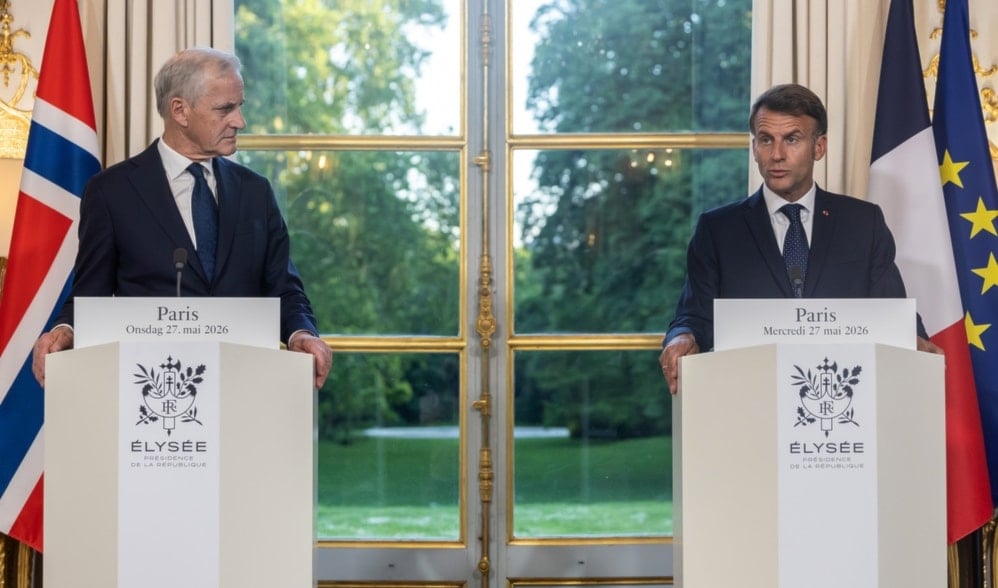
France's President Emmanuel Macron, right, and Norway's Prime Minister Jonas Gahr Store attend a joint news conference at the Elysee Palace in Paris, France, Wednesday, May 27, 2026. (Christophe Petit Tesson/Pool Photo via AP)
France and Norway agreed on Wednesday to deepen military cooperation through a new defense pact that includes participation in a Paris-led nuclear deterrence scheme aimed at strengthening European security amid growing geopolitical tensions.
Norwegian Prime Minister Jonas Gahr Store and French President Emmanuel Macron announced the agreement in Paris, describing it as part of a broader effort to reinforce continental defense coordination.
“We are contending with the most serious security situation since the Second World War,” Store said, noting that Oslo had recently concluded defense agreements with Germany and the United Kingdom as part of its expanding security partnerships.
Norway joins France-led European deterrence initiative
The agreement places Norway within France’s expanding “forward” nuclear deterrence framework, a program designed to extend the role of French nuclear capabilities in supporting allied security across Europe.
In March, Macron introduced the initiative, under which France, the European Union’s only nuclear-armed state, would make elements of its nuclear posture available to allied deterrence planning.
The scheme includes the potential deployment of French “strategic air forces” to allied territories, aimed at increasing operational flexibility and complicating adversary calculations, according to Macron.
Norway joins eight other participating countries, including Belgium, Denmark, Germany, Greece, the Netherlands, Poland, Sweden, and the United Kingdom.
Macron’s expanding nuclear strategy in Europe
Macron has positioned France’s nuclear arsenal as a central pillar of broader European defense coordination, particularly as concerns over long-term regional security intensify.
Under the framework, participating states would engage in closer operational coordination, including joint planning, exercises, and potential prepositioning of military assets.
“Norway, a key geographical and strategic partner… will represent a strong added value for this enhanced deterrence,” Macron said, highlighting Oslo’s role in strengthening the initiative.
Defense cooperation beyond nuclear policy
Beyond nuclear deterrence, the agreement expands cooperation across several security domains, including hybrid warfare, maritime security, cybersecurity, space, support for Ukraine, and defense industrial collaboration.
Store said the pact establishes “concrete structures, plans, exercises, and prepositioning of equipment,” enabling faster and more coordinated responses in times of crisis.
“The agreement also provides a framework for closer cooperation on hybrid warfare, maritime security, space cooperation, cybersecurity, support to Ukraine, and defense industrial cooperation,” he added. Russia's intelligence agency previously warned that France and the UK were preparing to transfer nuclear weapons to Kiev.
Europe’s nuclear balance
France is estimated to possess around 290 nuclear warheads, according to the Stockholm International Peace Research Institute (SIPRI) and the Federation of American Scientists (FAS). More than 80 percent of its arsenal is submarine-based, according to the Bulletin of the Atomic Scientists.
This places France as the world’s fourth-largest nuclear power, behind Russia with over 4,300 warheads, the United States with approximately 3,700, and China with around 600. The United Kingdom, a NATO ally outside the European Union, is estimated to hold about 225 warheads.
Read more: Russia urges UK, France to probe nuclear arms supply plan to Kiev


