
Nuclear submarines on agenda as South Korea, US set to meet in Seoul
 2 Min Read
South Korea and the US are set to hold high-level security and economic talks in Seoul on June 2-3, with discussions expected to include nuclear-powered submarines.
-
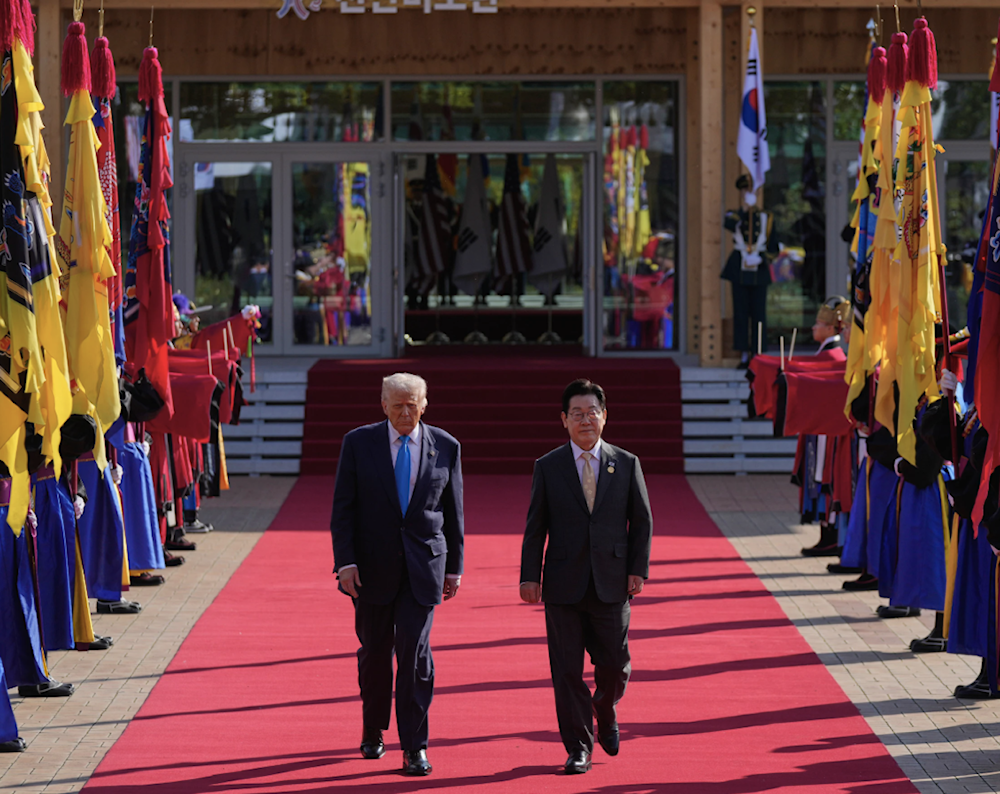
President Donald Trump and South Korean President Lee Jae Myung walk in a welcome ceremony in South Korea on October 29, 2025. (AP)
South Korea and the US will hold high-level security talks in Seoul on June 2 and 3, bringing together senior officials from the foreign affairs, defense, nuclear energy, and industry sectors, Seoul’s foreign ministry said on Friday.
The discussions will mark the first major meeting focused on implementing the security and economic cooperation framework agreed upon by the leaders of South Korea and the US, according to the ministry.
The US delegation will be led by Under Secretary of State Allison Hooker, Seoul said.
South Korean officials indicated that the talks are expected to address Seoul’s proposal to develop nuclear-powered submarines, a hot issue amid rising regional tensions and expanding military competition in East Asia.
Expanding nuclear submarine talks in East Asia
Recent discussions around South Korea’s nuclear-powered submarine ambitions are unfolding alongside broader US-led efforts to expand advanced defense cooperation frameworks in the Indo-Pacific, particularly through the evolution of the AUKUS pact.
While originally centered on Australia’s acquisition of nuclear-powered submarines, AUKUS has increasingly been framed as a flexible platform for integrating additional regional partners.
In 2025–2026, US officials signaled exploratory talks with both Japan and South Korea regarding participation in AUKUS Pillar II initiatives, which focus on advanced military technologies, and potential longer-term collaboration on nuclear propulsion capabilities.
Although neither Tokyo nor Seoul is formally part of the core submarine-sharing agreement, both countries have shown growing interest in nuclear-powered naval platforms amid intensifying strategic competition with China and the DPRK.


