
Oman FM: World risks return to gunboat diplomacy era
 4 Min Read
Oman's foreign minister warns that eroding international law and leaders bypassing diplomats risk a return to gunboat diplomacy, citing stalled Hormuz talks.
-
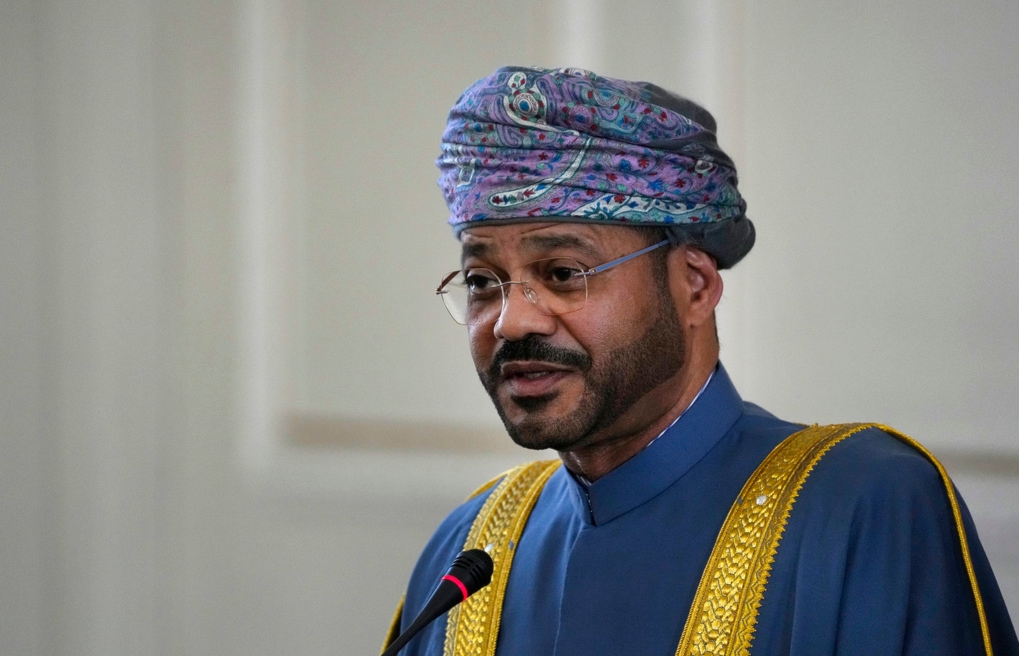
Omani Foreign Minister Badr Albusaidi speaks in a joint press briefing with his Iranian counterpart Abbas Araghchi after their meeting in Tehran, Iran, on December 30, 2024. (AP)
Oman's Foreign Minister Badr Albusaidi warned in an op-ed for the Financial Times that a decline in respect for international law, combined with a growing habit among world leaders of sidelining diplomats altogether, is pushing global politics back toward an era in which major powers acted with impunity, only this time with weapons of mass destruction at their disposal.
Albusaidi wrote that these two trends explain why years of initiatives, mediations, summits and memoranda have produced only "a few provisional agreements" and no lasting resolution in Palestine, Iran, Yemen, Sudan, Lebanon, "Israel", and Ukraine.
He pointed to the consolidation of occupations, the growing use of assassination and abduction as instruments of state policy, attacks on civilian populations, and open disregard for the United Nations, the International Court of Justice and the International Criminal Court.
Bypassing diplomats for gunboats and sanctions
The Omani foreign minister argued that when leaders try to conduct diplomacy without diplomats, they quickly run out of tools to achieve their aims and fall back on one of two options: 19th-century-style gunboat diplomacy, or its modern equivalent of using economic power to pressure entire populations into submission in pursuit of regime change and a compliant successor government.
Albusaidi did not name any government. But the pattern he describes echoes US-Israeli policy and their actions in the war on Iran, where military aggression has run alongside a sanctions campaign that is aimed at forcing regime change in Tehran. The remarks also refrence Israeli actions taken during the continued attacks on the Gaza Strip and South Lebanon, despite ceasefire agreements and international law.
Small states and the old norms
For smaller states operating in this environment, Albusaidi argued the best response is to keep insisting on international law even when doing so looks tedious or futile, since those rules exist to protect the majority of the world's population from unrestrained power.
He described the diplomat's task, particularly for a small nation, as being the persistent interlocutor who remains at the table even when talks appear to have nothing left to offer.
Hormuz talks still unresolved
Albusaidi cited Oman's ongoing effort to broker an agreement restoring navigation through the Strait of Hormuz as a direct application of that approach, describing it as a complex negotiation conducted under the constant threat of war, with major implications for the global economy.
He said no resolution has been reached yet, but that Muscat has no intention of abandoning the process, given the stakes involved for both the region and the broader principle that states can resolve disputes through dialogue rather than force.
The talks unfold against the backdrop of the US-Israeli war on Iran, during which Tehran took control of the strait in response to the US-Israeli aggression, cutting off American military resupply routes through the Gulf and driving up global energy prices.
Albusaidi framed Oman's continued engagement around the three objectives of protecting its own territorial waters, shielding the wider international community, particularly the most vulnerable states that would suffer most from a prolonged closure, and reinforcing the standing of international law by operating strictly within its framework. He described this approach as "constructive neutrality," which he said means not just facilitating talks but actively building and strengthening the international legal order through the actions taken in its name.
Read more: Vance: Iran war 'not a war,' avoids responsibility for wedding strike


