
Orbán defeat may reshape EU stance on 'Israel' policy
 3 Min Read
Hungary’s political shift weakens "Israel’s" EU backing as pressure grows for sanctions, trade review, and policy changes across European capitals.
-
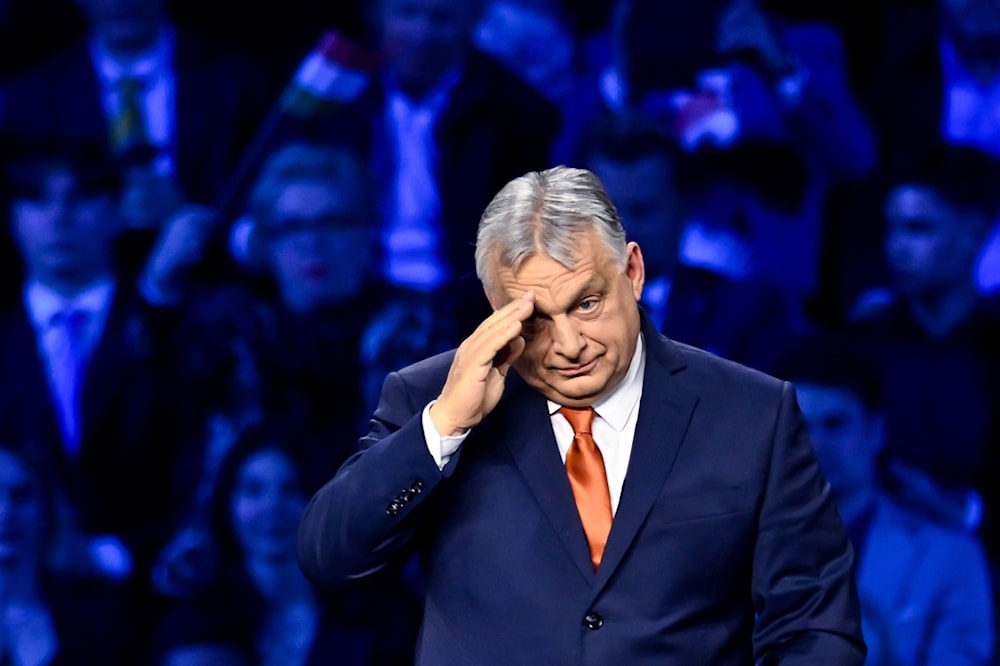
Hungary's former Prime Minister Viktor Orban gestures at the end of his speech during a pre-election rally in Budapest, Hungary, Tuesday, April 7, 2026. (AP Photo/Denes Erdos)
The political defeat of Viktor Orbán has triggered a reassessment of "Israel’s" diplomatic position within the European Union, removing one of its most consistent institutional supporters in Brussels.
Orbán’s government had frequently used veto power and political leverage to block EU initiatives targeting Israeli policies, particularly those concerning settlement expansion and human rights scrutiny in the occupied territories.
His departure is now seen as altering internal EU dynamics at a time of increasing divergence over West Asia policy.
EU pressure on 'Israel' intensifies
Across Europe, political criticism of "Israel" has become more pronounced, with debates emerging over potential sanctions and diplomatic measures.
In Germany, Friedrich Merz expressed concern over developments in the occupied West Bank, citing reports of increased violence involving Israeli settlers.
Meanwhile, Italy suspended parts of a defense and technology agreement with "Israel" after Foreign Minister Antonio Tajani condemned military operations in Lebanon as “unacceptable.”
These developments indicate a gradual tightening of political language even among states traditionally viewed as moderate toward "Israel".
West Bank sanctions back on EU agenda
One of the most immediate policy discussions concerns sanctions against Israeli settlers that have attacked Palestinians in the West Bank.
Under Orban’s leadership, Hungary blocked a proposal supported by 26 of 27 EU member states to impose such sanctions.
Diplomatic sources in Brussels now indicate that the removal of this veto could clear the path for renewed consideration of the measure, depending on the position of Hungary’s incoming leadership.
Read more: Former EU diplomats urge Europe to suspend cooperation with 'Israel'
EU-'Israel' association agreement under review
Another focal point is the EU-"Israel" Association Agreement, which governs trade and political relations between the two sides.
The agreement, in force since 2000, has previously been debated in response to human rights concerns, including during periods of escalation in Gaza.
Spanish Prime Minister Pedro Sánchez has recently called for a reassessment of the framework, reflecting growing pressure from segments of EU leadership to condition economic ties on compliance with international law obligations.
Approval for suspension would require a qualified majority, which has so far been difficult to achieve due to internal divisions.
Diverging positions within Europe
Despite rising criticism, positions within the EU remain fragmented. Some member states continue to emphasize strategic and security cooperation with "Israel", while others push for stronger accountability mechanisms.
A recent decision by the European Union foreign policy apparatus, led by Kaja Kallas, condemned the recently passed Israeli bill that calls for the execution by hanging of Palestinian detainees. Kallas described it as a “grave regression.”
Germany, France, and the United Kingdom also issued warnings that such measures could undermine what they call democratic commitments.
Internal EU diplomacy and shifting mood
EU diplomatic sources indicate that the broader political atmosphere is changing, influenced by developments in both Gaza and Lebanon.
Some officials argue that recent military escalations have accelerated skepticism toward Israeli policy, while others caution that ongoing mediation efforts could delay formal action.
Discussions are expected to continue within the EU foreign minister meetings in Luxembourg, where both sanctions and trade relations are on the agenda.


