
Pakistan says talks provide 'grounds for optimism' for durable deal
 5 Min Read
Pakistan’s Ishaq Dar says the high-level call led by US President Donald Trump brought progress on Iran negotiations and regional peace efforts involving multiple Middle Eastern states.
-
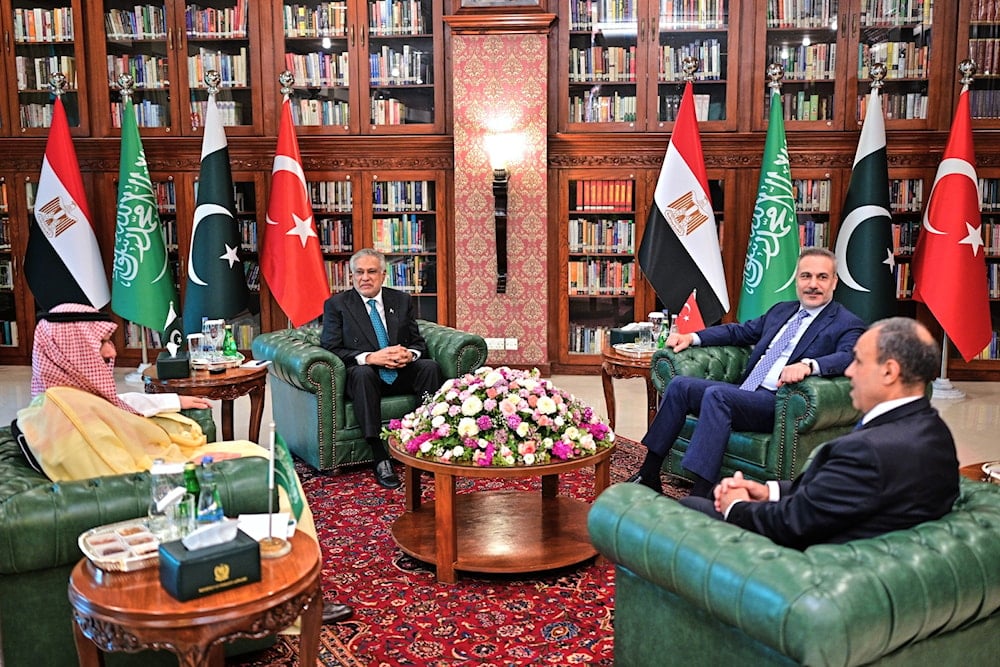
From left, Saudi Arabian FM Faisal bin Farhan, Pakistani FM Ishaq Dar, Turkish FM Hakan Fidan, and Egyptian FM Badr Abdelatty attend a meeting on the war on Iran in Islamabad, Pakistan, March 29, 2026 (AP)
A high-level telephone call led by US President Donald Trump that took place early Sunday involving regional leaders marks a “significant step” toward advancing diplomatic efforts aimed at regional peace and stability, Pakistan’s Deputy Prime Minister and Foreign Minister Ishaq Dar stated.
In a post on X, Dar said the call included leaders from Pakistan, Saudi Arabia, Turkey, Qatar, Egypt, the United Arab Emirates, and Jordan and focused on efforts to reach an “early diplomatic outcome” related to ongoing negotiations involving Iran.
Earlier, sources told Al Mayadeen that Tehran and Washington are in the final stages of drafting a framework agreement through Pakistani mediation aimed at ending the ongoing war and establishing de-escalation arrangements.
According to the sources, the proposed arrangement is not a final agreement but rather a memorandum of understanding designed to outline immediate political, military, and maritime steps following months of regional escalation.
The sources added that the memorandum does not include any clause related to Iran’s nuclear file, which is expected to be addressed in a separate track after the framework is signed.
'Meaningful progress'
Pakistan's Deputy PM and FM said the engagement reflected progress toward shared objectives of regional stability and praised the commitment of participating leaders to dialogue and diplomacy.
Today’s important telephone call led by President Donald J. Trump @realDonaldTrump with the leaders of Pakistan, Saudi Arabia, Türkiye, Qatar, Egypt, the UAE, and Jordan marks a significant step closer toward the shared objective of regional peace, stability, and an early…
— Ishaq Dar (@MIshaqDar50) May 24, 2026
Dar commended US leadership in the process, specifically acknowledging Trump, Vice President J.D. Vance, Secretary of State Marco Rubio, and other members of the US team involved in the discussions.
He also referred to the participation of US officials Steve Witkoff and Jared Kushner, saying their engagement contributed to what he described as “meaningful progress” in the negotiations.
Dar further expressed appreciation for the constructive role played by Iranian officials, including President Masoud Pezeshkian, Foreign Minister Abbas Araghchi, and Speaker Mohammad Bagher Ghalibaf.
Regional and UN engagement
The Pakistani foreign minister also thanked UN Secretary-General Antonio Guterres and regional partners for their involvement, noting what he described as sustained diplomatic coordination since late February.
He specifically mentioned counterparts in Saudi Arabia, Turkey, Egypt, and Qatar, as well as other unnamed partners, for their continued engagement in support of the talks.
Dar additionally praised Pakistani leadership, including Prime Minister Shehbaz Sharif and Field Marshal Asim Munir, for their roles in the process, alongside the country’s foreign ministry.
A step toward regional stability
The Deputy PM said Pakistan remains committed to supporting diplomatic efforts aimed at achieving lasting peace, mutual respect, and regional stability.
He added that the outcome of the negotiations provides “grounds for optimism” that a durable agreement could be reached, stressing that dialogue and diplomacy must prevail over conflict and confrontation in the region.
Participants in the call
Meanwhile, Anadolu Agency reported that Turkish President Recep Tayyip Erdogan and several regional leaders took part in the teleconference, according to Turkey’s Communications Directorate.
The call brought together a wide group of leaders, including Bahrain’s King Hamad bin Isa Al Khalifa, UAE President Sheikh Mohammed bin Zayed Al Nahyan, Qatar’s Emir Sheikh Tamim bin Hamad Al Thani, Egypt’s President Abdel Fattah el-Sisi, Saudi Crown Prince Mohammed bin Salman, Jordan’s King Abdullah II, Pakistan’s Chief of Army Staff Asim Munir, and members of the US Cabinet.
The discussions followed Trump’s announcement that an agreement with Iran to end the war had been “largely negotiated, subject to finalization.”
Erdogan welcomes diplomatic progress
Erdogan welcomed progress in the diplomatic process with Iran, aligning with Trump’s remarks on the state of negotiations. He praised the countries involved in mediation efforts and stressed that any agreement guaranteeing free passage through the Strait of Hormuz would contribute to regional stability.
The Turkish president also reaffirmed Ankara’s readiness to support the implementation of any potential deal with Tehran.
Turkey, he said, seeks a regional order in which states do not pose threats to one another, adding that a “just peace would have no losers.”
Erdogan reiterated Turkey’s longstanding position in favor of resolving regional disputes through dialogue and diplomacy, saying Ankara continues to work toward stability in West Asia.
Solutions could eventually be found to complex issues such as Iran’s nuclear program, despite ongoing tensions, he concluded.
Read more: Pakistan's Sharif praises Trump, signals new Iran-US talks soon
US–Iran talks continue via mediation channels
The US and Iran have been holding indirect negotiations through Islamabad on proposals aimed at reopening the Strait of Hormuz, addressing Tehran’s nuclear program, and discussing sanctions relief.
Trump said earlier this week that Washington had postponed further military aggression against Iran following requests from Gulf leaders, adding that “serious negotiations” were underway between the parties.
He said in a statement, "I have been asked by the Emir of Qatar, Tamim bin Hamad Al Thani, the Crown Prince of Saudi Arabia, Mohammed bin Salman Al Saud, and the President of the United Arab Emirates, Mohamed bin Zayed Al Nahyan, to hold off on our planned Military attack of the Islamic Republic of Iran, which was scheduled for tomorrow."
The president claimed that "serious negotiations are now taking place" and that, in the opinion of the Gulf leaders, "a Deal will be made, which will be very acceptable to the United States of America, as well as all Countries in the Middle East, and beyond."
Trump added, "This Deal will include, importantly, NO NUCLEAR WEAPONS FOR IRAN!"
Read more: Strait of Hormuz to remain under Iran's control despite Trump's claims


