
Trump halts Iran attack at Gulf leaders' request, warns assault ready
 3 Min Read
President Trump has cancelled a planned attack on Iran at the request of Gulf leaders, but warns that a "full, large scale assault" remains ready to be launched.
-
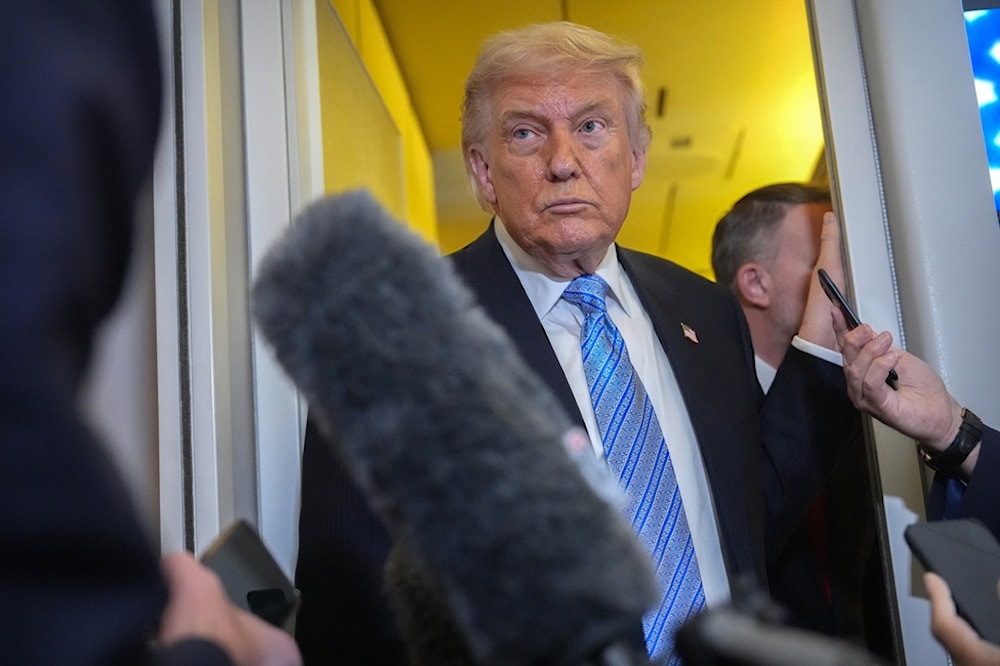
President Donald Trump speaks to reporters aboard Air Force One, Friday, May 15, 2026, as he returns from a trip to Beijing, China. (AP)
President Donald Trump has announced that he has cancelled a planned military attack on Iran, originally scheduled for tomorrow, following direct requests from the leaders of Qatar, Saudi Arabia, and the United Arab Emirates, while warning that a "full, large-scale assault" remains ready to be launched at a moment's notice if no acceptable deal is reached.
In a statement, Trump said: "I have been asked by the Emir of Qatar, Tamim bin Hamad Al Thani, the Crown Prince of Saudi Arabia, Mohammed bin Salman Al Saud, and the President of the United Arab Emirates, Mohamed bin Zayed Al Nahyan, to hold off on our planned Military attack of the Islamic Republic of Iran, which was scheduled for tomorrow."
The president claimed that "serious negotiations are now taking place" and that, in the opinion of the Gulf leaders, "a Deal will be made, which will be very acceptable to the United States of America, as well as all Countries in the Middle East, and beyond."
Trump added: "This Deal will include, importantly, NO NUCLEAR WEAPONS FOR IRAN!"
War on Iran remains on the table
Despite the postponement, Trump made clear that the threat of military action has not been withdrawn.
He stated that "based on my respect for the above mentioned Leaders, I have instructed Secretary of War, Pete Hegseth, The Chairman of The Joint Chiefs of Staff, General Daniel Caine, and The United States Military, that we will NOT be doing the scheduled attack of Iran tomorrow."
However, he immediately warned that he has "further instructed them to be prepared to go forward with a full, large scale assault of Iran, on a moment's notice, in the event that an acceptable Deal is not reached."
Gulf leaders seek to avert further escalation
The intervention by the three Gulf leaders suggests growing regional concern over the prospect of renewed large‑scale hostilities.
The UAE and Saudi Arabia have already been involved in the war, with reports that both covertly carried out aggression on Iranian territory earlier in the war. Qatar has positioned itself as a mediator between Washington and Tehran.
Iran has consistently maintained that it has no interest in developing nuclear weapons, a position confirmed by multiple US intelligence assessments. Trump's demand for "NO NUCLEAR WEAPONS FOR IRAN" is therefore not a concession from Tehran but a restatement of its existing policy.


