
Personnel advised to leave Al Udeid Base in Qatar in 'posture change'
 5 Min Read
US personnel at Al Udeid Air Base in Qatar were advised to leave amid growing tensions with Iran, signaling a shift in military posture.
-
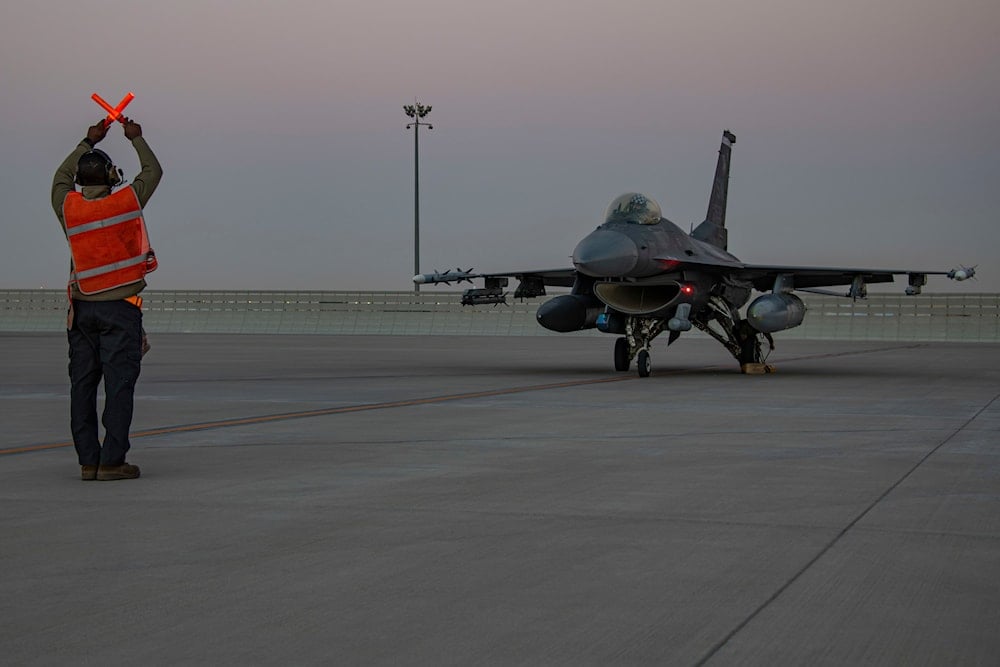
In this handout photo from the US Air Force, an airman guides an F-16 Fighting Falcon during training at Al Udeid Air Base, Qatar, Jan. 24, 2022 (AP)
Personnel at the US military’s Al Udeid Air Base in Qatar have been advised to leave by Wednesday evening, three diplomats told Reuters, as Washington issues warnings that it could interfere in Iran.
The US embassy in Doha had no immediate comment, while Qatar’s Foreign Ministry did not respond to Reuters’ request for confirmation. One diplomat emphasized that the guidance reflects a “posture change and not an ordered evacuation,” adding that no specific reason for the change was provided.
Earlier, a senior Iranian official told Reuters that Tehran had warned regional countries it would target US military bases if Washington carried out an attack, following President Donald Trump’s threats of intervention in Iran.
What are the Middle East's main US bases?
Sprawling from Bahrain all the way to Turkey, the United States operates numerous military bases, all of which Iran could target in the case of a military confrontation between Washington and Tehran.
#MiddleEast pic.twitter.com/Jblv3GwJfg
— Al Mayadeen English (@MayadeenEnglish) June 23, 2025
In Bahrain, the US Navy’s Fifth Fleet headquarters oversees operations throughout the Gulf, Red Sea, Arabian Sea, and parts of the Indian Ocean, making it a critical strategic hub.
Meanwhile, in Qatar, the sprawling Al Udeid Air Base outside Doha serves as the forward headquarters for US Central Command, directing operations across a territory stretching from Egypt in the west to Kazakhstan in the east. The base, home to around 10,000 troops, recently opened a new coordination cell to enhance integrated air and missile defense alongside regional partners.
Kuwait hosts several significant US installations, including Camp Arifjan, the forward headquarters of US Army Central, as well as Ali Al Salem Air Base near the Iraqi border and Camp Buehring, a staging point for deployments into Iraq and Syria.
In the United Arab Emirates, Al Dhafra Air Base, south of Abu Dhabi, supports reconnaissance missions, while Dubai’s Jebel Ali Port regularly hosts US aircraft carriers and naval vessels, despite not being a formal military base.
In Iraq, US forces operate from Ain Al Asad Air Base in Anbar province, previously struck by Iranian missiles in retaliation for the killing of General Qasem Soleimani, and from Erbil Air Base in the semi-autonomous Kurdistan Region, which functions as a hub for training, intelligence sharing, and logistical coordination.
In Saudi Arabia, over 2,300 US personnel work in coordination with local authorities, including at Prince Sultan Air Base south of Riyadh, which hosts air defence assets such as Patriot missile batteries and THAAD systems.
Further east, Jordan’s Muwaffaq al Salti Air Base in Azraq supports US operations across the Levant, while Turkey’s Incirlik Air Base in southern Adana province, jointly operated by the US and Turkey, houses US nuclear warheads and personnel supporting coalition operations in Syria and Iraq. Collectively, these bases represent a network of strategic points that could be directly affected if tensions between Washington and Tehran escalate.
Trump pours gas on fire, Gulf urges de-escalation
On January 13, US President Donald Trump publicly called on Iranians to continue rioting against their government, stating that he had canceled all meetings with Iranian officials until what he described as the "killing of protesters" comes to an end.
In a post on his Truth Social platform, Trump addressed what he called “Iranian patriots", urging them to “keep protesting” and to “take over your institutions,” in what amounted to a call to riot, disrupt public order, and interfere with the functioning of public service institutions.
“I have canceled all meetings with Iranian officials until the senseless killing of protesters stops,” Trump said, framing foreign-backed riots and acts of terrorism in this way, while adding that “help is on its way,” without offering further details but suggesting a possible action against the Islamic Republic.
US escalating despite restraint calls
Meanwhile, several Gulf Arab states have quietly taken steps to restrain Washington from escalating toward military confrontation or regime change in Iran, as senior US officials signal that the use of force remains a serious option, The Wall Street Journal reported.
According to the report, Saudi Arabia, Oman, and Qatar have privately urged the Trump administration not to pursue attacks on Iran, warning that such actions could destabilize global energy markets and ultimately inflict harm on the US economy.
Despite those warnings, US officials cited by the Wall Street Journal said that a strike on Iran was “more likely than not,” highlighting growing concern across the region that Washington may be preparing to escalate its actions regardless of opposition from neighboring states.


