
Pezeshkian: Any decision to end war will reflect Iran's conditions
 3 Min Read
Iranian President Pezeshkian says any decision to end the US-Israeli war on Iran will strictly follow Tehran's conditions, as diplomacy remains slow and fraught.
-
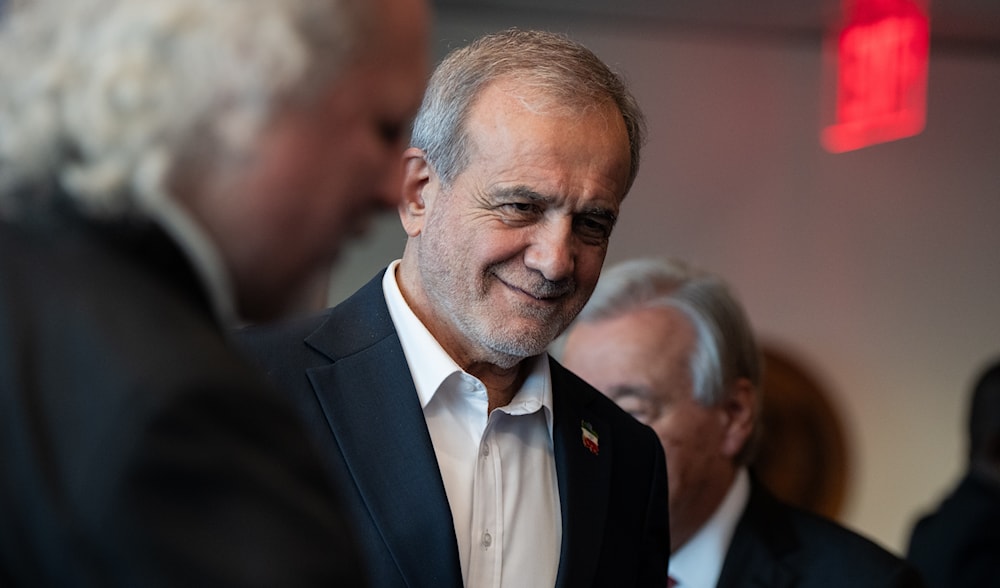
Masoud Pezeshkian, the President of Iran, attends the United Nations General Assembly at United Nations headquarters, on Sept. 25, 2025 (AP)
Iranian President Masoud Pezeshkian affirmed Monday that any decision to end the ongoing aggression will be made strictly in accordance with Iran's stated conditions and within a framework that guarantees the security and interests of the Iranian people.
Speaking at a cabinet meeting one month after the start of the US-Israeli war on Iran, Pezeshkian praised state institutions for maintaining uninterrupted service delivery throughout the war, stressing the need to sustain inter-agency coordination and reinforce a strong sense of responsibility among officials.
"Ensuring the uninterrupted provision of services is a key pillar of resilience at this stage," the president said, adding that these efforts must continue "with full commitment until victory over the enemy is achieved."
Pezeshkian also commended the armed forces for their "decisive and critical" role in protecting Iran's territorial integrity and national security, while highlighting the public's "conscious and strong presence," including nighttime gatherings, as a reflection of national unity and a vital asset in navigating the current sensitive phase.
He concluded his remarks by declaring that "Iran stands tall today, shining like a radiant jewel on the world stage, inspiring all those who seek freedom."
War's diplomatic track 'highly complicated'
Pezeshkian's address comes amid a fraught and slow-moving diplomatic backdrop. A source has told Al Mayadeen that preparations for any talks between Washington and Tehran remain limited to exchanging messages through intermediaries, with the source warning that "the path toward a settlement is very slow and highly complicated" and that "the risk of the collapse of this track is also high," citing Israel's role as the most dangerous obstacle, as it "does not want this war to end."
Iran has rejected the United States' 15-point proposal for negotiations, with a senior Iranian security-political source confirming to Al Mayadeen that Tehran "cannot accept" the terms outlined.
However, Iran subsequently delivered its own response through intermediaries, laying out a series of conditions including an immediate halt to assassination operations, binding guarantees against renewed aggression, defined compensation and reparations, and a full cessation of hostilities across all fronts, including all resistance groups in the region.
Iran also reaffirmed its sovereignty over the Strait of Hormuz, describing control of the waterway as a legal right and a mechanism to ensure implementation of any commitments made by the other side.
Tehran has maintained that there are no ongoing direct talks with Washington, stressing that the US abandoned diplomacy when it launched its aggression on Iranian territory and oversaw the assassination of Ayatollah Sayyed Ali Khamenei.


