
Pezeshkian calls for Islamic unity, rejects Western-driven divisions
 3 Min Read
The Iranian president calls for Islamic unity with Gulf states, rejecting claims that Tehran targeted its neighbors.
-
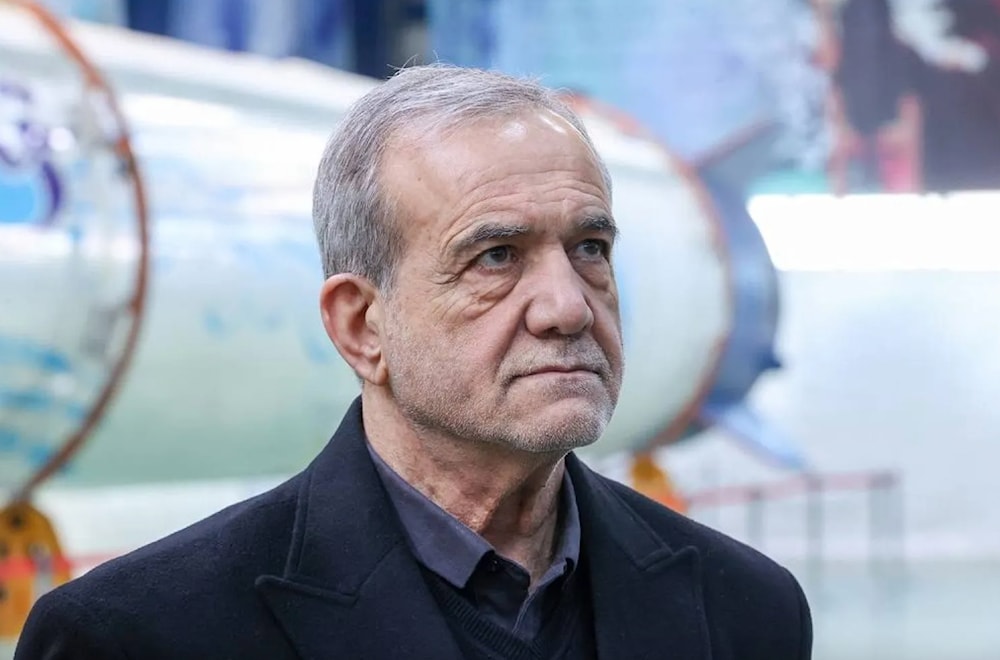
02 February 2025, Iran, Tehran: Iranian President Masoud Pezeshkian visits an exhibition that showcases the defense ministry's latest advancements in defense and space in Tehran. (Iranian Presidency)
Iranian President Masoud Pezeshkian has renewed calls for unity among Islamic countries, stressing that Tehran seeks no conflict with its neighbors while facing a sustained US-Israeli war on the country.
In a message marking Eid al-Fitr, Pezeshkian described neighboring states as “brothers” and warned that divisions within the Islamic world serve only one actor: “the Zionist entity.” He urged Muslim nations to strengthen solidarity and act in accordance with the teachings of Prophet Mohammad to prevent external forces from exploiting regional divisions.
إلى الدول الإسلامية وجيراننا الأعزاء، أنتم إخوتنا ولسنا في صدد أي نزاع معكم. المستفيد الوحيد من خلافاتنا هو الكيان الصهيوني.
— Masoud Pezeshkian (@drpezeshkian) March 21, 2026
نسأل الله في #عيد_الفطر أن يمنحنا القوة والوحدة بالعمل بتعاليم #رسول_الله لنيل رضاه.
The statement comes at a critical moment, as Iran continues to face sustained US-Israeli aggression following a large-scale campaign launched in late February. The war has involved targeted assassinations of senior Iranian leaders and widespread strikes on civilian and economic infrastructure, marking one of the most severe assaults on the country in recent history.
In response, Iran has exercised its right to self-defense, directing its actions toward US and Israeli military assets linked to the attacks, particularly bases across the Gulf from which US attacks were launched.
Iran's leadership has consistently maintained that its posture remains defensive. Pezeshkian has repeatedly stated that Iran “is not seeking war with its neighbours,” placing responsibility for the escalation on Washington and its allies.
Russian Foreign Minister Sergey Lavrov questioned responses by Arab countries in which they condemned Iran, pointing to the absence of comparable condemnation when US and Israeli attacks were targeting Iran, which he described as an act of aggression.
“Many of the Arab monarchies have publicly said there is no need to pursue a military solution and that they will not allow the use of airspace. But when it all started, despite your repeated appeals to the United States and Israel, did you condemn what the United States and Israel began to do? Condemned the death of 170 girls at school?” he said.
Unity as resistance strategy
Tehran’s emphasis on Islamic unity is not new, but it has taken on renewed urgency amid the current war. Iranian officials argue that external powers have historically relied on divisions within the region to maintain influence, weaken states, and justify military intervention.
This framing is rooted in a broader political doctrine that views regional solidarity as a form of resistance.
Iranian leaders have long maintained that cohesion among Muslim countries can counterbalance Western military and economic pressure, particularly in strategic areas such as energy routes and security cooperation.
Pezeshkian’s message also directly responds to accusations that Iran is targeting Arab states.
Iranian officials reject this characterization, arguing that operations carried out across the region are aimed at US military infrastructure and strategic assets, not the sovereignty or interests of neighboring countries.
At the same time, Iran has continued to signal openness to cooperation with neighboring states, even as the conflict escalates.
Read more: Sayyed Khamenei marks Eid, Nowruz, denies Iran attacks on Turkey, Oman


