
Pezeshkian doubles down on diplomacy, warns against aggression
 4 Min Read
Iranian President Masoud Pezeshkian says Tehran remains committed to diplomacy and dialogue, warning that any aggression against Iran will prompt a swift response.
-
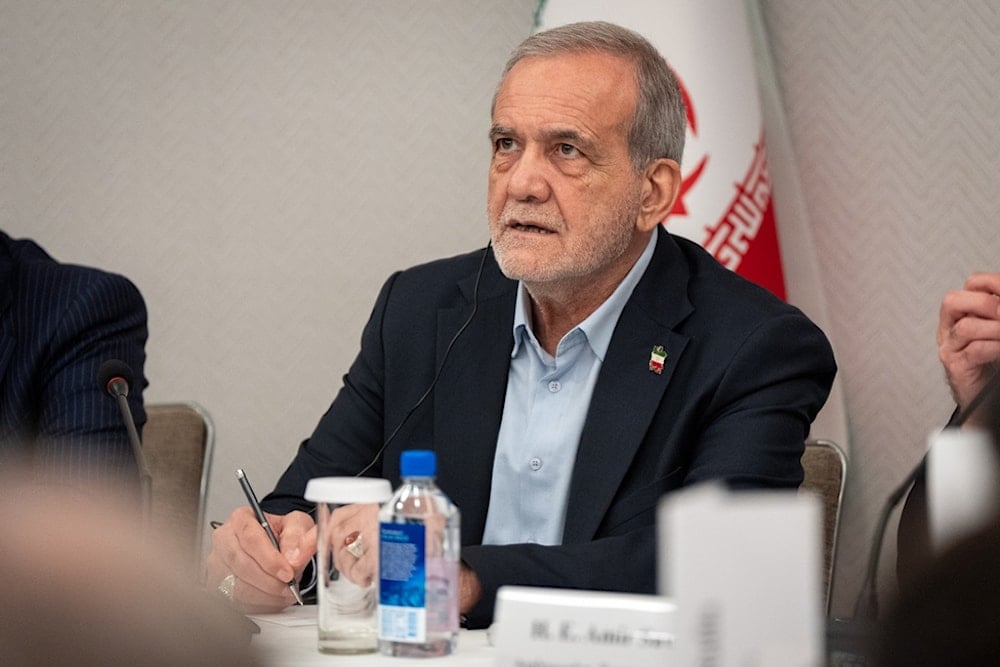
Masoud Pezeshkian, the President of Iran, takes questions from the media at a press briefing in New York, Friday, September 26, 2025 (AP)
Iranian President Masoud Pezeshkian has reaffirmed Tehran’s commitment to dialogue and engagement under international law, while warning that any aggression against the country would be met with an immediate and decisive response.
Pezeshkian made the remarks during a telephone conversation on Friday with Sheikh Mohammed bin Zayed Al Nahyan, president of the United Arab Emirates, as the two leaders discussed the latest regional developments.
Emphasizing Iran’s policy of what he described as “dignified diplomacy,” Pezeshkian said Tehran’s approach is based on interaction and dialogue within the framework of international law, mutual respect, and the rejection of threats or the use of force to resolve disputes. He stressed, however, that any act of aggression against Iran would be answered promptly and firmly.
The Iranian president expressed appreciation for the support shown by Islamic countries toward Iran and underlined the importance of coordinated regional efforts to reduce tensions and help consolidate peace and stability across the Middle East.
Iran prioritizes neighbourly ties
Outlining Iran’s foreign policy priorities, Pezeshkian said strengthening relations with neighboring and Islamic countries across all fields remains a strategic objective. He added that reinforcing unity within the Islamic world and expanding regional cooperation are central pillars of Tehran’s diplomatic approach.
Pezeshkian also referred to what he described as hostile actions by the United States and the Zionist regime against the Iranian nation, including sanctions, pressure campaigns, and confrontational rhetoric. He reiterated that Iran has never sought war and does not consider conflict to be in the interest of any party, while accusing Western actors of failing to demonstrate a genuine commitment to diplomacy and international law.
For his part, Sheikh Mohammed bin Zayed welcomed the exchange and highlighted the UAE’s diplomatic efforts to help reduce regional tensions. He praised Iran’s emphasis on dialogue and diplomacy and reiterated Abu Dhabi’s readiness to play a constructive role in initiatives aimed at enhancing security, stability, and sustainable development in the region.
Iran Army warns against aggression
Iranian Army spokesman Brigadier General Mohammad Akrami-Nia warned on Thursday that Iran is prepared to respond swiftly and decisively to any hostile action against the country.
“If the enemy commits any folly, we will respond to it swiftly and decisively,” Akrami-Nia said, stressing that any confrontation would not remain limited in scope.
Akrami-Nia said that any escalation would expand beyond Iran’s borders, warning that the entire region would be affected, including “from the Zionist entity to the countries where there are American bases.”
In a separate statement, he added that Iran’s armed forces are fully prepared to deliver a rapid and painful response should any party violate Iran’s sovereignty. “The necessary plans have been prepared regarding possible enemy attacks,” he said, adding that Iran has proportionate responses ready for all scenarios.
The Iranian military spokesman also addressed recent rhetoric from Washington, warning against assumptions of a short, contained military operation.
US threats escalate
The comments come amid heightened regional tensions after the US attempted to launch an aggression against Iran earlier this month. According to AFP, Saudi Arabia, Qatar, and Oman mounted a coordinated diplomatic effort on January 15 to dissuade US President Donald Trump from authorizing military strikes, warning that such an attack could trigger uncontrollable regional repercussions given the concentration of US military bases and strategic assets across the Gulf.
On the same day, diplomatic sources in Tehran told Al Mayadeen that a friendly regional party had informed Iran that Washington had reversed course on plans for military action following a reassessment of security and military risks, including the potential consequences of a large-scale strike and an evaluation of internal conditions inside Iran. Despite this reported pullback, Iranian authorities said they remained on full alert while keeping diplomatic channels open.
On January 18, Pezeshkian warned that any aggression against the Leader of the Islamic Revolution would amount to an all-out war against the Iranian nation, reinforcing it as a central red line within Iran’s deterrence doctrine.


