
Pezeshkian says Iran seeks dialogue while rejecting pressure
 3 Min Read
Iran's president says Tehran supports diplomacy to protect national interests while rejecting demands affecting sovereignty and defense.
-
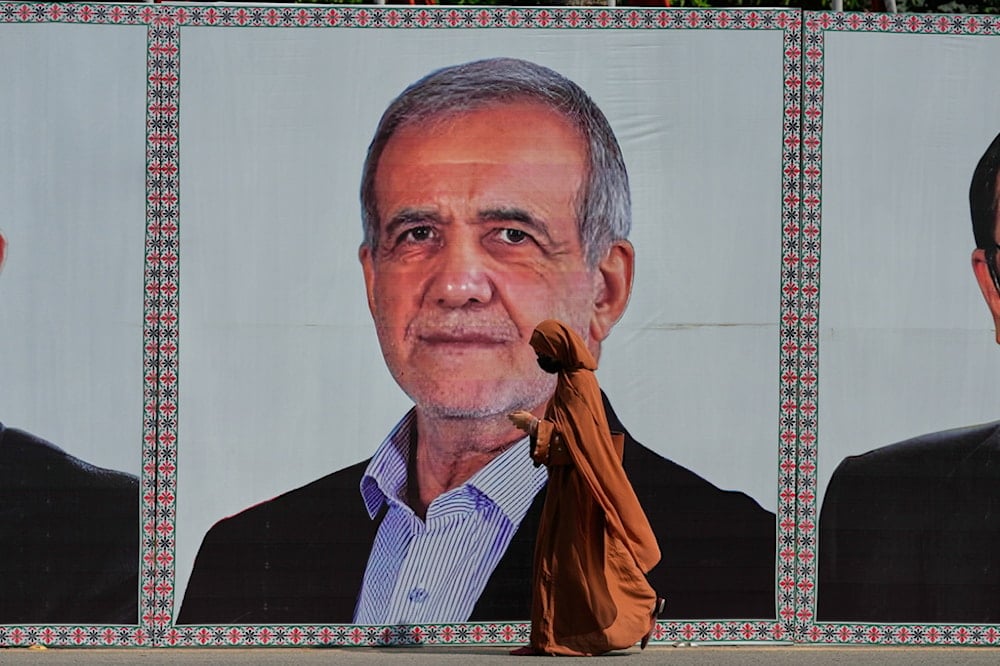
A woman walks past a welcoming billboard featuring Iranian President Masoud Pezeshkian along a roadside in Islamabad, Pakistan, Tuesday, June 23, 2026 (AP)
Iranian President Masoud Pezeshkian said Tehran remains committed to dialogue with the United States and European countries but will not accept demands that undermine Iran’s sovereignty, national interests, or defensive capabilities.
Speaking in the final part of an extensive address to the Iranian public, Pezeshkian said Iran did not initiate the US-Israeli war, adding that Tehran’s decision to engage in negotiations was aimed at protecting national interests and preventing unnecessary conflict.
The Iranian president rejected claims that his administration had pressured the country’s leadership into accepting negotiations, saying major decisions were made through coordination with Iran’s leadership and relevant state institutions.
Pezeshkian said diplomacy remains a tool for safeguarding Iran’s rights and interests, stressing that negotiations should not be interpreted as weakening Iran’s defensive capabilities.
“Iran does not intend to attack other countries, seize territory, or expand its borders,” he said, emphasizing Tehran’s stated policy of coexistence with neighboring countries and contrasting it with the expansionist ambitions of the Israeli regime.
Read more: Pezeshkian to al-Hayya: Palestine remains central to Iran's policy
Tehran rejects pressure over defense capabilities and negotiations
Pezeshkian said Iran had reached understandings with European representatives during diplomatic efforts aimed at resolving disputes, but argued that European countries later failed to act independently.
He said the issue of the snapback mechanism was subsequently pursued by European states despite previous understandings reached during negotiations.
The Iranian president also defended a diplomatic understanding reached following the conflict, saying Tehran achieved significant results without accepting unacceptable concessions.
He referred to arrangements related to the Strait of Hormuz, saying Iran agreed to allow vessels to pass under its regulations while expecting the other side to fulfill its own commitments.
Pezeshkian maintained that Iran’s willingness to engage diplomatically does not mean accepting restrictions on its military or defense capabilities.
Iran warns against regional divisions
Addressing Iran’s relations with neighboring states, Pezeshkian said Tehran had resolved many longstanding issues with regional countries and improved relations across its surroundings.
He warned that the Israeli regime and the United States were seeking to encourage divisions between Iran and Gulf countries, saying Tehran was working to prevent such developments.
The Iranian president stressed that Muslim countries should not be drawn into conflicts against one another.
“Iran regards Muslim countries as brothers,” he said, questioning why regional states should become involved in confrontation with each other.
Pezeshkian also criticized internal divisions, warning that disagreements could be exploited by external actors seeking to weaken Iran.
Pezeshkian dismisses claims of internal disagreements
The Iranian president rejected reports of disagreements between the government, diplomatic institutions, and the armed forces regarding negotiations and the conflict.
He said decisions were made through Iran’s national security structures and that military and security institutions had supported those decisions.
Pezeshkian emphasized that the government remains fully coordinated with Iran’s armed forces, describing support for them as a responsibility.
He also rejected reports of differences between himself and Iran’s Leader, saying his administration has consistently followed the leadership’s policies.
The Iranian president said unity among political, security, and military institutions is essential for Iran to withstand external pressure and address regional and international challenges.
Read more: Araghchi calls for Islamic unity as Pakistan visit nears


