
Political anger deepens as US midterms approach
 4 Min Read
New research finds rising anger across Congress and social media, highlighting deepening polarization and the political incentives behind increasingly hostile US rhetoric.
-
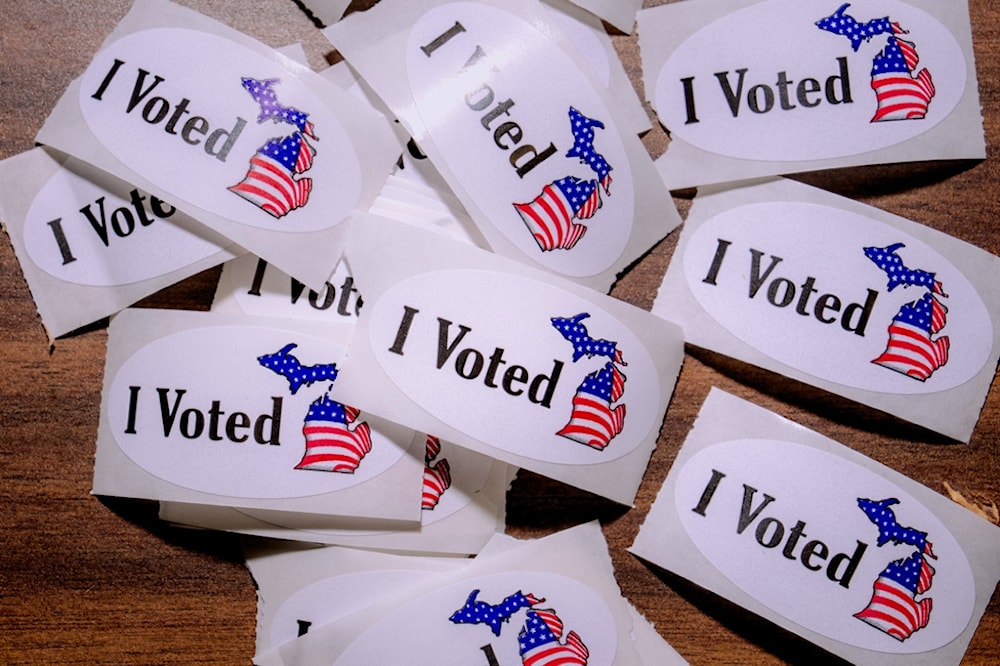
A close-up view of "I Voted" stickers at Maples Elementary School on primary election day on August 4, 2026, in Dearborn, Mich. (AP Photo/Nic Antaya)
Political anger in the United States has intensified sharply over the past decade, with increasingly hostile rhetoric from elected officials coinciding with deeper partisan divisions and growing public frustration ahead of the 2026 midterm elections.
US President Donald Trump has become one of the most prominent practitioners of confrontational political rhetoric, repeatedly attacking Democratic opponents and former Republican allies with personal insults and inflammatory language.
But the trend extends beyond Trump. New research examining more than 150 years of congressional speeches and millions of social-media posts suggests that political anger has become substantially more common across the US political system.
Read more: Trump’s legacy obsession leaves Republicans facing midterm trouble
Anger rises across US politics
Economists from Harvard University, HEC Paris, Paris-Saclay and the University of California, Berkeley analyzed congressional speeches and social-media posts using artificial intelligence, including large language models and natural-language processing.
The researchers assessed eight emotions - anger, sadness, pride, gratitude, fear, disgust, joy and hope - as well as overall emotional intensity.
Their findings point to a marked increase in political anger. Angry statements in Congress rose sharply during former Republican House Speaker Newt Gingrich's leadership in the 1990s before declining in the early 2000s.
The increase has since returned with greater force. According to the study, angry statements in Congress have risen by 50% since 2013.
The change is also visible among voters. Between 2013 and 2025, the proportion of policy-related sentences expressing anger in voter posts on X rose by 35%. On Reddit, the increase reached 46%.
The figures suggest that political hostility is no longer confined to campaign speeches or partisan media. Anger has increasingly become part of how political disagreements are expressed by both politicians and voters.
Polarization creates a cycle of outrage
Researchers do not attribute the increase to a single factor. Political scientist Steven Webster of Indiana University, however, points to the deepening partisan divide in US society.
Americans are increasingly separated not only by political preferences but also by social networks and media consumption. Democrats and Republicans have become more likely to view members of the opposing party as dishonest or immoral, transforming political disagreement into broader social hostility.
Pew Research Center data cited in the research show that the proportion of partisans who say the opposing party makes them “angry” rose by almost 30 percentage points between 2016 and 2025, reaching 76%.
Stefanie Stantcheva of Harvard, one of the researchers behind the study, describes the process as a reinforcing cycle.
Anger also has a practical political advantage. The researchers found that angry posts by members of Congress receive 59% more reposts than emotionally neutral messages, giving politicians a strong incentive to use increasingly confrontational language to capture public attention.
The consequences extend beyond political campaigning. Previous research has linked political anger with declining trust in government, greater polarization and weaker commitment to democratic norms.
Economic frustration fuels political anger
The political effects of anger are also reflected in voters' policy preferences.
Stantcheva and her colleagues found that people exposed to negative emotions became less favorable toward immigration and free trade while becoming more supportive of economic redistribution.
The findings point to an important dimension of political anger: it can reflect not only partisan hostility but also frustration over inequality, living costs, and perceptions that economic and political systems serve powerful interests at the expense of ordinary people.
Midterms turn anger into a campaign tool
The approaching November midterm elections are providing another outlet for this political hostility.
Democratic candidates have increasingly incorporated confrontational language into their campaigns. Axios reported in April that nearly 50 Democratic campaign advertisements used the words “fighter” or “fight.”
Democratic Senate candidate Josh Turek has emphasized fighting for Iowa while also calling for “hope and positivity and optimism.” Texas Senate candidate James Talarico has focused on public service rather than political combat. The contrast illustrates a broader question facing candidates in 2026: whether voters want politicians to intensify their anger or provide an alternative to it.
The research suggests that outrage has become deeply embedded in the US political environment because it is rewarded by both voters and digital platforms. Yet the same dynamic is contributing to a political system in which disagreement increasingly becomes personal hostility, making compromise more difficult and further eroding public trust.
Read more: US Senate delays crypto bill vote until after August recess: Politico


