
Poll: 71% of Israelis distrust Trump on Iran deal, war outcome
 4 Min Read
A new Israeli poll shows growing distrust in Donald Trump's handling of talks with Iran, while only 11% of respondents believe "Israel" emerged victorious from the recent war.
-
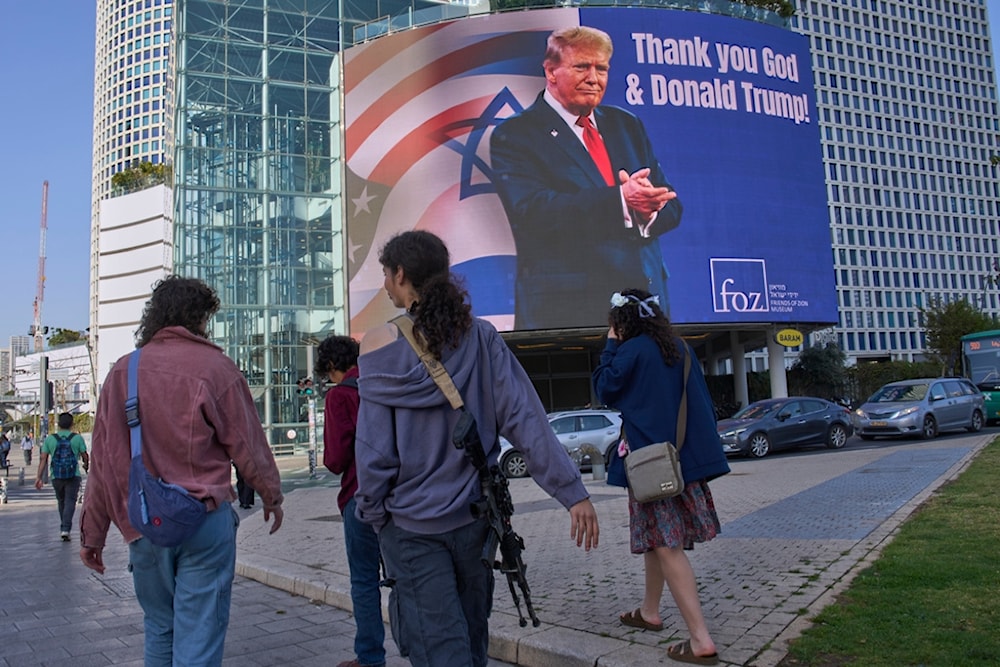
People pass by an electronic billboard displaying an image of President Donald Trump alongside the message "Thank you God and Donald Trump" in Tel Aviv, "Israel", Thursday, March 12, 2026. (AP Photo/Ohad Zwigenberg)
A new Israeli television poll has revealed deepening concerns among Israeli settlers regarding US President Donald Trump's negotiations with Iran, with a large majority expressing little confidence that Washington will safeguard Israeli interests in any future agreement.
The survey, published Thursday by Channel 12, found that 71% of respondents do not trust Trump to protect Israeli interests in a deal with Iran. Only 13% said they trust the US president, while 16% remained undecided.
The findings indicate a significant decline in support compared with polling conducted a week earlier, when 62% expressed distrust and 21% said they trusted Trump on the issue.
The figures represent a notable shift in public opinion toward a US president who has traditionally enjoyed strong support among Israeli voters. The change comes amid mounting concern over the recently signed US-Iran memorandum of understanding and increasingly public disagreements between officials in Washington and Tel Aviv.
Read more: Hezbollah confronts Israeli advance in southern Lebanon
Majority say Netanyahu harmed Israeli interests
The poll also points to growing dissatisfaction with Israeli Prime Minister Benjamin Netanyahu's handling of relations with the United States during negotiations with Iran.
Asked whether Netanyahu's conduct benefited or harmed Israeli interests in the US-Iran agreement, 52% said it caused harm. Just 24% believed his actions benefited Israeli interests, while another 24% were uncertain.
The results suggest that a majority of respondents view the current diplomatic trajectory as a setback for the occupation government's strategic objectives, particularly regarding Iran's nuclear program and broader regional influence.
The survey was conducted as part of wider polling on voting intentions ahead of general elections scheduled for October.
Most Israelis reject victory narrative after war
The poll also challenged official narratives regarding the outcome of the war on Iran.
According to the findings, only 11% of respondents believe "Israel" won the war. By contrast, 43% said the occupation entity lost the war, while 41% described the outcome as inconclusive.
The figures highlight a substantial gap between government messaging and public perceptions of the results of the war on Iran.
Polling on future elections showed opposition Zionist parties outperforming Netanyahu's bloc of right-wing and religious parties. However, the opposition would still fall short of the 61 seats required to form a governing coalition.
Read more: Inside Trump and Netanyahu's relationship post-war on Iran: WSJ
Trump signals support for Netanyahu despite tensions
Despite increasingly visible tensions between Washington and Tel Aviv, Trump indicated that he remains inclined to support Netanyahu politically.
Speaking to "Israel's" Kan public broadcaster, Trump said he would "most likely" endorse Netanyahu ahead of the upcoming elections. However, he added that he wanted to review the full field of candidates before making a final decision.
"I’ll have to look at who’s running, but I like Bibi very much. I would be most likely to endorse him," Trump said.
At the same time, the US president suggested Netanyahu "has got to be a little bit more rational," in remarks reportedly linked to the occupation's military aggression on Lebanon.
The comments came after reports that Netanyahu's Likud party had scaled back plans to emphasize the premier's close relationship with Trump in campaign messaging following domestic backlash over the US-Iran agreement.
In recent weeks, Trump has alternated between criticism and praise of Netanyahu, reportedly describing him as "f****** crazy" and lacking judgment while also characterizing their relationship as strong.
Defending the memorandum of understanding with Iran, Trump argued that the agreement had removed what he described as a nuclear threat against "Israel".


