
Trump likely to endorse Netanyahu but urges more 'rational' approach
 4 Min Read
President Trump has said he is likely to endorse Israeli Prime Minister Benjamin Netanyahu in the upcoming Israeli elections, praising him as doing "a very good job" while suggesting he needs to be "a little bit more rational."
-
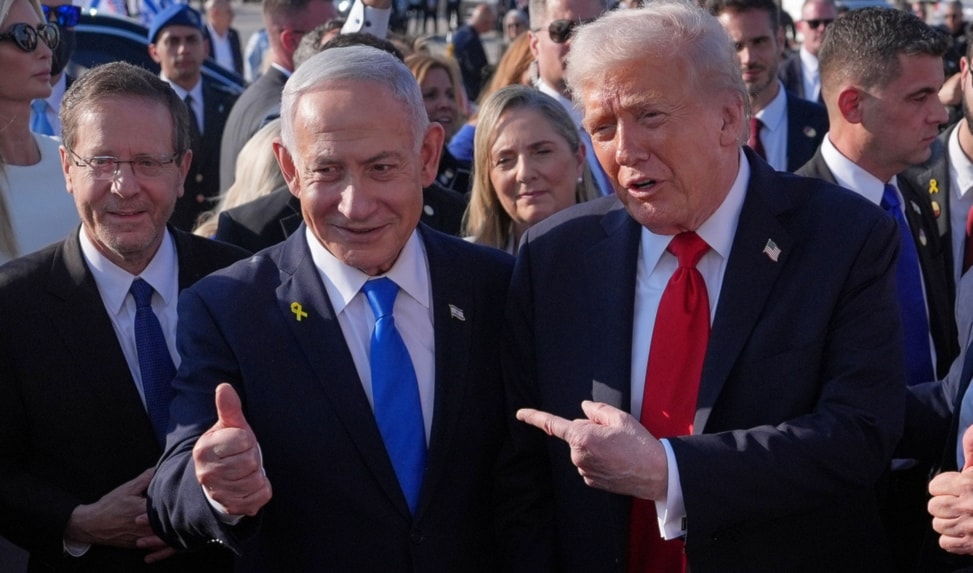
US President Donald Trump poses for a photo with Israeli Prime Minister Benjamin Netanyahu before he boards Air Force One at Ben Gurion International Airport, Oct. 13, 2025, near Tel Aviv. (AP Photo/Evan Vucci)
US President Donald Trump has said he is likely to endorse Israeli Prime Minister Benjamin Netanyahu in the upcoming Israeli general election, praising his ally while suggesting he "got to be a little bit more rational," as tensions between the two leaders continue to strain their relationship.
In an interview with "Israel's" KAN broadcaster, Trump said: "I'll have to look at who's running, but I like Bibi [Netanyahu] very much. I would be most likely to endorse him." The US president added that, from his point of view, Netanyahu is doing "a very good job," though he noted that "he's got to be a little bit more rational."
The comments come as tensions have reportedly strained the relationship between the two leaders in recent weeks. Trump has expressed frustration with Netanyahu over Israeli aggression in Lebanon, with the US president reportedly describing him as "a very difficult guy" who "should be very thankful to us."
Growing rift over war strategy
The public criticism reflects a growing rift between the two leaders over the US-Israeli war on Iran. According to Israeli newspaper Yedioth Ahronoth, tensions escalated as the two figures diverged on how and when the war should end.
Trump may have believed, based on what Netanyahu and Mossad chief David Barnea told him, that the war against Iran would be "a walk in the park," only to discover that reality was far more complicated.
When Trump felt that Netanyahu was attempting to undermine negotiations behind the scenes, he began publicly criticizing him. Washington reportedly viewed "Israel's" attack on Beirut as a "spit in Trump's face," with the US president regarding the strike as a deceptive act reflecting "ingratitude."
A source told the newspaper that "Trump realized Netanyahu's vision is not his own," adding that Netanyahu did not want the war to end and was not interested in an agreement, preferring instead to resume military strikes.
The report added that Trump chose to send Netanyahu a political message by saying he was "not sure" Netanyahu would run in the next election, a remark interpreted as a symbolic indication that Trump was "showing him the door."
Netanyahu faces political risks at home
The general election in "Israel" is scheduled to take place no later than October 27. Netanyahu faces growing domestic criticism over his handling of the war, with opponents accusing him of failing to achieve strategic objectives while damaging ties with Washington.
Any peace arrangement, particularly one shaped abroad, is likely to intensify scrutiny of his foreign policy record as he prepares for a challenging election campaign.
Netanyahu has invested enormous political capital in his relationship with Trump, making it a central pillar of his political identity. However, the relationship has been tested by the US-Iran negotiations, from which "Israel" was excluded. Despite his long-standing alliance with Trump, Netanyahu now risks being viewed as an obstacle to a broader diplomatic agreement that could carry major implications for his future.
Aaron David Miller, a senior fellow at the Carnegie Endowment for International Peace, told The Guardian: "Let's be clear, Trump has enormous leverage. No American president has ever talked to an Israeli prime minister the way Donald Trump has talked about Netanyahu. No American president has ever allowed his private conversations to be leaked and so profanity-laced and mocking. It's really quite extraordinary."
Trump's endorsement, if formally given, could provide a significant boost to Netanyahu's re-election campaign. However, the president's public criticism and the growing rift over their war strategies suggest that their relationship may no longer be the asset it once was for the Israeli prime minister.
Read More: As Washington changes course, Netanyahu misses the turn


