
Post-Assad Syria rebuilt for US power, not its people: Opinion
 5 Min Read
Syria's post-Assad transition is being shaped not by genuine national sovereignty but by a US-aligned political and economic order that risks turning reconstruction into another form of external control.
-
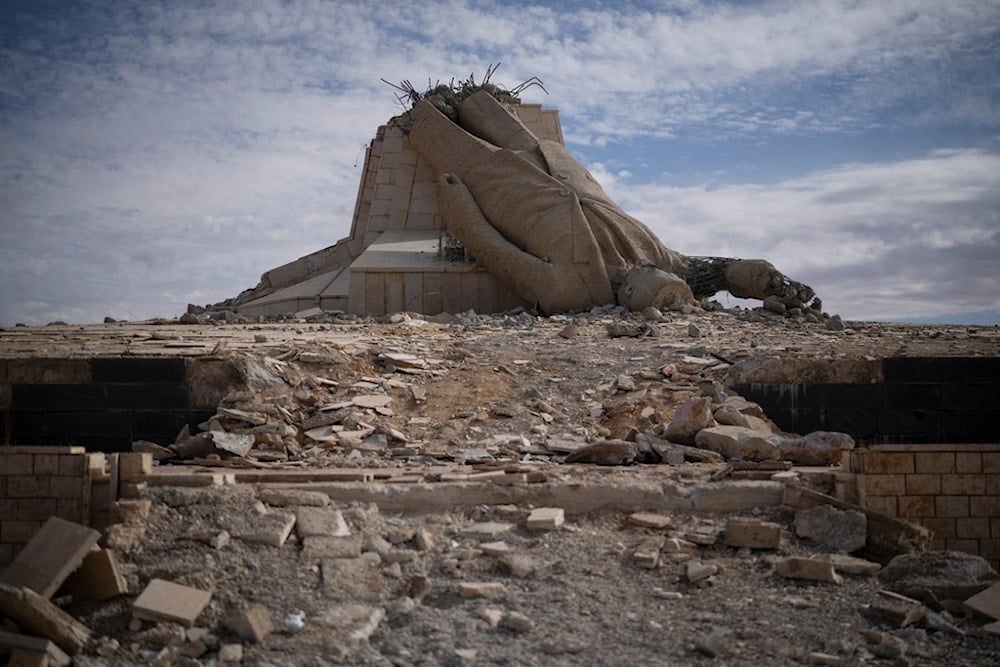
FILE - A destroyed statue of late Syrian President Hafez Assad is seen in Dayr Atiyah, Syria, on Jan. 5, 2025 (AP Photo/Leo Correa, File)
The fall of Bashar al-Assad should have opened a path toward political self-determination. Instead, Syria is being reorganized around the requirements of US power, Gulf capital, and a regional architecture increasingly defined by normalization with "Israel." The appointment of Ahmed al-Sharaa, the rebranded former HTS emir known as Abu Mohammad al-Julani, has not liberated Syria from authoritarianism or external control. It has simply replaced one form of dependency with another.
Washington’s priorities became clear within days of Assad’s collapse. The US partially suspended sanctions, pledged cooperation, and framed Syria’s postwar reconstruction as an investment frontier that could attract Western, Gulf, and multinational capital. In return, Al-Sharaa’s transitional government signaled flexibility on every major American demand: economic liberalization, security coordination, distancing from Iran, and, crucially, an eventual normalization track with "Israel." The wall that once defined Syrian foreign policy, namely, no talks without full Israeli withdrawal, has quietly shifted. Al-Sharaa rejects immediate normalization, but indirect and now direct talks with "Israel" have already taken place. The debate in Washington is no longer whether Syria will normalize, but how quickly and on what terms.
Constructed Dependency
This moment is often framed as a Syrian “rebirth.” In reality, it is the consolidation of a US-led imperial design built on the ruins of a country deliberately exhausted by war. As economist Ali Kadri argues, wars in the Global South serve as “industries of waste,” producing the destruction and depopulation that clear the ground for new forms of dependency. The Syrian war did precisely that: it shattered national industries, collapsed the welfare infrastructure, scattered millions, and created a population too exhausted to resist the political economy taking shape in the transition.
The architecture of this new Syria is unmistakable. Gulf sovereign funds are being courted with promises of privatized ports, energy assets, cement factories, and logistics hubs. Investment laws are being rewritten to guarantee profit extraction and allow capital flight. Al-Sharaa’s brother, Hazem, now heads a secretive committee that is quietly absorbing Assad-era holdings, replacing one opaque oligarchy with another, this time aligned with US and Gulf interests. The IMF has entered early discussions. “Structural reform” has become the euphemism for dismantling what remains of state-managed sectors and shifting the country onto a model of externally financed reconstruction and debt-driven growth.
Controlled Security
Security, too, is being reorganized around American and regional priorities. Syrian airspace and borders are being calibrated in line with Turkish, Israeli, and US interests. Kurdish-led forces, long backed by Washington, are now being integrated into the national security structure under US mediation. Iran’s influence is being rolled back in exchange for sanctions relief. In other words, the “new Syria” is being built as a compliant node in the US-centered order that has dominated the Middle East for decades.
This does not mean Syrian sovereignty has disappeared entirely. The state has not collapsed; it is not Libya or Somalia. Damascus has a functioning government, a consolidated leadership, and a unified administrative structure. But sovereignty today is being limited to the interior, to policing Syrians, not shaping Syria’s place in the world. The key external decisions, particularly those involving reconstruction financing and regional diplomacy, are being shaped elsewhere.
Doomed Future?
Is Syria doomed? Only if one assumes imperial projects always succeed. They do not. The contradictions within this transition are already visible. Al-Sharaa must reassure Washington that he has turned away from his jihadist past, while persuading his own base that he has not surrendered the core nationalist and Islamist narratives that sustained the revolt. Any move toward full normalization with "Israel" risks splitting his coalition, provoking armed backlash, and dissolving what remains of his legitimacy among Syrians who fought, bled, and suffered for something more meaningful than subcontracting the country’s future to foreign powers.
The reconstruction model itself, namely privatization, foreign debt, and externally imposed reforms, will deepen inequality and generate new crises, not stability. It is a model that has failed everywhere it has been tried. And despite the image of a centralized transitional presidency, the country remains fractured, traumatized, and vulnerable to renewed conflict if the new order fails to deliver more than speculative investment and security pacts.
Stolen Rebirth
Syria has not fallen; it has been folded back into an imperial system that never left. The US strategy is clear: convert the ruins of war into a platform for normalization, investment, and regional realignment. But Syria’s future will not be decided in Washington, Riyadh, or Tel Aviv. It will be decided by the capacity of Syrians themselves, those inside the country and those exiled by twelve years of war, to resist becoming the collateral of yet another externally engineered project.
Assad is gone. The question now is whether Syria will be rebuilt for its people, or whether it will remain a managed landscape for capital, security arrangements, and geopolitical bargaining. For now, the answer leans toward the latter. But nothing in this region, and nothing in this war, has ever gone according to the plans of those who try to dictate history from above.
Read more: Tom Barrack urges full repeal of Caesar Act to 'give Syria a chance'


