
Pre-Trump Republicans challenge Vance’s path to the GOP future
 5 Min Read
Traditional Republican factions are criticizing JD Vance as the vice president emerges as a leading contender for Trump’s political succession.
-
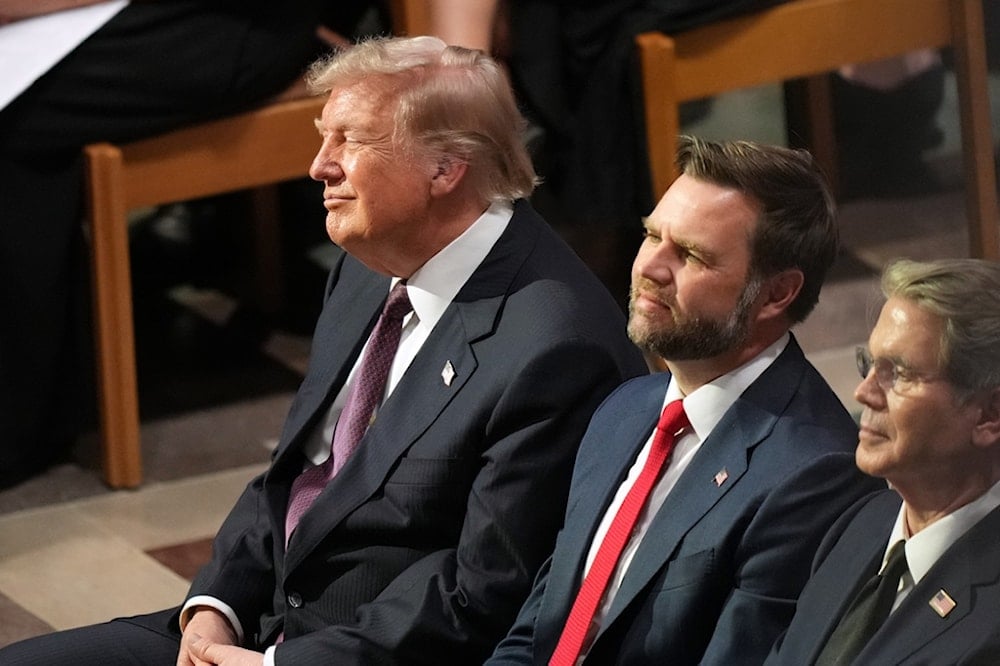
US President Donald Trump, Vice President JD Vance and Treasury Secretary Scott Bessent attend the funeral of Sen. Lindsey Graham, R-S.C., at the Washington National Cathedral, Tuesday, July 28, 2026, in Washington. (AP Photo/Alex Brandon)
A growing divide within the Republican Party is emerging over the future of the movement Donald Trump reshaped, with Vice President JD Vance facing early criticism from figures associated with the pre-Trump GOP establishment, Axios reported on Sunday.
Vance, widely viewed as a potential successor to Trump and a leading contender for the 2028 Republican presidential nomination, has become the target of criticism from traditional conservative voices who oppose handing control of the party to a figure closely aligned with Trump’s political transformation.
Axios cites the Wall Street Journal’s editorial page, which opposed Trump during his first presidential campaign and again during his 2024 comeback bid, has recently published a series of columns criticizing Vance’s leadership style, political priorities, and foreign policy positions.
Read more: Trump jokes about running for a third term, again
Wall Street Journal attacks Vance’s political approach
WSJ editorial writers have accused Vance of focusing too heavily on his political future rather than governing, pointing to his media appearances promoting his recently released book, while congressional Republicans attempt to advance the Trump administration’s agenda.
Axios reports that one editorial board member argued that Vance’s public profile-building risks becoming a distraction, claiming that his efforts to strengthen his national image serve neither the Republican Party nor the administration.
Critics have also questioned Vance’s response to political criticism, portraying him as overly sensitive to opposition from conservative commentators.
Another line of attack has focused on Vance’s support for the US-Iran memorandum of understanding, with critics arguing that his defense of the agreement showed excessive optimism toward Tehran.
The WSJ editorial board dismissed Vance’s position, comparing it to previous diplomatic approaches pursued by Democratic administrations.
Vance’s critics reflect broader Republican divide
The criticism against Vance has united several factions within the Republican Party that remain skeptical of Trump’s influence over the party.
Among them, Axios reports, are pro-"Israel" conservatives, traditional Republicans who favor a return to pre-Trump policies, and figures connected to the broader conservative media establishment.
The dispute also reflects tensions within the Murdoch media empire, which owns both the Wall Street Journal and Fox News. While Rupert Murdoch repeatedly clashed with Trump during his political rise, he later adjusted his relationship with the former president.
According to reports, Murdoch previously urged Trump to consider other candidates over Vance when selecting his vice-presidential running mate.
Some conservatives who oppose Vance have instead pointed to US Secretary of State Marco Rubio as a preferred alternative for 2028, praising Rubio’s more traditional Republican approach.
Vance allies say establishment attacks strengthen him
Vance’s supporters have rejected the criticism, arguing that attacks from traditional Republican institutions only reinforce his appeal among Trump’s voter base.
They argue that the Wall Street Journal’s editorial board represents an older Republican establishment that no longer reflects the priorities of the party’s grassroots supporters.
A senior Vance ally told Axios that criticism from “the pre-Trump GOP establishment” benefits the vice president politically, saying that attacks from the WSJ editorial board send the message to Trump-aligned voters that Vance remains opposed by the same forces that resisted Trump’s rise.
Vance’s allies also pushed back against claims that he has neglected his responsibilities, saying he has remained active in Congress and that his defense of the Iran memorandum reflected his role in supporting an agreement signed by the president.
They argue that critics are attempting to preserve a Republican Party model that has already been rejected by voters.
Trump’s transformation of the GOP shapes 2028 battle
The emerging conflict highlights the extent to which Trump has transformed the Republican Party over the past decade.
Vance has aligned himself closely with Trump’s positions on issues including immigration, trade, and foreign policy, areas where the former Republican establishment has often disagreed with the president.
Supporters argue that these positions reflect the priorities of Republican voters, while critics warn that they represent a departure from traditional conservative policies.
The debate over Vance’s future comes as Republican figures begin positioning themselves ahead of the 2028 presidential race. While Rubio remains a potential alternative, he has repeatedly said he is not seeking the nomination.
For Vance, the challenge will be proving that he can inherit Trump’s political coalition while expanding it beyond the president’s personal influence.
The struggle over his candidacy reflects a deeper question facing the Republican Party: whether Trump’s political transformation will continue after him, or whether traditional conservative forces can regain influence.
Read more: Vance Secret Service Agent investigated over alleged security breach


