
Putin warns nuclear proliferation, terrorism threaten all countries
 3 Min Read
Russian President Vladimir Putin warns that uncontrolled nuclear proliferation, extremism, drug trafficking, and cybercrime pose a global threat, calling for stronger international security cooperation.
-
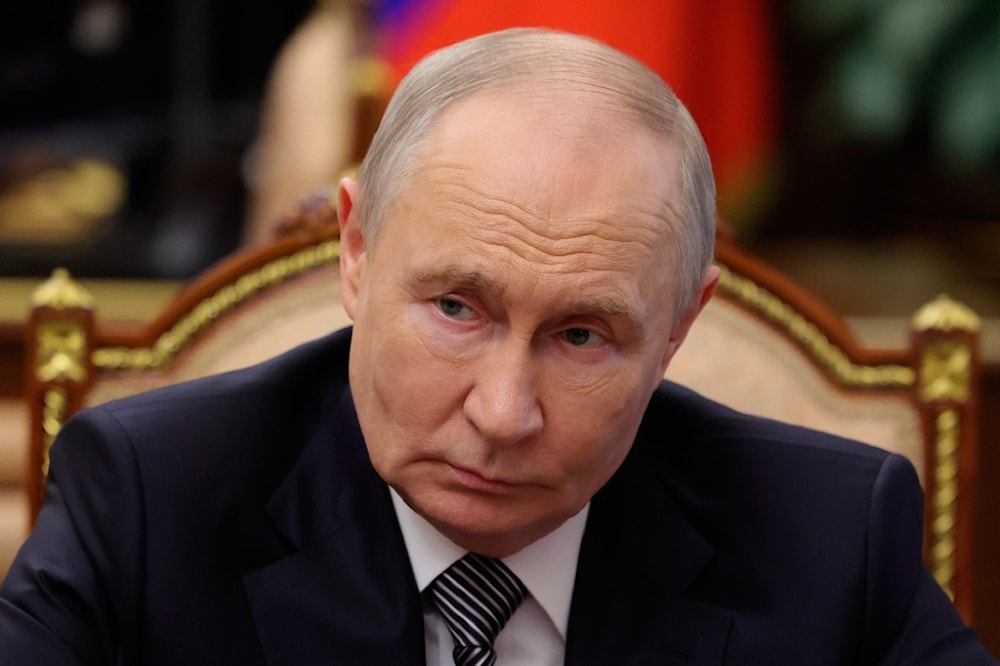
Russian President Vladimir Putin listens to Russian Union of Industrialists and Entrepreneurs Alexander Shokhin during their meeting at the Kremlin in Moscow, Tuesday, May 26, 2026. (Vyacheslav Prokofyev/Sputnik, Kremlin Pool Photo via AP)
Russian President Vladimir Putin has warned that a range of transnational threats, including the uncontrolled spread of nuclear weapons, extremism, drug trafficking, and cybercrime, continue to pose serious risks to all states without exception.
Putin delivered the remarks in a video address to participants in the International Security Forum, where he outlined what he described as mounting global instability and the need for coordinated responses to emerging security challenges.
“As before, international terrorism, the risks of uncontrolled nuclear weapons proliferation, extremism, drug trafficking, and cybercrime pose a serious threat to all countries without exception,” Putin said, underscoring the continued relevance of these threats across geopolitical blocs.
His remarks come amid a period of heightened international fragmentation, where security challenges are increasingly interconnected across military, technological, and criminal domains rather than confined to individual states.
Escalating complexity in global threat environments
The Russian president’s comments reflect a broader framing of global security as a multi-layered system under sustained pressure. Nuclear proliferation risks, in particular, remain a central concern as geopolitical tensions continue to influence arms control frameworks and international trust mechanisms.
Alongside these risks, cybercrime has emerged as a structurally embedded threat, increasingly affecting financial systems, infrastructure networks, and state institutions.
Extremist movements and illicit trafficking networks further contribute to what Putin described as an interconnected threat landscape.
While such risks are often treated separately in policy discussions, the framing presented in the forum emphasized their convergence within a single global security environment shaped by instability and uneven governance capacity.
Role of international security forums
Putin also highlighted the importance of multilateral dialogue platforms in addressing these challenges. Speaking about the forum’s agenda, he noted its scale and thematic scope.
“I know that the program of your forum is extremely busy and substantive. During several days, 25 thematic sessions will be held in the form of conferences, roundtable discussions, briefings, and presentations,” the Russian leader added.
The remarks point to an emphasis on sustained diplomatic and analytical engagement at a time when international institutions are widely seen as under strain. Such forums are increasingly positioned as spaces for dialogue amid deteriorating trust between major global actors.
Read more: Putin discusses storing Iran uranium during meeting with Xi: Kremlin
Putin’s statements reflect a wider global environment marked by contested security architectures and declining consensus on arms control, digital governance, and transnational crime enforcement.


