
UN nuclear nonproliferation talks end without agreement
 4 Min Read
UN negotiations on nuclear nonproliferation and disarmament ended without a deal after four weeks of talks, exposing deep divisions over nuclear weapons policy and rising global security concerns.
-
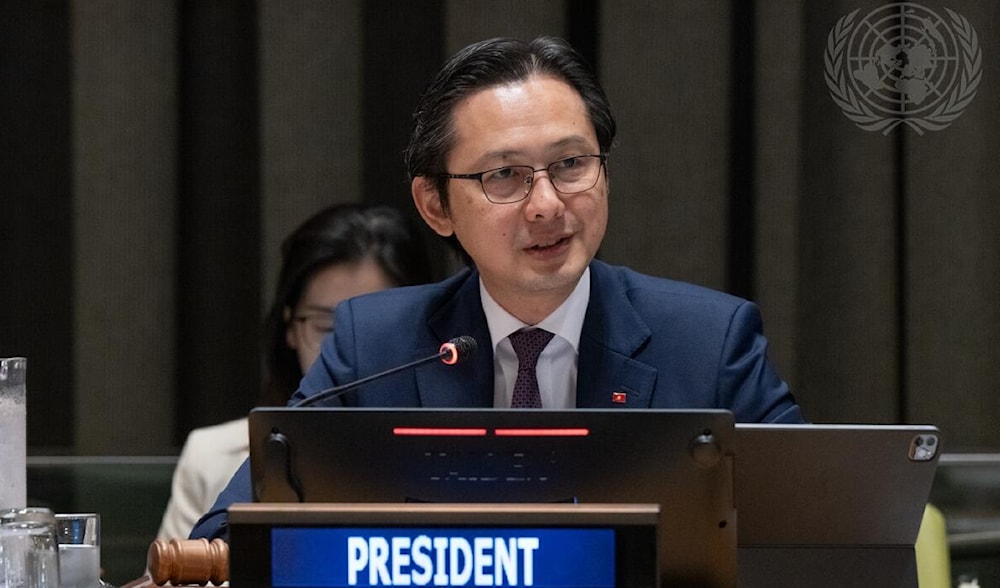
Do Hung Viet, president of the 2026 NPT Review Conference, chairs a meeting at the United Nations headquarters in New York. (UN Photo/Eskinder Debebe)
Talks to reaffirm nuclear nonproliferation and disarmament goals at the United Nations ended without agreement on Friday, following four weeks of negotiations conducted with low expectations.
Vietnam’s Do Hung Viet, president of the conference, said that “despite our best efforts... it is my understanding that the conference is not in a position to achieve agreement on its substantive work.” He added, “I do not intend to put the document forward for adoption.”
Delegates had been reviewing the Treaty on the Non-Proliferation of Nuclear Weapons (NPT), the central framework governing global nuclear arms control, amid growing concerns about a renewed arms race. Previous review conferences in 2015 and 2022 also failed to reach consensus.
Growing concerns over global nuclear risks
With expectations already muted, negotiators worked on a repeatedly revised and diluted draft text that ultimately failed to gain approval.
Despite the absence of an agreement for the third consecutive review cycle, experts stressed that the treaty itself remains in force, though they warned its authority may be weakening.
“The text keeps on becoming less and less anchored in the realities of current conflicts and proliferation risks,” said Richard Gowan of the International Crisis Group, citing tensions involving the DPRK and Iran ahead of the outcome.
UN focuses on Iran, DPRK
The latest draft reviewed by AFP stated that Tehran must “never” develop nuclear weapons, though the line remained in brackets due to disagreement among delegations. This comes despite Iran's repeated affirmations that it does not intend to develop nuclear weapons under a religious edict legislated decades ago.
Iran has consistently stated that, unlike "Israel", which is not a member of the NPT and owns nuclear weapons, its nuclear program is being developed for pure civilian purposes and maintains a peaceful nature.
Earlier references to Iran’s alleged “non-compliance” were also removed from the text, while language expressing concern over the DPRK’s nuclear program and calls for the “denuclearization” of the Korean Peninsula were also dropped.
The draft also excluded a call for the United States and Russia to begin negotiations on a successor to the New START treaty, which expired in February and previously limited the world’s two largest nuclear arsenals.
Experts warn of weakening treaty legitimacy
“The majority of countries are indeed working in good faith for disarmament,” said Seth Shelden of the International Campaign to Abolish Nuclear Weapons (ICAN), reacting to the collapse of the talks.
“But the small handful of nuclear-armed states, and certain of their allies, are undermining the NPT, frustrating disarmament efforts, expanding arsenals and provoking proliferation, and pointing the world toward catastrophe,” he added.
According to the Stockholm International Peace Research Institute (SIPRI), the nine nuclear-armed entities, Russia, the United States, France, the United Kingdom, China, India, Pakistan, "Israel", and the DPRK, possessed 12,241 nuclear warheads as of January 2025, with roughly 90 percent held by Washington and Moscow.
Washington, while demanding the denuclearization of several of its rivals, continues to expand its own arsenal, recently threatening to seize Tehran's enriched uranium.
What the NPT is and why it matters
The NPT entered into force in 1970 and has since been signed by almost all countries, with notable exceptions including India and Pakistan, as well as the Israeli regime. It is built on three pillars: preventing the spread of nuclear weapons, advancing disarmament, and promoting the peaceful use of nuclear energy.
Despite repeated review failures, the treaty remains the cornerstone of the global nuclear order, though its inability to reach consensus is increasingly seen as a reflection of deep divisions among states over disarmament and security priorities.
Read more: Russia warns of Western shift on nuclear weapons role


