
Qassem Soleimani's legacy strengthens Resistance front: IRGC
 3 Min Read
On the 6th anniversary of Qassem Soleimani’s assassination, the IRGC says his legacy continues to erode US power and unify the resistance front across West Asia.
-
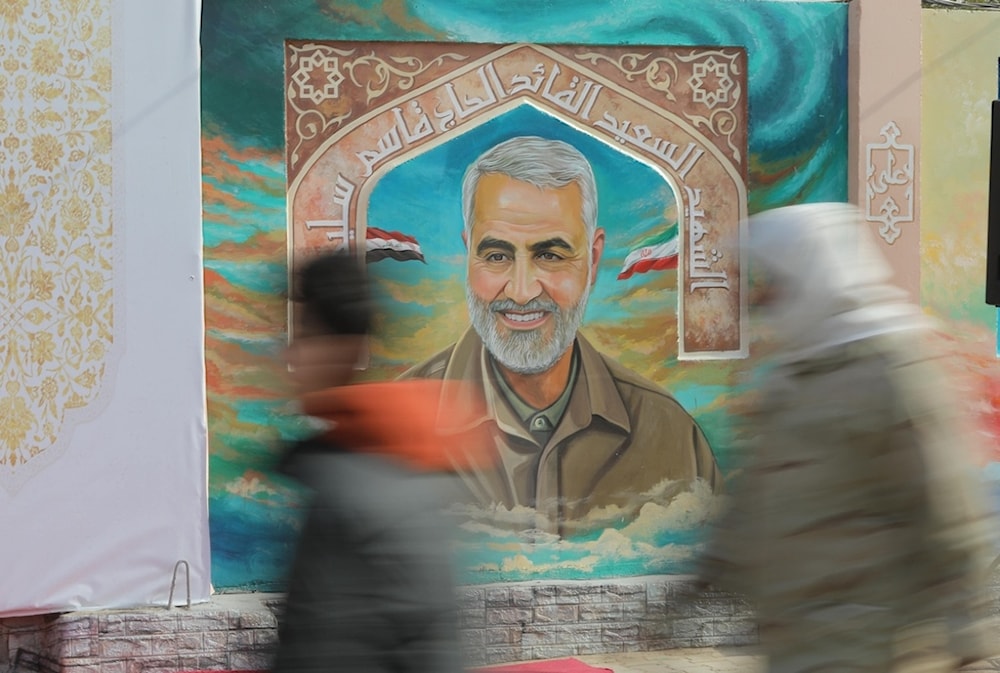
Members of the Popular Mobilization Forces walk past a graffiti depicting General Qassem Soleimani, center, head of Iran's Quds Force, during celebrations to mark the sixth anniversary of the martyrdom of Abu Mahdi al-Muhandis, deputy commander of the PMF, and Gen. Qassem Soleimani, in Najaf, Iraq, Saturday, January 3, 2026. (AP Photo/Anmar Khalil)
The Islamic Revolution Guards Corps (IRGC) stated on Saturday that the assassination of Lieutenant General Qassem Soleimani failed to weaken Iran or the regional Resistance front, instead accelerating the decline of US political and security power across West Asia and beyond.
The statement was issued on the sixth anniversary of Soleimani's assassination, highlighting the continued influence of the former Quds Force commander on regional developments.
“The erosion of the political and security power of the system of domination and the collapse of the US-led order in the region and beyond are among the lasting effects of this martyr and the fighters of the resistance front,” the IRGC declared.
The corps emphasized that the killing of Soleimani only strengthened the resolve and coordination of regional movements resisting US and Israeli policies. As evidence, it cited recent developments, including Operation Al-Aqsa Flood, launched by the Palestinian Resistance, as a sign of rising resistance activity and cooperation.
According to the statement, Soleimani’s martyrdom “marked the beginning of his enduring influence,” reinforcing a unified front that continues to challenge foreign domination in the region.
Read more: Ghalibaf says Soleimani’s legacy lives on as resistance model
US , 'Israel' blamed for regional destabilization
The IRGC explicitly named US President Donald Trump and Israeli Prime Minister Benjamin Netanyahu as those responsible for what it called the “cowardly assassination". It described the operation as part of a broader attempt to weaken the regional Axis of Resistance.
However, the IRGC asserted that rather than dismantling the Resistance, the assassination has amplified its ideological and operational strength, noting an increase in anti-occupation sentiment across the region.
Read more: Shamkhani: Iran ready for immediate response to any aggression
Expanding impact of Soleimani's ideological legacy
The IRGC linked Soleimani’s legacy to a growing political and ideological movement centered on justice, sovereignty, and defiance of Western hegemony. It cited the growing popularity of the slogan “Free Palestine”, particularly within the Islamic world and increasingly in Western societies, as a sign of the expanding reach of this movement.
The statement also accused Washington of continuing its efforts to destabilize Iran through political pressure and covert interference. It claimed that recent attempts to incite unrest within Iran were “thwarted by public vigilance and unity.”
Read more: Sayyed Khamenei links currency devaluation to 'enemy hand'
IRGC reaffirms commitment to Soleimani’s path
In its conclusion, the IRGC reaffirmed its allegiance to the Leader of the Revolution and the Islamic Republic, Sayyed Ali Khamenei, and pledged that Iranian forces, along with allied Resistance groups, would continue to follow Soleimani’s vision and path.
Soleimani and Abu Mahdi al-Muhandis, deputy chief of Iraq’s Popular Mobilization Units (PMU), were assassinated in a US strike near Baghdad International Airport on January 3, 2020. The operation, ordered by Trump, was widely condemned across the region.
Both commanders were widely respected for their roles in leading efforts against the ISIS terrorist group, particularly in Iraq and Syria, and are considered central figures in the formation and advancement of the Resistance front.


