
Reality check: ‘Bad part of war’ slaps Trump as slain US troops return
 4 Min Read
Trump receives the remains of six US service members killed in Kuwait; the first acknowledged deaths in the escalating US-Israeli war on Iran.
-
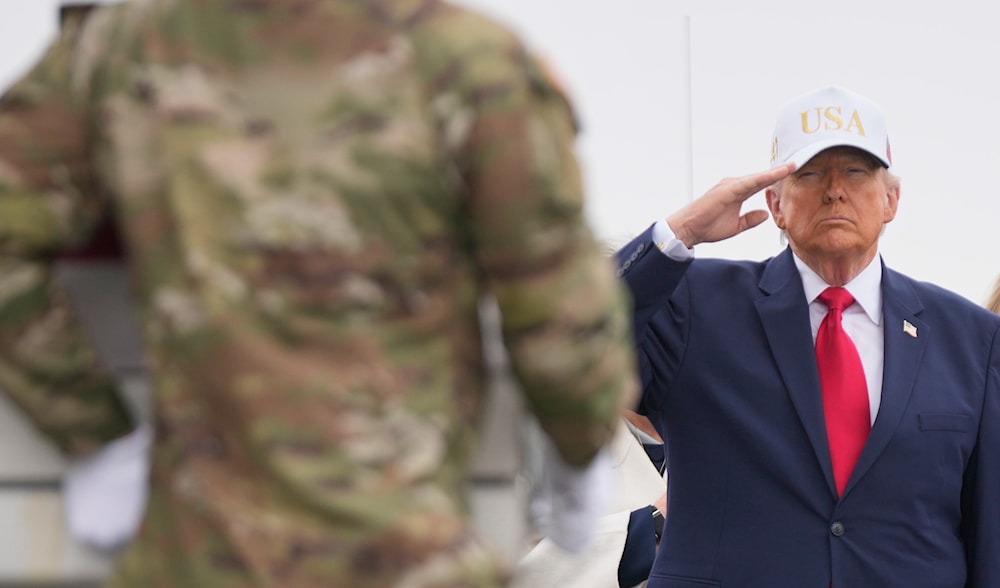
Army personnel carry the remains of US Army Reserve Capt. Cody Khork, 35, killed in a drone strike in Kuwait, past President Donald Trump during a casualty return at Dover Air Force Base, Delaware, March 7, 2026 (AP)
The remains of the first six US service members killed in the war on Iran were carried from a US Air Force transport aircraft on Saturday, as US President Donald Trump and other senior American leaders stood in silent salute, The Washington Post reported.
The moment marked the opening chapter of what could become an escalating war that may shape the course of the nation and Trump’s presidency.
The outcome remains uncertain: whether Trump will succeed in his effort to reshape Iran within a matter of weeks without further visits to Dover, the arrival point for US troops killed overseas, or whether the war will come to resemble the decades-long wars instigated by the US in the Middle East.
Trump on Saturday called the war a “short excursion” that will likely last just a few weeks, but he has also left open the possibility of it going longer. The president also said in response to a question from The Washington Post that he would send in ground troops if there were “very good reason," a far riskier move that could cost more lives and suck the country more deeply into war against a nation with a population twice that of Iraq, according to The Post.
During previous trips to witness the return of fallen American service members killed abroad, Trump had visited Dover in connection with wars he did not initiate. But the six service members carried Saturday from a C-17 Globemaster aircraft were killed in Kuwait in a war of Trump’s choosing, a war many of his predecessors had considered but ultimately rejected.
'Sad part of war'
“It’s a very sad day, and I’m glad we paid our respects. It’s a tough situation,” Trump told reporters aboard Air Force One after the solemn event in Dover.
“I hate to do it, but it’s a part of war,” Trump said. “It’s a sad part of war. It’s the bad part of war.”
After earlier military deaths, Trump could tell himself and the families of the fallen that the troops had died in wars he was seeking to end, not ignite; however, Trump has now become a wartime president, leading a war that he waged after deciding to cut short nuclear talks for a peaceful solution.
US hit with casualties amid campaign against Iran
Since the United States launched its war on Iran on February 28, 2026, the Pentagon has confirmed the deaths of six American service members in the conflict. The fatalities occurred early in the war during Iranian retaliatory attacks targeting US military positions in the region.
The six troops were killed on March 1, 2026, when an Iranian drone struck a command center used by US forces at the Port of Shuaiba in Kuwait. The strike targeted a logistical operations hub supporting American military activity in the Gulf.
All of the casualties were members of the 103rd Sustainment Command (Expeditionary) of the US Army Reserve, a unit responsible for logistics such as fuel, transport equipment, and supplies. Several of the soldiers had prior overseas deployments before the attack.
US officials also reported additional injuries during the early days of the war, with several American personnel wounded in Iranian strikes across the region.
US, 'Israel' wage war on Iran
Since February 28, 2026, the United States and "Israel" launched coordinated military strikes deep into Iranian territory, launching a war on Iran in the middle of nuclear talks.
These joint operations targeted Iranian military, missile, and leadership sites in cities including Tehran, Isfahan, Qom, and Karaj, and have so far led to the killing of over 1300 civilians across the country.
Among the targets was the leader of the nation, Sayyed Ali Khamenei.
Iran responded almost immediately with its own waves of attacks under Operation True Promise 4, firing hundreds of drones and ballistic missiles at Israeli-occupied territory and US targets across the Gulf. Iranian forces struck bases and allied facilities in Bahrain, Qatar, Kuwait, Iraq, Jordan, and the United Arab Emirates, signaling a broadening of the war beyond Iranian borders.
Tehran’s retaliation also included missile and drone barrages directed at US military installations and coalition assets in the region. These strikes aimed to disrupt Western military operations and challenge US and Israeli air superiority, while also asserting Iran’s ability to project power across the Middle East.


