
Republicans block fourth bid to limit Trump's Iran war powers
 3 Min Read
Senate Republicans have blocked efforts to limit Trump’s Iran war powers as costs surge, funding remains undisclosed, and pressure mounts over the war's economic impact and lack of strategy.
-
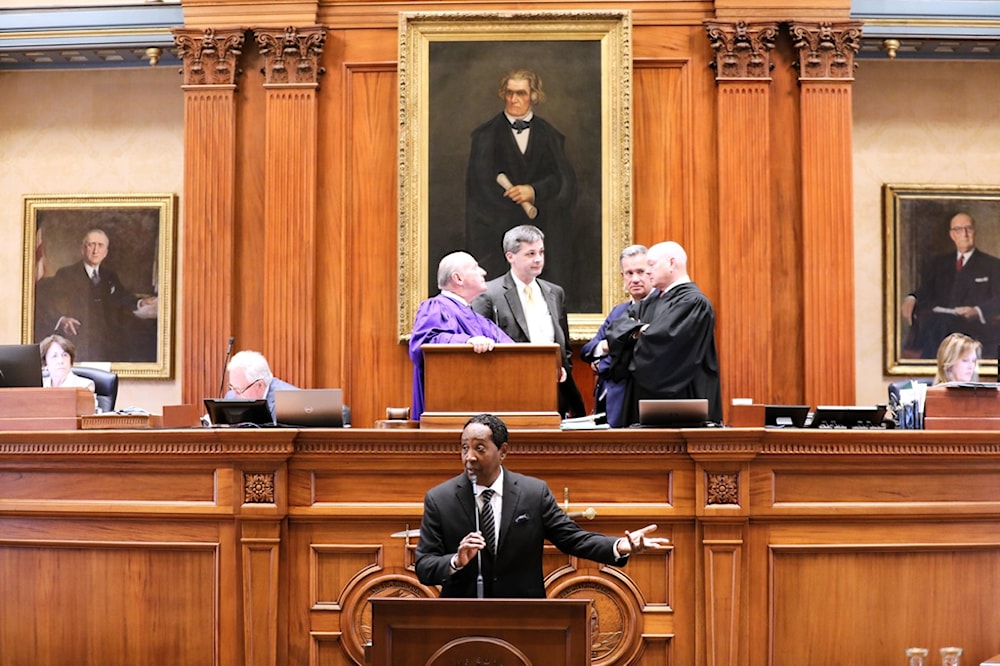
South Carolina Sen. Darrell Jackson, D-Columbia, speaks to the Senate in front of a portrait of former U.S. Vice President and slavery supporter John C. Calhoun on Tuesday, April 14, 2026, in Columbia, S.C. (AP)
Senate Republicans on Wednesday blocked a Democratic-led effort to curb President Donald Trump’s authority to continue the war on Iran, reflecting sustained political backing in Washington for the ongoing war despite its rising costs and consequences.
The measure failed in a 52-47 vote, largely along party lines. Republicans were joined by Democratic Senator John Fetterman of Pennsylvania in opposing the move, while Republican Senator Rand Paul of Kentucky broke ranks to support it.
The vote marked the fourth failed attempt in recent weeks by Democrats to reassert congressional war powers, pointing to continued Republican support for the administration’s approach as the war enters its second month.
Mounting unease
Despite the outcome, signs of strain are emerging within Republican ranks as the war drags on and its economic impact intensifies.
“I hope that we are arriving at an exit strategy here to bring this to a close to preserve our security interests and bring down the cost of gasoline,” Senator Josh Hawley of Missouri said, as quoted by The New York Times.
Some lawmakers have also begun pressing for greater clarity as the conflict approaches the 60-day threshold under the War Powers Resolution, which would require congressional authorization for continued military engagement.
“We’ve got to start answering questions,” Senator Thom Tillis of North Carolina told NBC News. “The 60-day target is what I’m looking at.”
Others have warned they would not support prolonged military action without congressional approval.
“I will not support ongoing military action beyond a 60-day window without congressional approval,” Senator John Curtis of Utah wrote, citing both constitutional and historical concerns.
Economic pressure builds
The war has increasingly translated into domestic economic strain, with rising fuel and agricultural costs fueling concern among lawmakers and constituents.
Gasoline prices have climbed alongside broader energy costs, while increases in diesel and fertilizer prices have added pressure on farmers, raising fears of political fallout as the conflict continues.
At the same time, the administration has yet to submit a formal funding request to Congress for the war, with officials declining to disclose its full cost. During a House Budget Committee hearing, White House budget director Russell Vought said, “We’re not ready to come to you with a request,” adding that officials are still determining spending needs across fiscal timelines.
Pressed on whether the request could exceed $50 billion, he said, “I don’t have a ballpark for you.”
Estimates indicate that US war spending has already reached between $25 billion and $35 billion, with daily operational costs at times nearing $2 billion.
Earlier reporting by The Wall Street Journal also placed US military losses in the first three weeks of the war at between $1.4 billion and $2.9 billion, following Iranian strikes targeting high-value assets, including radar systems, aerial refueling aircraft, and unmanned platforms.
Despite mounting costs, the Pentagon has reportedly pushed for a funding package exceeding $200 billion to sustain operations and replenish depleted stockpiles, a figure that has raised concerns among lawmakers.
The developments point to growing pressure on the administration to define a clear strategy, as the war continues to expand in scope while imposing mounting financial and political costs.
Read more: Republican unease grows as war on Iran strains economy, politics: WSJ


