
Rights groups warn Congress against deeper US-'Israel' military ties
 5 Min Read
Rights groups are urging Congress to remove a provision from the 2027 NDAA that would deepen US-"Israel" defense-industry integration.
-
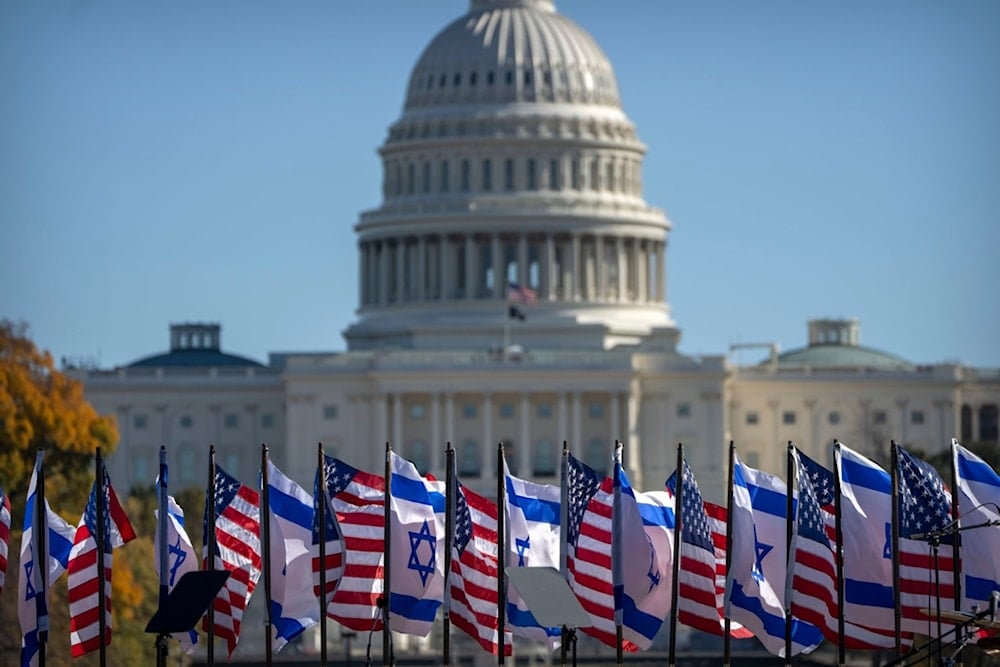
US and Israeli flags fly on the stage in front of the Capitol at the March for "Israel" at the National Mall on Tuesday, Nov. 14, 2023, in Washington (AP)
Dozens of US civil rights and advocacy organizations are pressing Congress to strike a provision from the 2027 defense budget that would further integrate the Israeli military industry into the United States' defense and technology sector, Reuters reported.
A coalition of 56 organizations warned lawmakers Thursday against Section 219 of the National Defense Authorization Act (NDAA), which seeks to expand cooperation between US and Israeli arms manufacturers through joint ventures, licensing agreements, technology development, and US-based weapons production.
The measure has already been included in the version of the NDAA passed by the House of Representatives in July and is now awaiting action in the Senate.
Groups warn of deeper Israeli influence
In a letter addressed to the heads of the House and Senate Armed Services Committees, the organizations described the proposed expansion of military-industrial cooperation with "Israel" as "exceptionally dangerous", particularly as opposition to Washington's unconditional backing of the occupation continues to grow inside the United States.
"At a time in which American interests are increasingly diverging from those of Israel, and American public opinion is turning increasingly against unconditional support to Israel, creating new points of influence for Israel in the U.S. defense-technology ecosystem is exceptionally dangerous," the letter said.
The signatories include Amnesty International USA, the National Lawyers Guild, and a number of Arab and Jewish advocacy organizations.
Israeli influence over US defense decisions
Opponents of Section 219 argue that the measure would go beyond Washington's existing military support for "Israel" by creating deeper structural links between Israeli arms companies and the US defense establishment.
Democratic Senator Chris Van Hollen warned that the proposed arrangement could expose sensitive US military technology while increasing the Israeli government's ability to influence Washington's defense establishment.
"This provision ... threatens to compromise sensitive technologies and, based on our prior experience, risks giving the Government of Israel the ability to interfere in U.S. defense decisions," Van Hollen told Reuters.
Gaza genocide sharpens opposition
The groups' intervention comes as "Israel" continues to face widespread accusations of violations of international humanitarian law over its war on Gaza and amid escalating settler attacks against Palestinians throughout the occupied West Bank.
More than 73,000 Palestinians have been killed in the Israeli assault on Gaza since October 2023, according to health authorities in the Strip.
The organizations argued that such circumstances should rule out moves to deepen Washington's military relationship with the occupation.
Washington moves toward deeper military-industrial partnership
Section 219 would establish frameworks allowing US and Israeli defense companies to pursue joint projects and licensing agreements while expanding co-production on US soil.
Supporters contend that integrating the two defense industries more closely could accelerate weapons development and military technology innovation.
From aid recipient to partner
The proposed measure also comes as Israeli Prime Minister Benjamin Netanyahu increasingly portrays the future US-"Israel" relationship as one based on military-industrial partnership rather than conventional US aid.
Netanyahu said in May that he hoped "Israel" could end its dependence on US military assistance within approximately a decade. In a June letter to a US congressman, he argued that the time had come for "Israel" "to move from aid recipient to partner."
Washington currently provides "Israel" with $3.8 billion in military assistance annually under a memorandum of understanding that expires in 2028.
Discussions have already begun over what will replace the agreement, raising questions over whether direct aid could increasingly be replaced or supplemented by deeper integration between the two countries' arms industries.
US support for 'Israel' erodes
The attempt to strengthen military ties comes against a significant shift in US public attitudes toward "Israel", particularly among Democratic voters.
A Quinnipiac University poll published in June found that 48% of US voters believe Washington is too supportive of "Israel". Among Democrats, that figure reached 66%.
That represents a sharp departure from 2017, when only 16% of voters overall and 20% of Democrats expressed the same position.
The shift has increasingly spilled into electoral politics, with candidates challenging unconditional US support for "Israel" gaining ground in Democratic primaries and more lawmakers publicly questioning policies that for decades enjoyed broad bipartisan backing.
Bipartisan push to strip provision
Opposition to Section 219 has also crossed party lines.
Republican Representative Thomas Massie of Kentucky and Democratic Representative Ro Khanna of California previously introduced an amendment aimed at removing the provision, although the effort failed to make it into the House version of the NDAA.
The Senate will now consider its own version of the defense legislation before representatives from both chambers negotiate a final text.
That process gives lawmakers another opportunity to remove Section 219 before the legislation is sent to US President Donald Trump for his signature or veto.
Read more: House blocks vote to halt US-'Israel' military integration


