
Riyadh trapped between war costs, painful concessions: The Economist
 5 Min Read
Saudi Arabia's renewed war on Yemen threatens its economic ambitions and exposes military vulnerabilities, leaving Riyadh facing prolonged conflict or costly concessions.
-
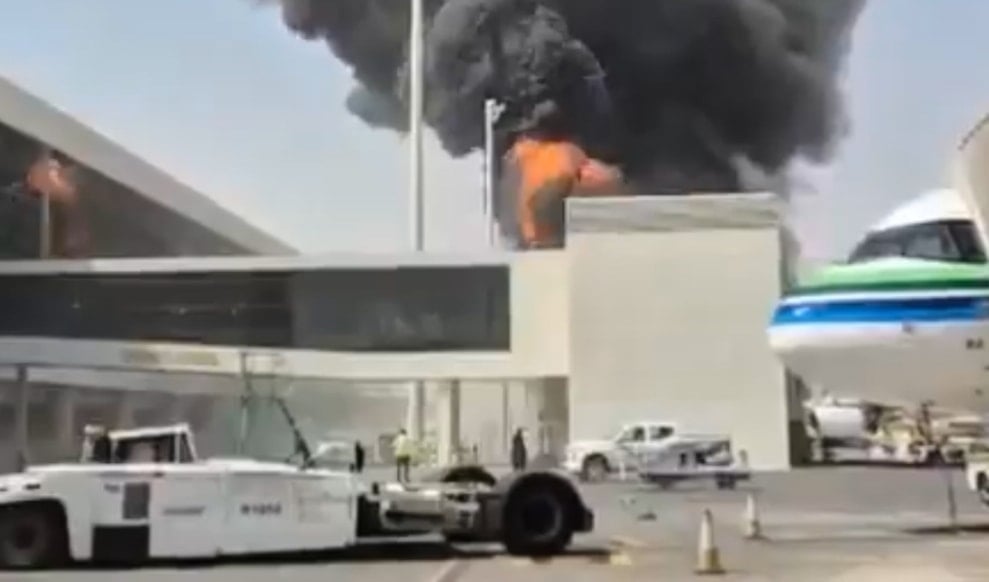
This image from a video obtained and verified by AP shows thick black smoke and flames rising from a fire at King Khalid International Airport in Riyadh, Saudi Arabia, Oct. 8, 2026 (UGC via AP)
Saudi Arabia’s renewed war on Yemen is placing its economic ambitions at risk, as attacks on airports and energy facilities expose the kingdom’s vulnerabilities while its military campaign struggles to achieve decisive gains, The Economist reported.
The magazine’s assessment points to mounting pressure on Riyadh: prolonged fighting could disrupt the investment and tourism projects central to its development plans, while negotiations with the Yemeni Armed Forces would likely require significant concessions.
Despite years of Saudi-led military operations, the YAF continue to control extensive areas of Yemen and retain the capacity to strike strategic infrastructure inside the kingdom.
Renewed campaign faces uncertain objectives
Saudi Arabia’s latest offensive has yet to reverse all the territorial gains made by the YAF in September, according to the report.
The movement advanced across much of Yemen’s southwestern coastline last month, taking control of the port city of Mokha.
The YAF have also continued efforts to surround Taiz, where opposing forces remain entrenched.
The renewed fighting follows the relative calm established by the 2022 ceasefire, which stabilized front lines without resolving the conflict stemming from the Saudi-led war launched in 2015.
Saudi Arabia reneged on the truce by launching airstrikes on Sanaa International Airport, in an attempt to prevent an Iranian aircraft trying to break the more than a decade-long siege on the country from landing.
People who recently met Saudi leaders told The Economist that Crown Prince Mohammad bin Salman was determined to recover territory lost in September. However, the campaign’s objectives beyond that remain uncertain.
“Whether they have clear goals beyond that, I don’t know,” one Western official said.
Investment plans face consequences of war
The escalation comes as Riyadh prepares to host the Future Investment Initiative on October 26, an event intended to reinforce the kingdom’s position as a destination for international capital.
Organizers said the gathering would proceed in an announcement issued hours before the October 10 attack on Riyadh’s airport.
However, repeated strikes and flight cancellations have cast doubt on attendance and access to the capital, the magazine reported. Diverting visitors through other Saudi cities may offer limited reassurance, with Dammam’s airport also targeted.
The report argued that sustained attacks on transport and energy infrastructure could undermine Saudi efforts to diversify its economy.
That exposure places pressure on Riyadh to resolve a conflict in which its military advantages have failed to secure a conclusive outcome.
Repeated strikes raise air-defense questions
According to The Economist, the October 10 attack on Riyadh’s airport killed at least 13 people and wounded 309, some critically.
Witnesses cited by the magazine said missiles struck Terminal 3, which handles domestic flights, causing part of the roof to collapse. The airport remained closed for more than 24 hours at the time of reporting, without a confirmed reopening date.
A further attack on October 11 hit Terminal 4 and caused a fire.
The magazine also reported that an October 8 strike killed three people and destroyed an aircraft belonging to a Saudi state-owned carrier.
Despite the earlier attacks and widespread flight cancellations, Saudi authorities had continued operating the airport, a decision the report said was facing criticism in the capital.
The strikes have raised questions about the effectiveness of Saudi Arabia’s US-made Patriot and THAAD systems. Although the reasons for the failed interceptions remained unclear, the magazine noted concerns over shrinking interceptor supplies following months of regional warfare.
Foreign backing unlikely to secure decisive victory
Riyadh has sought additional support from its international partners, invoking a mutual-defense agreement signed with Pakistan and Turkey in August, according to the report.
Pakistan deployed several thousand troops while stating that it would not participate in fighting inside Yemen. Britain sent an aerial-refuelling aircraft, and France pledged personnel to protect a major Saudi oil port on the Red Sea.
US President Donald Trump had repeatedly rejected Saudi requests for American airstrikes, although he suggested after the airport attack that he could reconsider.
Nevertheless, The Economist assessed that such assistance was unlikely to produce a decisive defeat of the Yemeni Armed Forces.
Negotiations would carry their own demands. The magazine suggested that the YAF would seek economic benefits, an end to the Saudi blockade of Yemen’s airspace, and other concessions.
The assessment leaves Riyadh confronting the unresolved consequences of its war: continued military operations threaten the economic agenda it seeks to advance, while a settlement would require concessions that force has failed to avert.
Read more: Saudi Arabia seeks two-week truce with Ansar Allah via Oman: Source


