
Rubio offers Europe alliance, on Trump's terms
 6 Min Read
Behind appeals to shared civilization and destiny, Rubio's speech operationalized Trump's National Security Strategy.
-
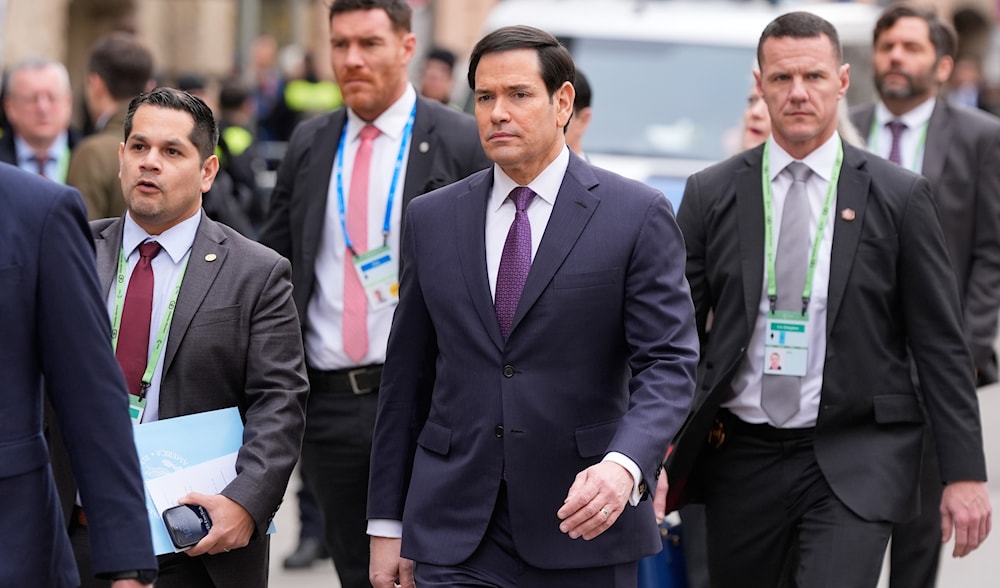
US Secretary of State Marco Rubio walks to a meeting of G7 foreign ministers at the Munich Security Conference in Munich, Germany, Saturday, Feb 14, 2026 (AP)
US Secretary of State Marco Rubio told European leaders at Munich that the US and Europe "belong together", then spent his speech detailing exactly how Europe must change to remain in Washington's favor.
The secretary's much-anticipated address at the annual Munich Security Conference offered renewed partnership, but strictly on Trump administration terms. What appeared as diplomatic outreach was the operationalization of Trump's National Security Strategy, a framework that redefines alliances as hierarchical rather than collaborative arrangements.
Describing the US as "a child of Europe," Rubio made an emotional appeal: "While we are prepared, if necessary, to do this alone, it is our preference, and it is our hope to do this together with you, our friends here in Europe."
Yet behind these appeals to shared Western civilization lay concrete demands. Europe must adopt US-style border restrictions, abandon climate commitments Rubio termed a "cult", redirect welfare spending to defense budgets, and accept US primacy over international institutions.
Strategic doctrine becomes diplomatic pressure
To understand what Rubio was actually offering, one must read his speech through the lens of Trump's National Security Strategy (NSS). The NSS establishes core principles, where economic security equals national security, allies function as "force multipliers" rather than equal partners, and international institutions must serve US interests or face reform.
"We in America have no interest in being polite and orderly caretakers of the West's managed decline," the US Secretary of State said. "We do not seek to separate, but to revitalise an old friendship and renew the greatest civilisation in human history," he added.
But revitalization comes with conditions. "What we want," he continued, "is a reinvigorated alliance that recognises that what has ailed our societies is not just a set of bad policies, but a malaise of hopelessness and complacency."
The remedy for this malaise, according to Rubio, requires Europe to embrace Trump's worldview entirely. He acknowledged this directly: "This is the path that President Trump and the United States have embarked upon. It is the path we ask you here in Europe to join us on."
Borders, economics, and selective sovereignty
Rubio's demands translated the National Security Strategy doctrine into specific diplomatic pressure, revealing how Washington envisions the "renewed" alliance.
"Gaining control of national borders is not an expression of xenophobia or hate. It is a fundamental act of national sovereignty," he said on migration. He added that "the failure to do so is not just an abdication of one of our most basic duties owed to our people, it is an urgent threat to the fabric of our societies and the survival of our civilisation itself."
Yet sovereignty applies selectively. Europe must restrict migration on US terms while accepting US tariffs that constrain economic autonomy. Rubio blamed "a foolish but voluntary transformation" of Western economies that "left us dependent on others for our needs and dangerously vulnerable to crisis." This provides ideological cover for Trump's tariff regime, but Europe is being told to decouple from China while Washington imposes tariffs on European goods.
Defense spending followed the same pattern. Rubio criticized Western nations for "expanding welfare states at the expense of national defence," demanding Europe redirect social budgets to military spending.
International law as 'abstraction'
Most revealing was Rubio's dismissal of international legal frameworks. "In a perfect world, all of these problems and more would be solved by diplomats and strongly worded resolutions," he said. "But we do not live in a perfect world. And we cannot continue to allow those who blatantly and openly threaten our citizens and endanger our global stability to shield themselves behind abstractions of international law which they themselves routinely violate."
International law exists as an "abstraction" when it constrains US power or Israeli military action, but as a binding reality when invoked against adversaries. The law, in this framework, is not a universal standard but an instrument of power, applied selectively to advance strategic interests while dismissed as a technicality when inconvenient.
On institutional reform, Rubio insisted it would not be necessary "to dismantle institutions such as the UN but to reform and rebuild them."
Ideological conformity demanded
Rubio attempted to bind Europe into Trump's broader project by claiming both continents made the same mistakes together: bowing down to "a climate cult," expanding welfare states, embracing globalization, and "a world without borders in which everyone would be a citizen of the world."
He said the US under Trump "did not want a Europe that was weak or shackled by guilt or shame," yet offered a relationship where Europe's strength would be measured by its alignment with US priorities. Europe must be sovereign enough to restrict migration and reject climate action, but not sovereign enough to chart an independent foreign policy.
The substance behind the warmth
Delegates at the Munich conference greeted Rubio's speech with relief, primarily because his tone proved warmer than Vice President JD Vance's combative approach at the same conference last year. Many pointed out, however, that Rubio was not offering a partnership of equals, but an alliance largely framed in Donald Trump's terms.
The relief was understandable but misplaced. Rubio's warmer rhetoric couldn't disguise the fundamental demand of total European alignment with Trump's vision. He admitted Americans "may come across as a little direct and urgent," justifying this because "the US was profoundly concerned by the fate of Europe, and knew their destinies were intertwined."
Yet when substantive negotiation was required, rhetoric gave way to reality. Rubio said little in his speech about Ukraine and skipped a Friday meeting with European leaders on the issue, citing scheduling conflicts. On the substance, he acknowledged "the two sides had narrowed the items of difference, while the remaining issues were the hardest ones," hardly evidence of the dealmaking prowess claimed.


