
Russia questions US credibility in Ukraine talks after Iran aggresion
 3 Min Read
Russian officials and analysts say the US-Israeli war on Iran has deepened distrust toward Washington, raising doubts in Moscow about the credibility of US-led negotiations to end the war in Ukraine.
-
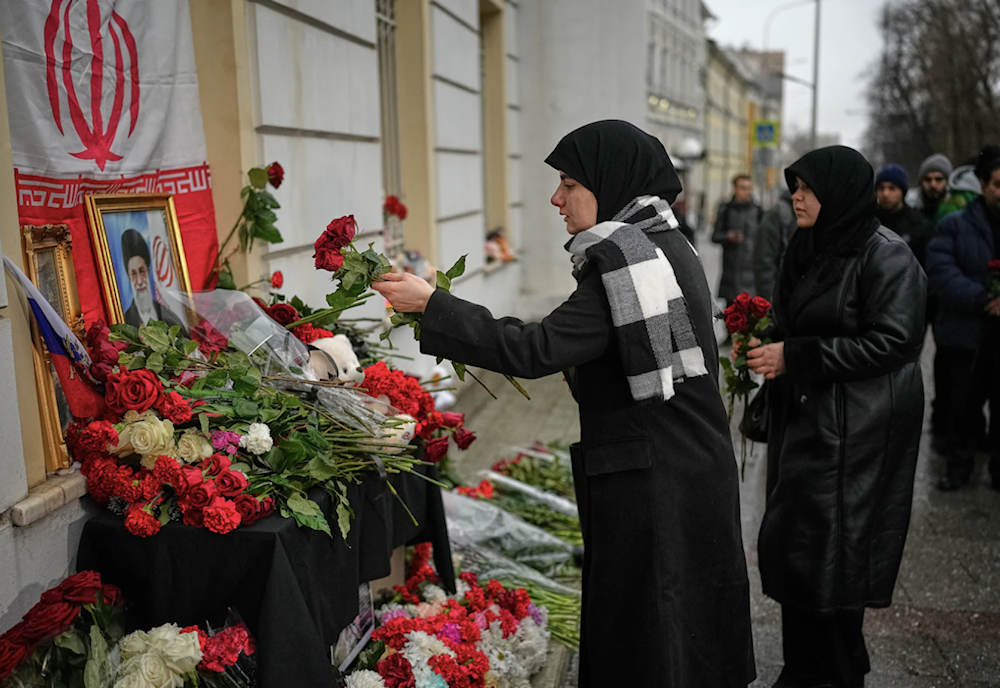
Iranian students who study in Russia lay flowers by a portrait of martyred Sayyed Ali Khamenei outside the Iranian Embassy in Moscow on March 2, 2026. (AP)
Russian state media and political commentators have increasingly questioned whether negotiations with the United States can be trusted following the US-Israeli aggression against Iran.
The war on Iran, including the assassination of the Leader of the Islamic Revolution, the martyred Sayyed Ali Khamenei, during ongoing negotiations between Tehran and Washington, has fueled skepticism among Russian hardliners about the reliability of diplomacy with the United States.
In an opinion piece published in the newspaper Moskovsky Komsomolets, columnist Dmitry Popov argued that Washington is “devouring Russian allies one by one” while promising cooperation with Moscow.
The commentary reflects a growing sentiment among Russian political circles that diplomacy with Washington may be fragile, or even meaningless, if the US resorts to military force while negotiations are ongoing.
War on Iran reshapes Russia’s approach to Ukraine
The war on Iran has reinforced the belief among some Russian officials that the war in Ukraine will ultimately be decided on the battlefield rather than through negotiations.
Russian foreign policy analyst Fyodor Lukyanov, who advises the Kremlin, said the war marks a shift toward a new international reality. “At any moment, you can move from being a person sitting across the table to becoming a victim," Lukyanov said.
According to him, this raises fundamental questions about whether diplomacy can function in an environment where military action can suddenly replace negotiations.
Ukraine peace talks delayed as Washington focuses on Iran
Talks between the United States, Russia, and Ukraine were expected to resume in Turkey this week but were reportedly postponed after Washington shifted its focus to the war on Iran.
Ukrainian President Volodymyr Zelensky said the delay came at the request of the American side.
At the same time, Russian President Vladimir Putin held a phone call with Donald Trump, the first conversation between the two leaders this year.
Some analysts say Moscow could benefit from the war in West Asia, particularly through rising global oil prices and the possibility that Washington could reduce pressure on Russia while focusing on the Iran war.
Analysts say the war could still bring mixed consequences for Russia, and the diversion of US attention toward West Asia could also reduce Western support for Ukraine. Meanwhile, Ukrainian officials have expressed concern that weapons and military resources destined for Kiev could be redirected toward West Asia as the war on Iran intensifies.


