
Trump’s war on Iran echoes Putin’s Ukraine war: NYT
 3 Min Read
A New York Times report says Trump’s war on Iran echoes rhetoric and early assumptions seen in Putin’s war in Ukraine, raising concerns about unclear objectives and expectations of a short war.
-
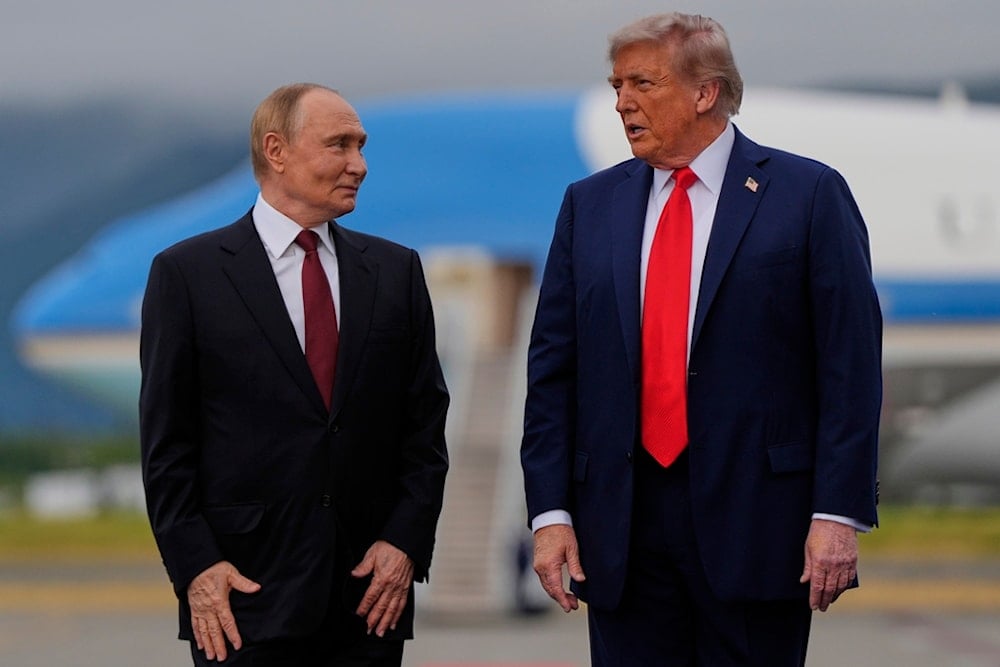
United States President Donald Trump, right, greets Russia's President Vladimir Putin, left, on August 15, 2025, at Joint Base Elmendorf-Richardson, Alaska, the United States. (AP)
The rhetoric and early dynamics surrounding United States President Donald Trump’s war on Iran bear striking similarities to the narrative used by Russian President Vladimir Putin when launching the Ukraine war in 2022, a report by The New York Times argues.
According to the newspaper, officials in Washington and Moscow have used remarkably similar language to frame their respective attacks while avoiding direct acknowledgment that they had initiated full-scale wars. US War Secretary Pete Hegseth stated last week that the United States “didn’t start this war, but under President Trump, we are finishing it,” a formulation the report notes closely mirrors Putin’s justification, according to the NYT.
After ordering the operation in 2022, Putin declared, “We didn’t start the so-called war in Ukraine. Rather, we are trying to finish it.”
Similar rhetoric and messaging
The NYT report highlights how both governments have attempted to avoid describing their actions as war. When asked whether the US campaign against Iran constitutes a war, US House Speaker Mike Johnson replied, “I think it’s an operation.”
The phrasing echoes the Kremlin’s insistence on calling the war in Ukraine a “special military operation”, terminology widely used by Russian officials, including State Duma speaker Vyacheslav Volodin.
The article also notes parallels in the leaders’ messaging to opposing militaries. During his announcement of “major combat operations” against Iran, Trump urged Iranian soldiers to “lay down your weapons” or “face certain death”.
Similarly, in the early hours of Russia’s invasion of Ukraine, Putin called on Ukrainian forces to “immediately lay down arms and go home”, warning that otherwise “responsibility for the possible bloodshed will lie fully and wholly with the ruling Ukrainian regime.”
Expectations of a short war
The paper notes that early expectations of a quick victory also echo the initial assumptions behind the war in Ukraine. In 2022, Russian planners believed Ukrainian resistance would collapse rapidly, with troops reportedly preparing for a quick military parade in Kiev. Instead, the conflict evolved into a prolonged war that has cost hundreds of thousands of lives on both sides.
The newspaper suggests that similar optimism may be shaping Washington’s expectations for the war on Iran.
Some Russian commentators have even begun referring to Trump’s strategy as “Tehran in three days”, a reference to the phrase “Kiev in three days”, which became shorthand for Moscow’s failed expectation of a rapid victory in Ukraine. Former Ukrainian Foreign Minister Dmytro Kuleba warned that assumptions of a quick outcome may prove unrealistic.
“American commentators are again talking about a ‘short war,’” he wrote on social media. “They said the same about Russia’s war against Ukraine.”
The NYT article also points to shifting US goals in Iran. While Trump has at times demanded “unconditional surrender”, members of his administration have also suggested narrower goals such as destroying Iran’s nuclear program or degrading its missile arsenal.
Military analyst Michael Kofman of the Carnegie Endowment for International Peace said such wars highlight the importance of aligning military action with political goals.
“The need for an alignment between military means and political aims” is one of the central lessons of modern warfare, he noted.
Read more: Who is Sayyed Mojtaba Khamenei, Iran's next leader?


