
Russia to honor new START treaty limits if US does the same
 5 Min Read
Russia will uphold the New START treaty limits if the US does the same, says Sergey Lavrov, stressing conditional commitment to arms control and strategic stability.
-
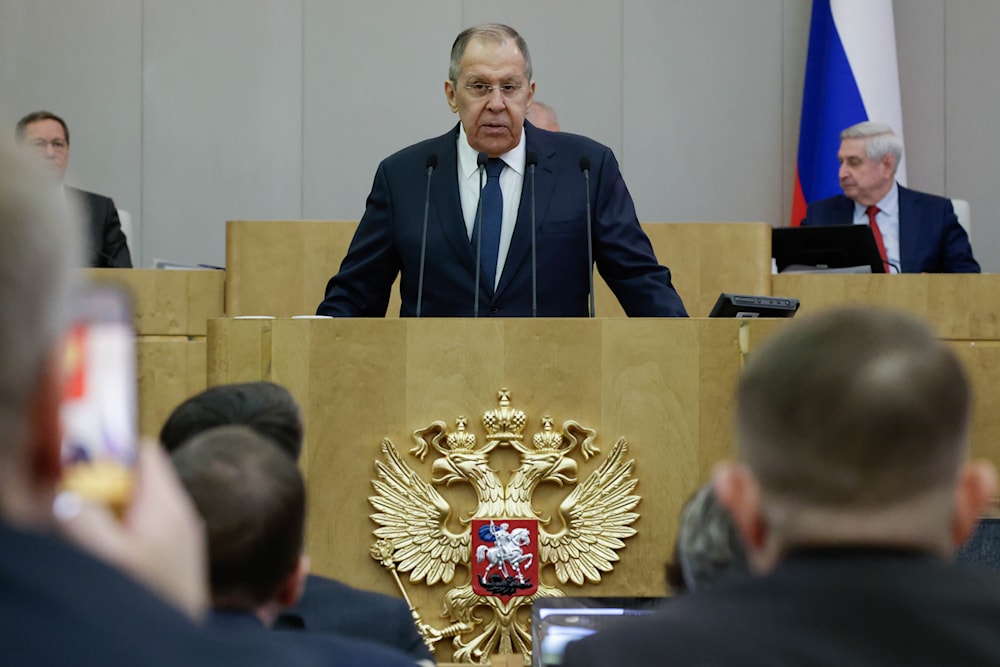
Russian Foreign Minister Sergey Lavrov, centre, delivers his speech at the State Duma, the Lower House of the Russian Parliament in Moscow, on Wednesday, Feb. 11, 2026 (AP)
Russia will continue to adhere to strategic arms limitations after the expiration of the New START treaty, provided that the United States does the same, Foreign Minister Sergey Lavrov said on Wednesday.
Speaking during a government session in the State Duma, Lavrov stated that Moscow remains committed to a moratorium on exceeding the treaty’s limits, an initiative previously announced by President Vladimir Putin. However, he emphasized that Russia’s position is conditional.
“We proceed from the fact that this moratorium on our part, which was announced by President [Vladimir] Putin, remains in place, but only as long as the United States also does not exceed the aforementioned limits,” Lavrov said.
The minister added that Russia has not yet received an official response from Washington regarding its proposal to maintain the arms restrictions beyond the treaty’s expiration.
The New START treaty, signed in 2010, limits the number of deployed strategic nuclear warheads and delivery systems held by both countries. Its future remains uncertain amid strained relations between Moscow and Washington.
US unlikely to loosen adherence to START treaty
There is reason to believe that the United States will not immediately deviate from the existing limits set under the New START treaty despite its expiration on February 5, Russian Foreign Minister Sergey Lavrov said Wednesday.
Speaking during a government session in the State Duma, Lavrov said Moscow sees no indication that Washington is rushing to move beyond the treaty’s established caps on strategic weapons.
“We have reason to believe that the United States is in no hurry to move away from these indicators, and these indicators will be respected for the foreseeable future. We will monitor very closely how everything is really happening,” Lavrov said.
He added that Russia would actively work toward a new agreement on strategic stability if the United States confirms what he described as a constructive approach.
The remarks come amid ongoing uncertainty over the future of bilateral arms control arrangements following the expiration of the New START treaty, which had limited deployed strategic nuclear warheads and delivery systems for both countries.
US, Russia agree to continue START compliance
The United States and Russia have agreed to continue observing the terms of the New START nuclear arms control treaty for at least six months, while initiating negotiations on a new agreement to replace it, Axios reported on February 5, citing informed sources.
According to the report, the current treaty was set to expire on February 5, prompting both sides to seek a temporary arrangement to prevent a lapse in nuclear arms limitations.
Talks between US and Russian officials took place over the past 24 hours in Abu Dhabi, where a draft framework for extending compliance and launching negotiations was discussed. Axios noted that the proposed plan still requires final approval from US President Donald Trump and Russian President Vladimir Putin before it can be formally adopted.
The Strategic Arms Reduction Treaty, commonly known as START, refers to a series of nuclear arms control agreements between the United States and the Soviet Union, and later Russia, aimed at reducing strategic nuclear weapons. The first treaty, START I, was signed on July 31, 1991, by US President George H. W. Bush and Soviet leader Mikhail Gorbachev, near the end of the Cold War.
What is the START treaty?
START I emerged after years of negotiations driven by concerns over the massive nuclear arsenals accumulated by both superpowers during decades of rivalry. Its primary goal was to cut deployed strategic nuclear weapons and establish strict verification measures to ensure compliance. The treaty entered into force on December 5, 1994.
Following the dissolution of the Soviet Union, START obligations were assumed by Russia and several former Soviet states, marking a significant shift in the global nuclear landscape. The treaty helped eliminate thousands of warheads and delivery systems, easing fears of nuclear escalation during a period of political transition.
The arms control framework was later renewed through the New START Treaty, signed in Prague on April 8, 2010, by US President Barack Obama and Russian President Dmitry Medvedev. It entered into force on February 5, 2011, replacing earlier agreements that had expired.
New START aimed to further limit nuclear arsenals by capping deployed strategic warheads and delivery systems, while preserving transparency through inspections and data exchanges. The treaty reflects ongoing efforts by Washington and Moscow to maintain strategic stability amid changing geopolitical conditions.


