
Russia warns Western nuclear policies are driving global escalation
 3 Min Read
Vassily Nebenzia warned that US, UK, and French nuclear policies are dismantling arms control and pushing the world toward a renewed nuclear arms race.
-
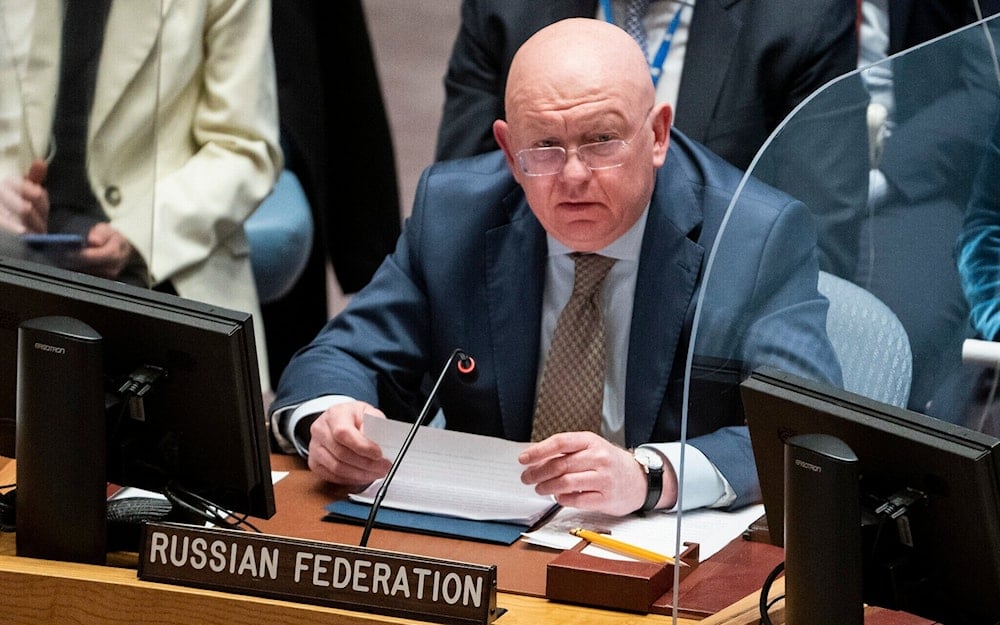
Vassily Nebenzia, permanent representative of Russia to the United Nations, speaks during a meeting of the UN Security Council, March 29, 2022, at United Nations headquarters (AP Photo/John Minchillo, File)
Vassily Nebenzia warned at the UN Security Council that Western nuclear powers are pushing the world toward a dangerous new phase of instability, as longstanding arms control mechanisms continue to erode.
"One cannot but note that the actions of all three Western states, the United States, France, and the United Kingdom, which possess nuclear weapons, are directly provoking a nuclear arms race," Nebenzia said.
The Russian envoy pointed to a pattern of escalation, with Paris and London openly expanding their nuclear arsenals, while Washington has stepped away from key limitations and signaled readiness to further increase its capabilities.
"Paris and London have already openly announced the expansion of their nuclear arsenals, while Washington, having freed itself from treaty restrictions and ignoring the test ban, has expressed its readiness to immediately expand its capabilities and resume nuclear tests at the first command," he added.
According to Russia, such developments reflect a broader dismantling of the global arms control architecture, raising concerns about the return of unconstrained nuclear competition. The expiration of the New START Treaty in February 2026, the last remaining agreement limiting US and Russian strategic nuclear arsenals, has effectively removed binding caps on the world’s two largest nuclear stockpiles. Earlier collapses of key frameworks, including the Intermediate-Range Nuclear Forces Treaty and the Open Skies Treaty, have further reduced transparency and constraints, while growing uncertainty surrounding the Comprehensive Nuclear-Test-Ban Treaty raises fears of a return to live nuclear testing.
Korea pressure response
Nebenzia also criticized the growing military footprint of NATO-aligned states in the Asia-Pacific, describing it as a destabilizing force that undermines prospects for a balanced regional security framework.
"The buildup of NATO countries' military presence in the Asia-Pacific region is systematically destroying the prospects for building a non-aligned collective security architecture in the region," he said.
Addressing the Korean Peninsula, the Russian diplomat argued that continued pressure by the United States and its allies is forcing the DPRK to pursue independent measures to guarantee its sovereignty.
"North Korea is forced to independently seek ways to ensure national security and sovereignty in the face of aggressive pressure from ill-wishers, including the US, Japan, and South Korea," Nebenzia stated.
He further emphasized the scale of military capabilities held by Washington and its regional partners.
"In the context of the situation on the Korean Peninsula, it should be emphasized that we are talking about three countries — the United States, the Republic of Korea, and Japan — which are among dozens of states with the largest military budgets. They are on combat alert, possessing the most modern and destructive military equipment in the world. In the face of such ill-wishers, the leadership of an independent and sovereign DPRK is forced to find a solution to ensure national security," he said.
Strategic recalibration
The remarks come as Russian officials signal a reassessment of strategic policy following Washington’s rejection of proposals related to the future of the New START Treaty, with Moscow indicating it will increasingly base its decisions on evolving Western military actions and the broader global security environment.
Read more: US $138bln nuclear modernization plan fuels nuclear arms race concerns


