
Saudi Arabia seeks Yemen gains before truce talks: Report
 5 Min Read
Saudi Arabia is demanding the reversal of Sanaa territorial gains before considering a Yemen ceasefire, POLITICO reported, raising fears of prolonged fighting and further disruption to regional oil exports.
-
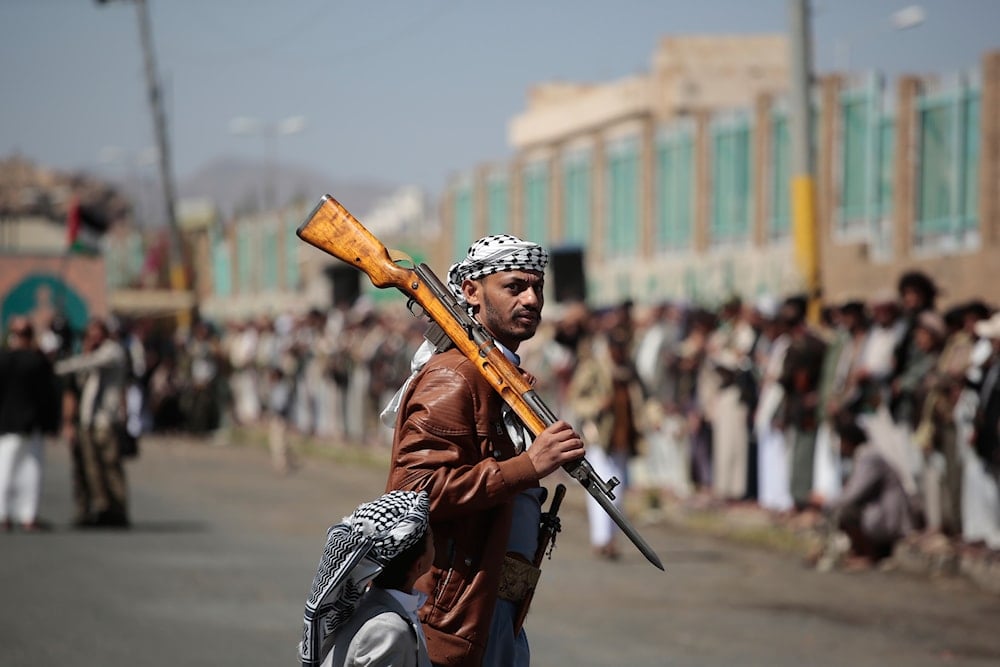
A Yemeni holds a rifle while attending a rally in Sanaa, Yemen, Wednesday, Oct. 7, 2026 (AP)
Prospects for a ceasefire in Yemen remain blocked by Saudi Arabia’s insistence on reversing recent territorial gains by Sanaa before considering a halt to fighting, POLITICO reported, citing six people familiar with Riyadh’s thinking, including regional officials.
The reported position threatens to prolong the Saudi military campaign and deepen pressure on shipping through Bab el-Mandeb, as the war on Iran continues to disrupt regional energy exports.
According to the report, Saudi officials fear that accepting a pause would project weakness and allow Sanaa to consolidate its position. The Saudi Embassy in Washington declined to comment.
Sanaa captured strategic territory along Yemen’s Red Sea coast in September. Saudi Arabia launched an offensive this week aimed at recovering those areas and securing access through Bab el-Mandeb, a vital route for Saudi oil shipments.
Washington supplies targeting intelligence
Although Washington has refrained from launching its own airstrikes in the latest confrontation, US personnel are already supporting the Saudi campaign.
Two US officials told POLITICO that Washington is supplying intelligence, including information on Sanaa forces positions, alongside aerial refueling for Saudi aircraft conducting defensive patrols. More than 200 US military and intelligence analysts are involved in the effort.
President Donald Trump has so far avoided breaking the truce reached with Sanaa last year, following a US military operation that the report described as having achieved limited results. Sanaa has pledged not to target US vessels during its current confrontation with Saudi Arabia.
Secretary of State Marco Rubio nevertheless signaled Washington’s commitment to Riyadh, saying this week that the United States “has a defense and security agreement with Saudi Arabia and we intend to live by it.”
The White House declined to comment on its plans concerning the conflict.
Riyadh has also activated its recently established defense arrangement with Pakistan and Turkey, known as the Mecca Alliance. According to POLITICO, a joint statement issued Monday suggested that Pakistani and Turkish troops could participate in the Saudi effort, although their potential roles remained unclear.
Fears Saudi campaign could expand
The prospect of Saudi objectives extending beyond the recovery of recently lost territory has drawn warnings of another prolonged war inside Yemen.
Following talks with Saudi Crown Prince Mohammed bin Salman in Riyadh, US Senator Chris Murphy said the kingdom could seek to advance farther than the areas it initially aimed to retake.
“It just creates a risk that this is going to be another long military engagement inside Yemen with massive consequences,” Murphy told reporters.
In a Tuesday social media post, he described the wider confrontation as a “full blown regional war.”
Murphy and other Senate Democrats have opposed adding US airstrikes to the Saudi campaign. Some Republican lawmakers, however, have left that possibility open.
“I don’t think you rule out options,” Senator John Hoeven told POLITICO last week. “We don’t want them choking off trade in the Red Sea,” he added, referring to Sanaa government.
A person familiar with UN negotiations on Yemen offered no clear timeline for an end to the fighting: “It’s impossible to say when this is going to end.”
Saudi oil exports face mounting pressure
The confrontation has compounded difficulties for Saudi energy exports, already strained by the standoff over the Strait of Hormuz.
Sanaa announced a naval blockade against Saudi Arabia in July and, according to the report, knocked a major Saudi oil pipeline offline before the latest escalation.
Maritime intelligence company Windward said Saudi-flagged vessels had almost entirely stopped transiting Bab el-Mandeb since July, while tanker crossings had fallen by more than a quarter.
Brett Erickson, managing principal at Obsidian Risk Advisors, described Riyadh’s reluctance to pursue a swift diplomatic settlement as “a remarkably dangerous gamble”.
“Saudi Arabia has demonstrated remarkably little ability to prevent the Houthis from striking critical energy infrastructure across the kingdom,” he said.
The continued disruption also carries political consequences for Washington ahead of November’s midterm elections, with higher fuel prices adding to public frustration over the war on Iran.
Republican strategist Alex Conant argued that voters would hold the governing party responsible for the regional turmoil, regardless of whether US forces directly joined the fighting in Yemen.
“They’re going to own it, whether they like it or not,” he said.
Sanaa says Saudi Arabia’s failure to fulfill commitments to lift the blockade on Yemen led it to abandon the 2022 truce. The movement also cites Saudi strikes on Sana’a airport in July as an Iranian aircraft was preparing to land.
For Yemen’s population, renewed fighting adds to years of hunger, displacement and destruction. UN humanitarian officials cited by POLITICO reported rising cholera cases and the displacement of 21,000 people in the past week alone.
Read more: Yemeni forces repel Saudi forces attack near Bab al-Mandab


