
Saudi escalation against Yemen a miscalculation: Foreign Policy
 5 Min Read
Foreign Policy says Saudi Arabia's latest escalation against Yemen was a strategic miscalculation, arguing the risks of striking Sanaa airport outweighed any potential gains.
-
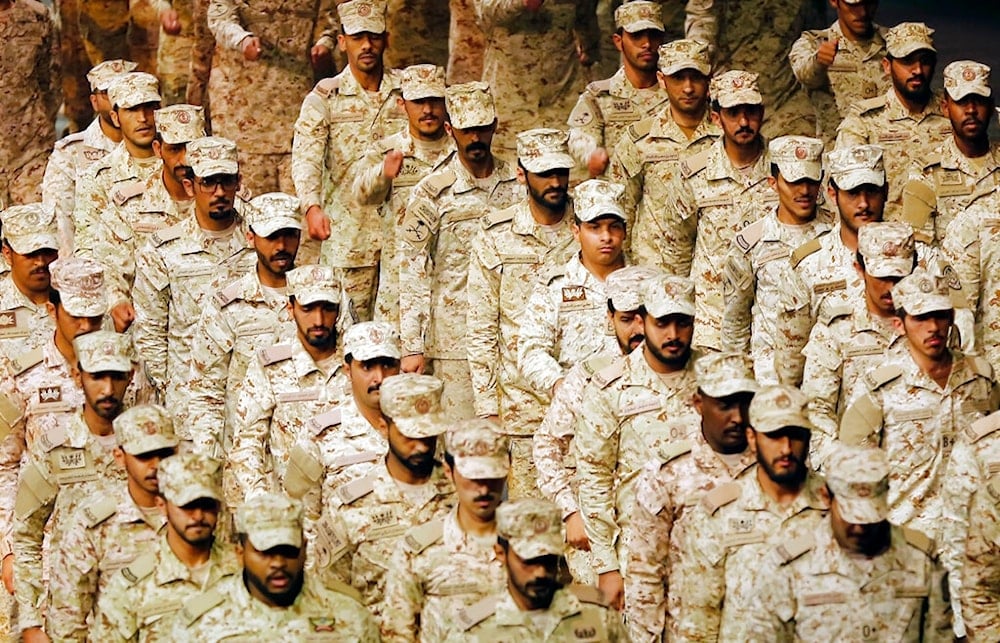
Saudi soldiers parade during a concert at the Green Hall Theatre marking Saudi Arabia's 89th National Day celebrations in Riyadh, Saudi Arabia, September 21, 2019 (AP)
The US magazine Foreign Policy argued that Saudi Arabia's recent military escalation against Yemen was an unnecessary strategic miscalculation, warning that the risks associated with bombing Sanaa International Airport outweighed any potential benefits.
In an article published on Wednesday, the magazine said Riyadh has found itself "trapped between Iran and Ansar Allah," adding that the situation is partly the result of "an incompetent American president."
According to Foreign Policy, the Saudi strikes on Sanaa airport were intended to prevent an Iranian aircraft carrying an Ansar Allah delegation from returning from the funeral of Iranian leader Sayyed Ali Khamenei from landing.
Magazine questions rationale behind Sanaa airport strike
The article argued that even if the flight had violated a UN Security Council resolution, creating a crater in the airport's runway was an unjustified response.
"It should have been an easy decision to allow the plane to land," the magazine wrote, adding that the dangers associated with attacking the airport exceeded the expected gains and that Saudi Arabia could have chosen to overlook the incident.
The article also said Saudi Arabia has largely faced Ansar Allah without meaningful support from its regional allies.
It argued that none of Riyadh's Arab neighbors provided military assistance during the latest escalation, claiming that most were unwilling or unable to risk confrontation with Ansar Allah.
Article criticizes Trump's Saudi policy
Turning to the US role, Foreign Policy described President Donald Trump's return to office during a difficult period for Saudi Arabia as particularly challenging for Riyadh.
The magazine recalled that Trump blocked an agreement that would have granted Saudi Arabia access to US nuclear technology unless it normalized relations with the Israeli regime.
It also argued that Trump's failed Operation Epic Fury strengthened Tehran's position at the expense of its Gulf neighbors and predicted that Washington would ultimately leave Saudi Arabia and its partners to deal with the consequences of any confrontation with Iran once it found an exit strategy.
Saudi Arabia urged to rethink regional strategy
The article described 2026 as a disastrous year for Saudi Arabia, saying the kingdom wishes it could isolate itself from regional crises but cannot.
It argued that Riyadh's long-standing approach of attempting to buy off potential adversaries has failed and urged Saudi leaders to abandon emotional and ideological drivers of policy in favor of a deeper understanding of the region's strategic environment.
The article concluded that only such a shift would give Saudi Arabia a greater opportunity to influence developments across the region.
Saudi Arabia launched airstrikes on Sanaa International Airport on July 13 in an attempt to prevent an Iranian aircraft carrying an Ansar Allah delegation from landing.
In response, the Yemeni Armed Forces targeted sensitive facilities at several Saudi airports and imposed a maritime ban on ships departing from or bound for Saudi Arabia under the "airport for airport and blockade for blockade" equation.
Riyadh 'sinking in quagmire of its crimes'
The Foreign Ministry of Yemen’s Sanaa government has warned that any attempt by Saudi Arabia to escalate the situation will be met with a “comprehensive escalation” that Riyadh “will not be able to bear the consequences of,” stressing that the equation of “blockade for blockade” has become an established reality that cannot be ignored.
In a statement, the ministry said Yemen took this decision after exhausting all options to secure its legitimate rights, adding that the international community recognizes the legitimacy of Yemen’s position despite formal positions that accommodate Saudi Arabia.
Sanaa also said Saudi Arabia’s attempt to absorb the impact of recent developments had failed, adding that Riyadh was “sinking into the quagmire of its crimes.”
It stressed that the path toward settlement remains “clear and without cost,” calling on those seeking stability to push Saudi Arabia toward this course.
Sanaa warns Saudi Arabia against further escalation
The warning comes amid renewed tensions between Sanaa and Riyadh following the collapse of the 2022 truce after a Saudi strike on Sanaa International Airport, which aimed at preventing an Iranian aircraft from landing.
The aircraft was carrying the Yemeni delegation that had participated in the funeral of the martyred Leader of the Islamic Revolution, Sayyed Ali Khamenei, as well as Yemeni patients, wounded individuals, and people stranded abroad.
According to the Sanaa government, the aircraft was forced to land at Hodeidah Airport due to the Saudi attack, prompting a response from the Yemeni Armed Forces, which targeted Saudi Arabia’s Abha Airport.


