
Sayyed Nasrallah is the Resistance, and Resistance is him: Sheikh Naim
 12 Min Read
Sheikh Naim Qassem reaffirms Hezbollah’s resistance path, honors Sayyed Hassan Nasrallah and Sayyed Hashem Safieddine, and vows to continue supporting Palestine.
-
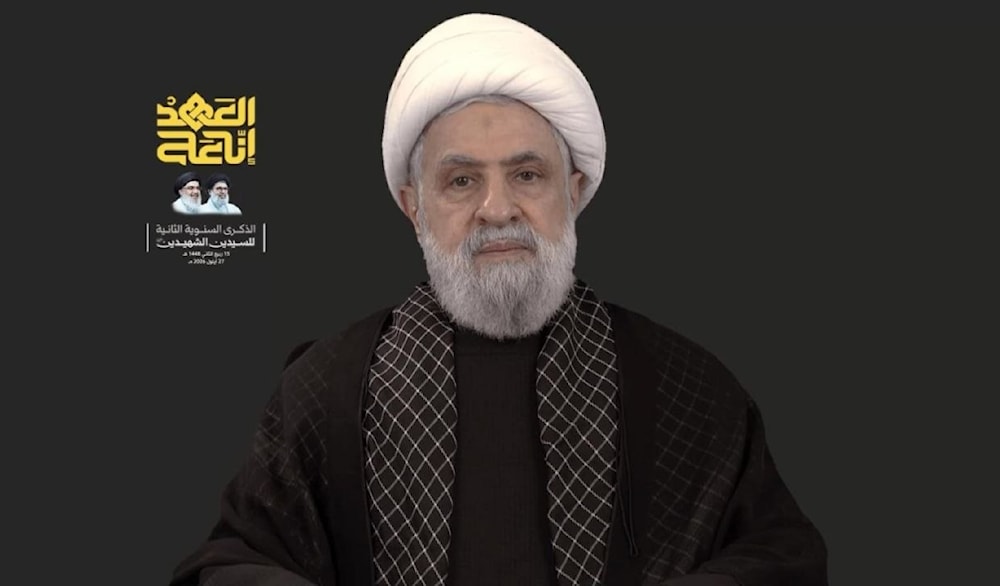
Sheikh Naim Qassem at the ceremony marking the second annual anniversary of the martyrdom of Hezbollah Secretary-Generals, Sayyed Hassan Nasrallah and Sayyed Hashem Safieddine, September 27, 2026 (Screengrab)
Hezbollah Secretary-General Sheikh Naim Qassem reaffirmed the movement’s commitment to its path of resistance, Palestine, and the liberation of occupied Lebanese territory, as he commemorated the second anniversary of the martyrdom of Sayyed Hassan Nasrallah and Sayyed Hashem Safieddine.
Speaking at a ceremony marking the occasion, Sheikh Qassem described the anniversary as “blessed by the elevated status of the martyrs” and by the continuation of their path, saying it had given Hezbollah and its supporters “resilience and enabled us to endure and remain steadfast.”
Addressing Sayyed Hassan Nasrallah, Sheikh Qassem recalled his former leader and companion on the path of Hezbollah and its resistance, saying he had “entered our hearts, filled our minds, and charted the course toward our cherished life.”
“You are the resistance, and the resistance is you,” Sheikh Qassem said, eulogizing Sayyed Nasrallah as a symbol of the resistance for “the free people of the world” and as a leader who had become an inspiration to others.
He said Sayyed Nasrallah had departed physically but left behind his teachings and “the light of your giving” that continues to provide the movement with resolve.
“We will continue along this Muhammadan-Alawi path, the path of Imam Khomeini, the path of Imam Khamenei, and the path of Imam Musa al-Sadr: the path of guardianship and jihad,” Sheikh Qassem said.
“Palestine will remain the compass,” he added, alongside the objective of liberating Lebanese land.
Sheikh Qassem honors Sayyed Safieddine and resistance commanders
Turning to Sayyed Hashem Safieddine, Sheikh Qassem said he had never rested or grown weary in serving Hezbollah’s path and had been “a pillar and an aide” to Sayyed Hassan Nasrallah.
Although Sayyed Safieddine’s departure came quickly, Sheikh Qassem said, “your steadfast steps will remain a landmark along the resistance’s path of jihad and the path of those who resist.”
He also paid tribute to commanders and figures who were martyred alongside the Ummah's martyrs.
Sheikh Qassem recalled the four aides who were martyred during the Battle of the People of Might, highlighting Sayyed Fouad Shukr, whom he hailed as one of the founders of resistance within Hezbollah and a key figure in building its formations.
He also honored Haj Ibrahim Akil, saying he had devoted his life to Resistance activity following the Israeli invasion and played a central role in establishing the Radwan Force.
Haj Abed al-Munem Karaki, Sheikh Qassem said, spent more than four decades engaged in Islamic activity and establishing the resistance’s first cells, while also assuming responsibility for Sayyed Hassan's headquarters during the campaign of solidarity launched after the Gaza war.
Sayyed Suhail Husseini, who assumed the chief-of-staff responsibility in 2008, developed the resistance’s formations and served as an educator and intellectual, Sheikh Qassem said.
He further honored martyr commander and mujahid Sheikh Nabil Qawouk, whom he described as a “true pillar” alongside Sayyed Nasrallah and said had held several responsibilities, most recently the security portfolio.
Sheikh Qassem also remembered martyr commander Abbas Nilforoushan, describing him as an aide, adviser, and commander who stood alongside the resistance.
He noted that Haj Mortada, Haj Adel Mohammad Bahsoun, and Haj Maher Shaheen were also martyred alongside Sayyed Safieddine.
A special tribute was extended to what Sheikh Qassem called the “living martyrs,” referring to those wounded in the pager attacks, whom he said had set an example, as well as to prisoners unjustly detained and to all those who stood by the martyrs and prisoners.
He also paid tribute to the 3,400 men and women who were martyred among resistance fighters and the broader population.
'We are true to the Pledge'
Sheikh Qassem said Hezbollah’s Shura Council had designated the period beginning with the People of Might Battle and continuing to the present as the “We are true to the Pledge” phase.
He explained that the designation reflected the movement’s intention to continue its path, with new leadership succeeding martyred leaders while remaining committed to their principles.
“‘We are true to the Pledge’ means remaining committed to our constants,” Sheikh Qassem said, identifying as the foremost constant “the courageous, dignified, divinely guided resistance in confronting aggression.”
He reaffirmed Hezbollah’s commitment to maintaining the resistance until the Israeli enemy withdraws from Lebanese territory and the occupied land is fully liberated.
The phrase also represented, he said, preserving the trust of the martyrs, foremost among them Sayyed Hassan Nasrallah, supporting Palestine and its liberation, working toward the complete liberation of Lebanese territory, and learning from previous stages and their lessons.
Addressing those who question the resistance’s achievements, Sheikh Qassem asked: “What has the resistance accomplished?” He then contrasted that question with another: “What has the state accomplished?”
Resistance halted Israeli objectives
Sheikh Qassem said the resistance had prevented the Israeli aggression from achieving its objectives, arguing that the scale of the Israeli military deployment had failed to break the resistance.
He said the resistance had demonstrated that formations numbering as many as 90,000 Israeli soldiers and officers could not accomplish their objectives by defeating it.
According to Sheikh Qassem, the resistance also prevented the Israeli occupation from becoming entrenched and blocked the establishment of settlements in Lebanon.
He stressed that Hezbollah had confronted “Israel” while it was backed by the United States with “unlimited capabilities.”
“Given the immense sacrifices made thus far, we can only continue. We cannot be defeated, and we will continue. Far be it from us to accept humiliation,” Sheikh Qassem said.
He said resistance fighters had halted the advance of Israeli brigades and tens of thousands of troops despite extensive bombardment and destruction involving different types of weapons.
Sheikh Qassem cited Bint Jbeil, Khiam, Aita al-Shaab, Naqoura, al-Bayyada, and Ali al-Taher among the locations where resistance fighters had held their positions, adding that resistance had been maintained across southern Lebanon.
At Ali al-Taher, he said, the steadfast defense lasted three months, while resistance at other locations continued for months.
He described the resistance’s battlefield approach as involving two elements: confronting the enemy at a given place and time to the extent possible, and preventing it from establishing a permanent foothold.
Sheikh Qassem said details concerning how the battle was managed could not be disclosed, noting that the preparations for the Battle of Al-Aqsa Flood had surprised observers.
“This means that withholding certain details is connected to the way the battle is managed,” he said.
He rejected arguments that the resistance itself was responsible for the situation, saying the central issue was aggression.
“The resistance emerged only because of aggression. Therefore, aggression is the cause, and aggression is the problem,” Sheikh Qassem said.
He warned that surrender to the Israeli enemy would mean the end of Lebanon and its model of coexistence in favor of Israeli settlements. “If some are willing to surrender, we are not,” he said, stressing that Lebanon belonged to all its people and that “not a single inch” of its 10,452 square kilometers should be relinquished.
“The foundation, pillar, and future of the country lie in southern Lebanon,” Sheikh Qassem said.
Sheikh Qassem challenges Lebanese authorities over resistance
Addressing the so-called “sovereigntists,” Sheikh Qassem rejected calls for the resistance to be blamed for Israeli aggression.
“Do not tell us to look at what the aggression has done because you are resisting it. Instead, ask yourselves: Why do you not resist it? Why do you make concessions?” he said.
He maintained that a memorandum of understanding had helped lower the level of escalation to the situation seen today.
Turning to efforts to secure exclusive state control over weapons, Sheikh Qassem questioned why Lebanese authorities were asking the Lebanese Army to disarm the resistance after spending two years attempting to do so themselves.
“The Lebanese Army is a national army, and the people of Lebanon resolve their affairs among themselves,” he said, rejecting efforts to make the army an instrument for implementing political demands.
He warned against any approach based on retaining part of Lebanon by surrendering another part of the country or its people.
“Whoever bets on retaining part of Lebanon in exchange for abandoning another part of the land or its people is deluding himself,” Sheikh Qassem said.
He also criticized the framework agreement, saying it had presented in a single session what Lebanon could discuss or offer in a manner serving the enemy’s interests.
Sheikh Qassem accused the authorities of relinquishing what he described as Lebanon’s sources of strength and accommodating the demands of the enemy, saying they were assisting an Israeli-American project rather than confronting it.
He also held the authorities responsible for the continuation of an unstable security situation resulting from attacks, saying they were placing their confidence in the United States and “Israel.”
Sttae must turn to indirect negotiations
Sheikh Qassem said the authorities had attempted direct negotiations in seven rounds but questioned their outcome, describing it as “below zero, not merely zero.”
He acknowledged that the President had the right to negotiate but said that right did not extend to violating the Constitution, the Taif Agreement, the presidential inaugural address, the ministerial statement, or Lebanon’s rights.
“Freeze direct negotiations, move to indirect negotiations, and raise your voice,” Sheikh Qassem said, adding that people would stand behind efforts to defend Lebanon’s sovereignty.
He said Hezbollah was prepared for dialogue but questioned how it could engage with those who had declared the resistance and its people to be outside the law.
“If ‘Israel’ were to withdraw from an area today or tomorrow, or announce a withdrawal plan, that would be the result of the resistance and the memorandum of understanding, not the result of negotiations,” he said.
Sheikh Qassem praised Hezbollah’s fighters, describing their performance as extraordinary and among “the most remarkable episodes of steadfastness and resistance” on the battlefield.
He said the Lebanese authorities had a responsibility to provide shelter and compensation and to undertake reconstruction and restoration following the destruction.
At the same time, Sheikh Qassem announced that Hezbollah would work to provide shelter, restoration, and reconstruction through its own capabilities and donations while urging the state to fulfill its responsibilities.
“I bring you good news: very soon, we will announce our contribution to a housing project and disclose the details related to it,” he said.
Economic crisis draws criticism
Sheikh Qassem also questioned the government’s role amid Lebanon’s deteriorating economic conditions, rising living costs, the weakening Lebanese currency, and what he described as a lack of improvement in public services.
“Where is the electricity? Where is the Foreign Ministry? Do we even have a foreign minister? And where are the depositors’ funds?” he asked.
On the issue of exclusive state control over weapons, Sheikh Qassem reiterated that Hezbollah was ready for dialogue and discussion but said the south must first be liberated and displaced residents allowed to return to their homes.
“Then we can reach an understanding among ourselves,” he said.
Turning to the international arena, Sheikh Qassem accused the United States of seeking to control the world and said there was no longer a functioning system of global justice or international law.
He pointed to the United Nations as evidence of what he described as the global rejection of “this enemy,” saying such developments would contribute to bringing it down.
Sheikh Qassem praises Iran, Yemen and Palestine
Sheikh Qassem praised Iran, hailing it as “heroic and martyred” and highlighting its sacrifices and its presentation of Leader Sayyed Ali Khamenei.
He also saluted the Yemeni people and Ansar Allah for their support for Palestine, Iran, and Lebanon.
Turning once again to Palestine, Sheikh Qassem hailed it as “the symbol and the face of the future,” praising its people as a great, sacrificing, and giving people and emphasizing their connection to the land.
Concluding his tribute to Sayyed Hassan Nasrallah, Sheikh Qassem repeated the words he had addressed to the former Hezbollah leader: “You are the resistance, and the resistance is you, and you have become its symbol for the free people of the world.”
Two years after the martyrdom of Sayyed Hassan, his legacy remains a subject of focus in “Israel.”
— Al Mayadeen English (@MayadeenEnglish) September 23, 2026
From his role as a central figure in three decades of confrontation to the equations he established, what remains of the Sayyed’s legacy, and how has the Resistance adapted in his… pic.twitter.com/A6bJcRj4cO


