
Seattle defies Trump, vows housing push before World Cup
 7 Min Read
Facing an international spotlight, Seattle is scrambling to expand shelter capacity as local officials push back against outside pressure and looming federal rollbacks.
-
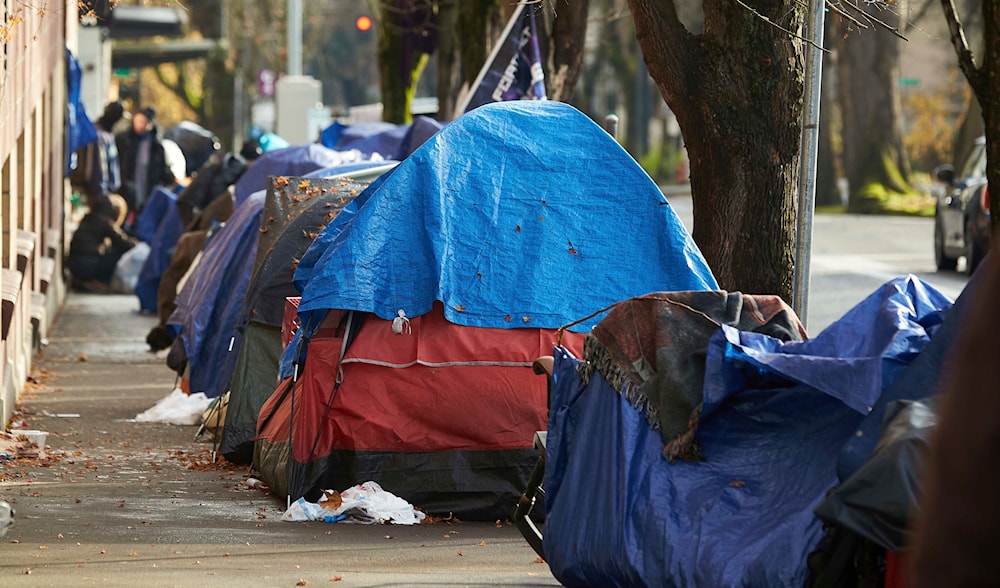
Tents line the sidewalk on SW Clay St. in downtown Portland, Ore., on December 9, 2020. (AP)
Seattle’s self-described socialist mayor has responded to US President Donald Trump’s threat to strip the city of World Cup matches with a bold counterproposal: rehousing the city’s homeless population before the first game kicks off in June, POLITICO reported.
Mayor Katie Wilson’s pledge stands out as the most ambitious effort by any US city leader to reshape local policy ahead of the World Cup, which will be staged across 16 cities in the United States, Canada, and Mexico.
Wilson says the tournament has imposed a hard deadline on efforts to move people off the streets, but not by pushing them elsewhere. "The World Cup gives us a pretty aggressive timeline for trying to bring people inside with the support that they need, as opposed to sweeping people to other neighborhoods," Wilson told POLITICO in her first interview on the issue since taking office.
“Folks who are experiencing homelessness downtown often also have complex challenges related to drug use and mental illness,” Wilson added.
Seattle expects an influx of up to 750,000 visitors during the tournament, according to the local organizing committee. The city will host six matches at Lumen Field, which sits close to a downtown area where Seattle confronts one of the nation’s largest populations of unsheltered homeless people.
A costly problem with little progress
Only weeks into her administration, Wilson remains in the early phases of a plan to clear encampments near the stadium, a challenge that has defeated previous mayors despite more than $1bn spent over the past decade.
Any progress will require navigating a bleak fiscal landscape, including looming reductions in federal funding that support existing homeless programs. Wilson also faces resistance from progressives opposed to encampment sweeps, which many homeless advocates see as ineffective and harmful.
“We do not have sustainable resources to scale up all the places for people to come inside, be it permanent or temporary locations,” said state representative Nicole Macri, a Democrat who also works for the Downtown Emergency Service Center.
“But it’s not the only thing that would hold it up,” Macri added.
A crisis years in the making
Seattle formally declared homelessness a crisis in 2015, yet the number of unhoused residents has continued to rise, from about 10,000 to nearly 17,000 between 2015 and 2024.
Former mayor Bruce Harrell, a moderate Democrat elected in 2021 amid voter frustration with crime and homelessness, focused on long-term housing while relying on pandemic-era renter programs to justify controversial encampment sweeps. Those policies failed to stem the rise in homelessness, and the expiration of American Rescue Act funding later forced the closure of hundreds of shelter beds across the region.
Wilson unseated Harrell last November after campaigning on a pledge to halt sweeps and expand housing options such as rent vouchers and tiny-home villages.
A global spotlight on local failures
The World Cup, some officials warn, will expose Seattle’s shortcomings in stark detail. “The World Cup will lay bare Seattle and King County’s long inadequacies on dealing with our homeless problem that no other event to this point will have been able to do,” said King County councilmember Reagan Dunn.
Washington state consistently ranks among the top five nationally for both per-capita homelessness and growth in its unhoused population. Federal data shows nearly half of the state’s homeless residents in 2024 were chronically homeless, the highest rate in the country.
In King County alone, almost 10,000 of the roughly 17,000 homeless residents lack any form of shelter.
Moreover, Lumen Field’s downtown location, unusual among US World Cup stadiums, has heightened concern about interactions between visiting fans and people living on the streets nearby.
Homeless advocates told POLITICO they worry unhoused residents could themselves be targeted by intoxicated spectators. Shortly after Wilson’s election, Trump said he might move World Cup matches if Seattle could not guarantee safety. Wilson dismissed the threat. “We’re going to have the World Cup here, it’s going to be great,” she said in January.
A pledge to expand shelter quickly
Even so, the tournament appears to have accelerated Wilson’s approach. Her administration plans to add 500 shelter units, including tiny homes, RVs, and apartments, before the first match on 15 June. That would mark a dramatic increase compared with the 13 units added over the past four years, but it would still house only a fraction of the city’s unsheltered population.
An executive order has also tasked city agencies with finding faster ways to expand shelter capacity, with recommendations due in March.
Wilson’s language has subtly shifted since the campaign. Last summer, she told The Stranger: “Let’s get people inside in time for the World Cup.” More recently, a spokesperson clarified the goal as housing “as many as possible,” not everyone.
Her early decisions reflect an administration still refining its strategy. She delayed the closure of one encampment in Ballard, but later approved the removal of another near the University of Washington, which will serve as a World Cup training site.
Debate continues over the use of temporary group shelters. Moderates often see them as a fast solution, while critics warn that they are inadequate and unsafe. Dunn suggested repurposing large tents originally used during the COVID pandemic for emergency shelters and food services.
Progressive pushback
Progressive leaders have been quick to challenge forced removals or reliance on group shelters.
City councilmember Alexis Mercedes Rinck argued that persuading people to leave familiar areas for shared shelters would be difficult. Advocates point to research showing that private, stable housing produces better long-term outcomes than congregate facilities, particularly for women.
Complicating matters are recent funding cuts and reversals by the Trump administration. Key federal grants that support transitional housing and mental health services now face uncertainty.
After the White House announced potential reductions in November, Washington joined a 21-state lawsuit challenging the move. A judge temporarily halted the cuts in December, with a hearing scheduled for February.
If funding reductions proceed, Macri estimates another 4,500 people could lose housing in Seattle. Additional uncertainty has come from abrupt reversals involving nearly $2bn in federal mental health grants.
“When money is cut for core social services, it really hurts,” Dunn said, adding: “It would be helpful if the federal government stayed the course on those funding streams. That would certainly help me do my job better."
Despite deep disagreements over policy, local officials share one view: they do not want federal intervention. “Nobody here, Republican or Democrat, wants the Trump administration coming in here with any federal presence to try and solve this problem,” Dunn said.
“We all want to solve it locally,” he stressed.
Read next: Voices grow in Europe to boycott Trump World Cup: WP


