
Six countries condemn US aggression on Venezuela
 4 Min Read
Brazil, Chile, Colombia, Mexico, Spain, and Uruguay condemn unilateral military action in Venezuela, warning it threatens regional peace and international law.
-
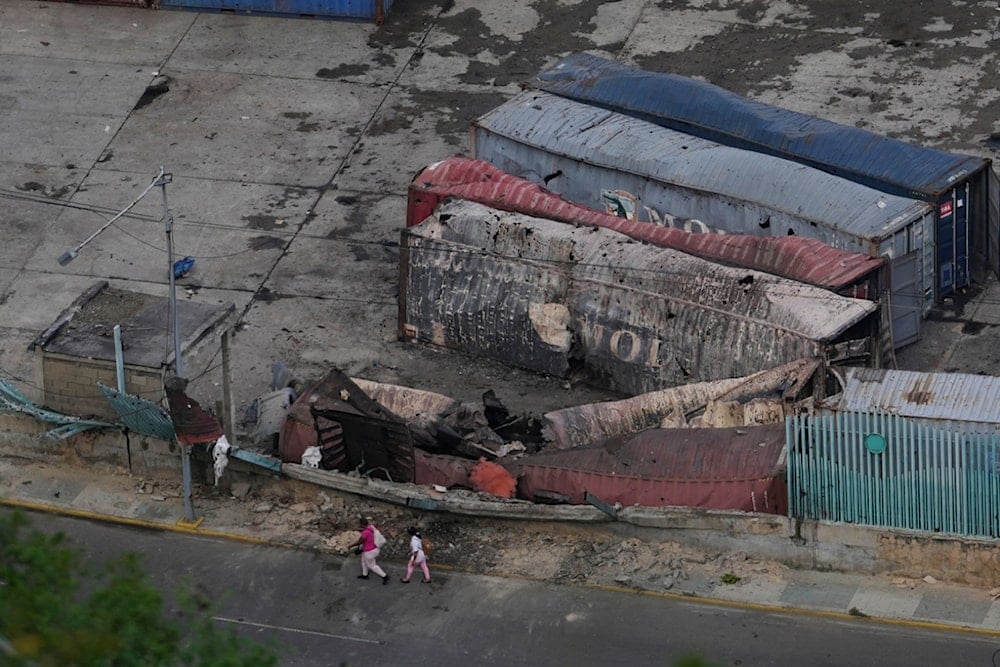
Pedestrians walk past destroyed containers at La Guaira port after explosions were heard in Venezuela, Saturday, January 3, 2026 (AP)
Brazil, Chile, Colombia, Mexico, Spain, and Uruguay issued a joint statement expressing deep concern and rejection of unilateral military actions carried out in Venezuelan territory, saying the move violates core principles of international law.
The statement said the actions contravene fundamental norms governing state sovereignty and non-interference, warning that such conduct sets “an extremely dangerous precedent” for regional peace and security as well as for the rules-based international order.
The six governments said the military operation also endangers the civilian population, stressing that its consequences extend beyond Venezuela and risk destabilising the wider region.
They cautioned that normalising unilateral military interventions undermines international legal frameworks designed to prevent conflict and protect civilians.
Call for a peaceful, Venezuelan-led solution
Reiterating their shared position, the signatories said the situation in Venezuela must be resolved exclusively through peaceful means, including dialogue and negotiation, and with full respect for the will of the Venezuelan people “in all its expressions”.
The statement underscored that any resolution must take place without external interference and in accordance with international law.
The joint position brings together governments from Latin America and Europe, including Brazil, Chile, Colombia, Mexico, Spain, and Uruguay, reflecting widening international unease over the escalation in Venezuela.
Rodriguez ordered to lead Venezuela
Venezuela’s Supreme Court on Saturday ordered Executive Vice President Delcy Rodríguez to assume and exercise, in an acting capacity, all powers and duties of the presidency to ensure administrative continuity and the comprehensive defense of the nation.
The ruling was issued by the Constitutional Chamber of the Supreme Tribunal of Justice following what the court described as a foreign military attack on January 3, 2026, which it said resulted in the abduction of Venezuela’s constitutional president, Nicolás Maduro.
Reading the decision, Constitutional Chamber president Tania D’Amelio Cardiet outlined the legal and factual grounds behind the ruling, stating that the president’s forced absence constituted a situation of material and temporary impossibility to carry out his constitutional duties.
She said the court was compelled to act in light of what it described as an exceptional and unprecedented scenario not explicitly foreseen in the Venezuelan constitution, one that posed a direct threat to state stability, national security, and the effective functioning of the legal order.
Interpretation of constitutional provisions
D’Amelio said the chamber exercised its interpretative authority under Article 335 of the Constitution to conduct a systematic and teleological interpretation of Articles 234 and 239, in order to determine the appropriate legal framework to safeguard state continuity and national defense.
According to the ruling, Article 234 broadly contemplates situations of presidential impossibility, while Article 239 assigns the executive vice president the responsibility of assuming presidential functions in cases of temporary absence.
The court emphasized that its decision was adopted as an urgent, precautionary, and preventive measure aimed at ensuring the uninterrupted operation of the executive branch amid what it described as a “manifest state of urgency” and a “certain threat” stemming from foreign aggression.
Army backs Rodriguez
Venezuela’s armed forces said they fully support a Supreme Court decision ordering Executive Vice President Delcy Rodríguez to assume, in an acting capacity, all presidential powers, duties, and responsibilities, according to a statement issued on Saturday.
The communiqué from the Bolivarian National Armed Forces said the move follows a January 3, 2026, ruling by the Constitutional Chamber of the Supreme Tribunal of Justice, which cited the need to guarantee continuity of government and national defense.
The statement opened by condemning what it described as the “cowardly abduction” of Venezuela’s constitutional president, Nicolás Maduro, and first lady Cilia Flores, alleging that members of Maduro’s security detail, soldiers, and civilians were killed during the operation.


