
Venezuela Supreme Court names Delcy Rodríguez acting president
 3 Min Read
Venezuela’s Supreme Court orders Vice President Delcy Rodríguez to assume presidential powers following Nicolás Maduro’s forced absence after a US attack.
-
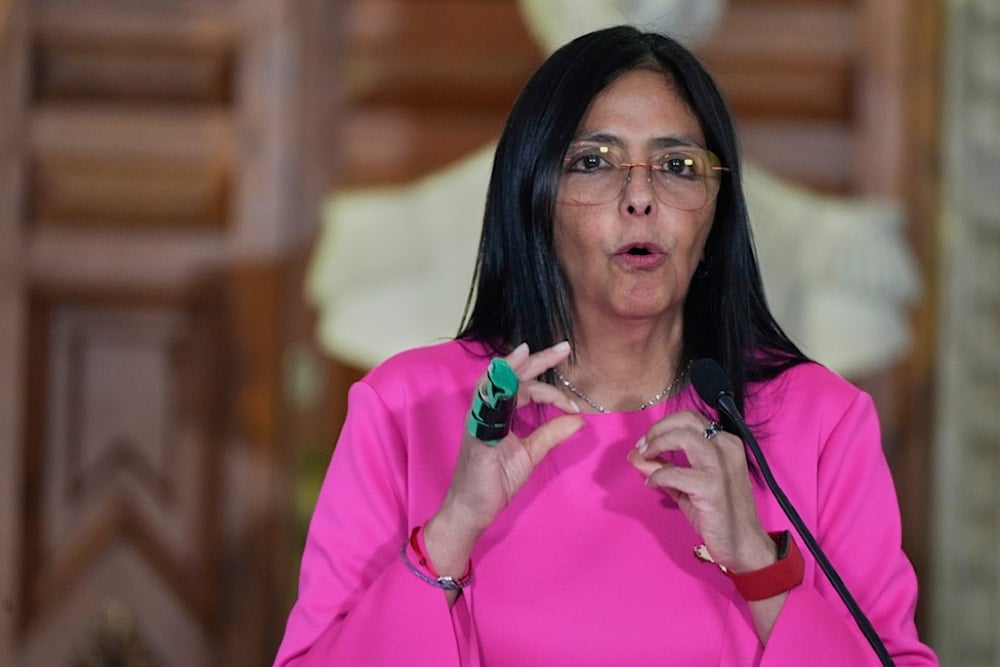
Venezuelan Vice President Delcy Rodriguez speaks to the press at the Foreign Office in Caracas, Venezuela, Monday, August 11, 2025 (AP)
Venezuela’s Supreme Court on Saturday ordered Executive Vice President Delcy Rodríguez to assume and exercise, in an acting capacity, all powers and duties of the presidency to ensure administrative continuity and the comprehensive defense of the nation.
The ruling was issued by the Constitutional Chamber of the Supreme Tribunal of Justice following what the court described as a foreign military attack on January 3, 2026, which it said resulted in the abduction of Venezuela’s constitutional president, Nicolás Maduro.
Reading the decision, Constitutional Chamber president Tania D’Amelio Cardiet outlined the legal and factual grounds behind the ruling, stating that the president’s forced absence constituted a situation of material and temporary impossibility to carry out his constitutional duties.
She said the court was compelled to act in light of what it described as an exceptional and unprecedented scenario not explicitly foreseen in the Venezuelan constitution, one that posed a direct threat to state stability, national security, and the effective functioning of the legal order.
Interpretation of constitutional provisions
D’Amelio said the chamber exercised its interpretative authority under Article 335 of the Constitution to conduct a systematic and teleological interpretation of Articles 234 and 239, in order to determine the appropriate legal framework to safeguard state continuity and national defense.
According to the ruling, Article 234 broadly contemplates situations of presidential impossibility, while Article 239 assigns the executive vice president the responsibility of assuming presidential functions in cases of temporary absence.
The court emphasized that its decision was adopted as an urgent, precautionary, and preventive measure aimed at ensuring the uninterrupted operation of the executive branch amid what it described as a “manifest state of urgency” and a “certain threat” stemming from foreign aggression.
Emergency and precautionary measure
D’Amelio stressed that the ruling does not constitute a definitive legal determination regarding whether the president’s absence should be classified as temporary or absolute, nor does it replace the authority of other state institutions to make such a determination through subsequent procedures.
The decision, signed by the president, vice president, justices, and secretary of the Constitutional Chamber, states that the immediate assumption of presidential duties by the executive vice president is “imperative, necessary, and proportionate” under current conditions.
The court said the move is intended to preserve the constitutional order and protect national interests as Venezuela confronts what it described as an ongoing external military threat.
No president other than Maduro
Earlier, Rodriguez headed an emergency National Defense Council session, where she reaffirmed Maduro as Venezuela’s sole legitimate president. She also announced the activation of the Citizen Security Agency and the country’s “national power” to defend Venezuela’s independence, sovereignty, and territorial integrity, which she said had come under direct attack.
“There is only one president here, and his name is Nicolás Maduro,” Rodríguez said, as she chaired the emergency meeting alongside senior government and military officials.
Rodriguez recalled that the Venezuelan government had repeatedly warned of an impending attack carried out under “false excuses", stressing that the true objective of the operation was “regime change in Venezuela” aimed at allowing the United States to “capture our energy, mineral, and natural resources.”
She urged the international community to recognize what she described as the real motivations behind the assault.


