
Source to Al Mayadeen: Lebanese Army not subject to foreign evaluation
 3 Min Read
A Lebanese army source rejected Israeli statements about internal divisions, stressing loyalty of all soldiers to the institution and the nation.
-
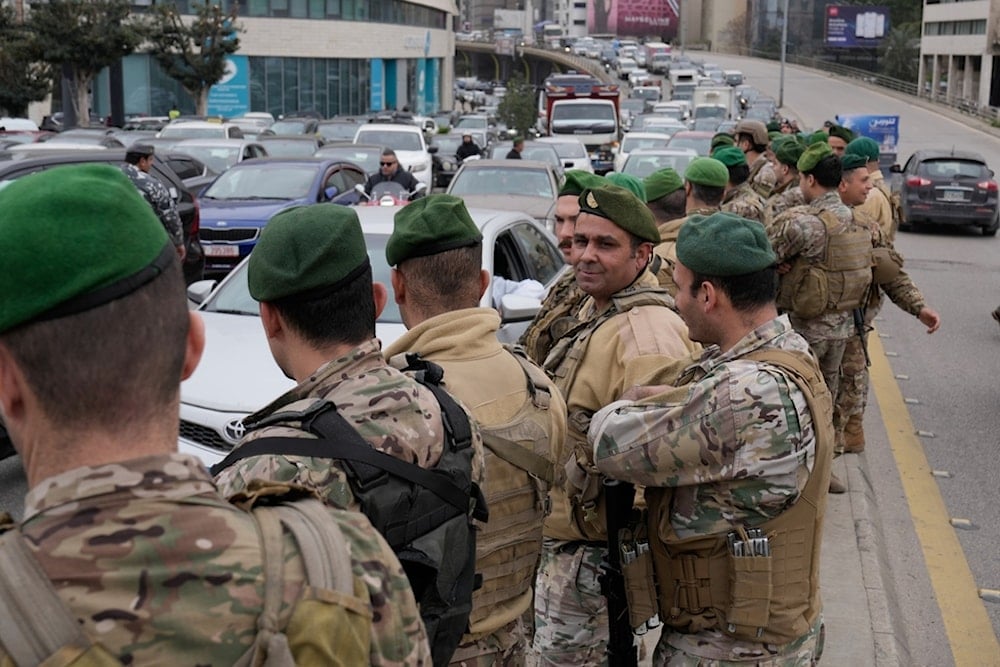
Lebanese army soldiers deploy after taxi drivers block a main highway with their cars, in Beirut, Lebanon, Tuesday, Feb. 17, 2026. (AP Photo/Hussein Malla)
A Lebanese military source has rejected reports circulating about alleged foreign assessments of the Lebanese Armed Forces, stressing that the army does not operate under evaluation by any external party.
Speaking to Al Mayadeen, the military source said that claims attributed to Israeli officials suggesting a so-called “purge of the army from non-loyal elements” are entirely false and condemned them as baseless.
The source added that all members of the Lebanese Armed Forces are loyal to the institution and to the country as a whole, and expressed pride in their commitment to every part of Lebanese territory.
Additionally, Lebanese President Joseph Aoun said Lebanon is preparing for the withdrawal of UNIFIL from southern Lebanon starting in 2027 and is seeking to prevent a security vacuum in the area.
He stressed continued efforts to strengthen the Lebanese Army with British support, as Beirut plans for a post-UNIFIL security arrangement in the South, including expanded state deployment along the border with “Israel.”
Aoun also referred to ongoing US-mediated discussions on southern security, noting proposals for phased arrangements involving Israeli withdrawal and Lebanese Army deployment, while stating that full withdrawal by “Israel” remains unresolved due to its refusal to commit to leaving all occupied areas.
He reaffirmed Lebanon’s goal of restoring state authority across southern Lebanon and stabilizing the border region.
Netanyahu threats, Washington deal deepen Lebanon tensions
Israeli Prime Minister Benjamin Netanyahu recently threatened the possibility of a renewed invasion of Lebanon, saying during remarks on regional developments that such a move could occur “if necessary.”
Netanyahu said that the recent agreement signed in Washington involving Lebanon as a “historic accomplishment” for “Israel,” claiming it would contribute to ending hostilities. At the same time, he stated that Israeli forces would continue operating in parts of Lebanese territory, including “free operations,” a reference widely interpreted as ongoing military activity.
He further alleged that the United States and Lebanon had agreed to an Israeli military presence on Lebanese territory and referred to the establishment of security zones intended, according to his claims, to test “Hezbollah’s disarmament.” He also said a buffer zone would remain under Israeli control with Washington’s approval.
While suggesting that Lebanon’s government is moving toward peace with “Israel,” Netanyahu simultaneously warned that Israeli forces could enter Lebanon again, stating: “If it becomes necessary for us to enter Lebanon, we will do so.”
He framed the arrangement as a strategic gain for “Israel” and a setback for Iran, while thanking the Lebanese government for its “courage.”
Israeli officials also spoke about planned withdrawals from areas like Zawtar al-Gharbiya and Froun, though reports indicate there has been no confirmed Israeli deployment in those locations.
Protests in Lebanon over US-backed framework
The announcement of the framework agreement triggered public backlash in Lebanon, where protests erupted in Beirut and other areas in rejection of the US-sponsored framework involving direct engagement with the Israeli occupation.
Roads were blocked in several districts, including Salim Salam, where tires were burned, while additional demonstrations were reported in Ramlet al-Bayda, Msharafiyeh, and Beirut’s southern suburbs.
Sit-ins continued across multiple locations, with participants calling for the cancellation of the agreement and warning against political normalization steps with “Israel.”


