
Efforts underway to preserve int'l presence in South, Aoun says
 4 Min Read
The Lebanese president urges continued British support for the Lebanese Army and efforts to preserve an international presence in southern Lebanon as UNIFIL withdrawal nears.
-
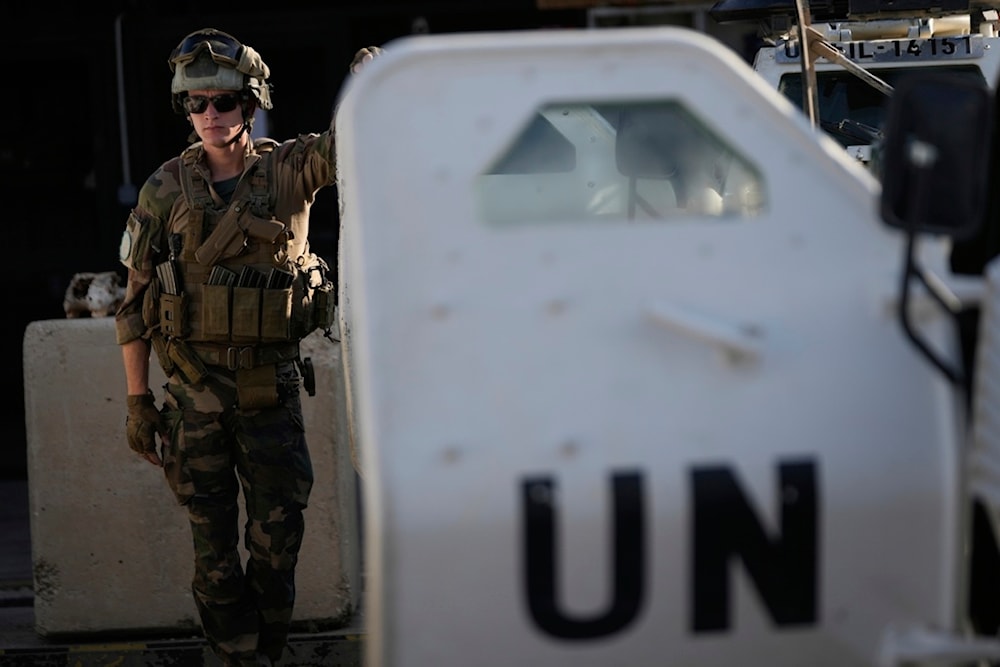
A French UN peacekeeper stands beside an armored vehicle at his base, waiting to move with his unit for a patrol along the Lebanese-Palestinian border in Deir Kifa, southern Lebanon, Wednesday, Aug. 20, 2025 (AP)
Lebanese President Joseph Aoun said Wednesday that Lebanon is seeking to maintain an international presence in the South once UNIFIL begins its withdrawal in early 2027, while calling for continued British support for the Lebanese Army as Beirut works to restore stability along its southern border.
Aoun made the remarks during a meeting with a British parliamentary delegation at Baabda Palace, attended by British Ambassador to Lebanon Hamish Cowell. He said Lebanon values British support in several fields, particularly assistance aimed at strengthening the army's capabilities.
Aoun seeks continued UK support for Lebanese Army
The president pointed to Britain's role in supporting the Lebanese Army through the construction of observation towers, training programs, and military capacity-building. He said such assistance remains essential as Lebanon prepares for a new security phase in the South, where UNIFIL's mandate is set to end on December 31, 2026, followed by an orderly drawdown and withdrawal throughout 2027.
The planned UNIFIL withdrawal has increased pressure on Beirut to secure an alternative framework that would prevent a security vacuum and allow the Lebanese state to extend its authority up to the internationally recognized southern border. UNIFIL has operated in southern Lebanon since 1978 and was tasked, under UN Security Council Resolution 1701, with monitoring the cessation of hostilities and supporting the Lebanese Army's deployment in the area.
Beirut prepares for post-UNIFIL phase
Aoun said efforts are underway to consolidate the ceasefire in southern Lebanon. He added that this process should be followed by the withdrawal of Israeli forces from the areas they continue to occupy, the deployment of the Lebanese Army, the return of residents to their towns and villages, the release of detainees, and the launch of reconstruction.
His remarks come as Lebanon and "Israel" continue US-mediated talks in Washington over proposed security arrangements in the south. Among the proposals under discussion are so-called "trial zones", where Israeli withdrawal would be followed by Lebanese Army deployment. Aoun said the designation of these zones remains under discussion and is still awaiting Israeli approval.
Washington talks focus on Southern security arrangements
The Washington track remains complicated by "Israel's" refusal to commit to a full withdrawal. Israeli officials have said their forces would remain in southern Lebanon as long as they deem necessary, while reports said "Israel" is seeking to maintain a "buffer zone" and impose conditions on the Lebanese Army units that would deploy in areas handed back to state control.
For Beirut, the central demand remains the restoration of Lebanese sovereignty over the South. Aoun said the ongoing Lebanese-US-Israeli negotiations are focused on the security measures needed to restore stability and extend state authority to the southern border.
He also clarified that the Washington talks are separate from the meetings held in Switzerland last week between the United States and Iran, which took place under Qatari and Pakistani sponsorship and follow-up. The Switzerland track has been linked to broader efforts to de-escalate the region, including mechanisms to support the halt in hostilities in Lebanon.
Lebanon-Syria coordination continues
Turning to Lebanese-Syrian relations, Aoun said coordination between Beirut and Damascus is ongoing. He added that recent positions expressed by Syrian President Ahmad al-Sharaa were positively received and helped put an end to repeated claims about a possible Syrian military role in Lebanon.
Read more: US may pressure Israeli withdrawal from South Lebanon: Israeli media


