
South Korea, Iran discuss Hormuz maritime security, sailors stranded
 3 Min Read
South Korean special envoy Chung Byung-ha has met with Iranian Foreign Minister Abbas Araghchi in Tehran to discuss maritime security in the Strait of Hormuz, where 26 South Korean vessels and approximately 173 Korean sailors remain trapped amid the ongoing US-Israeli war on Iran.
-
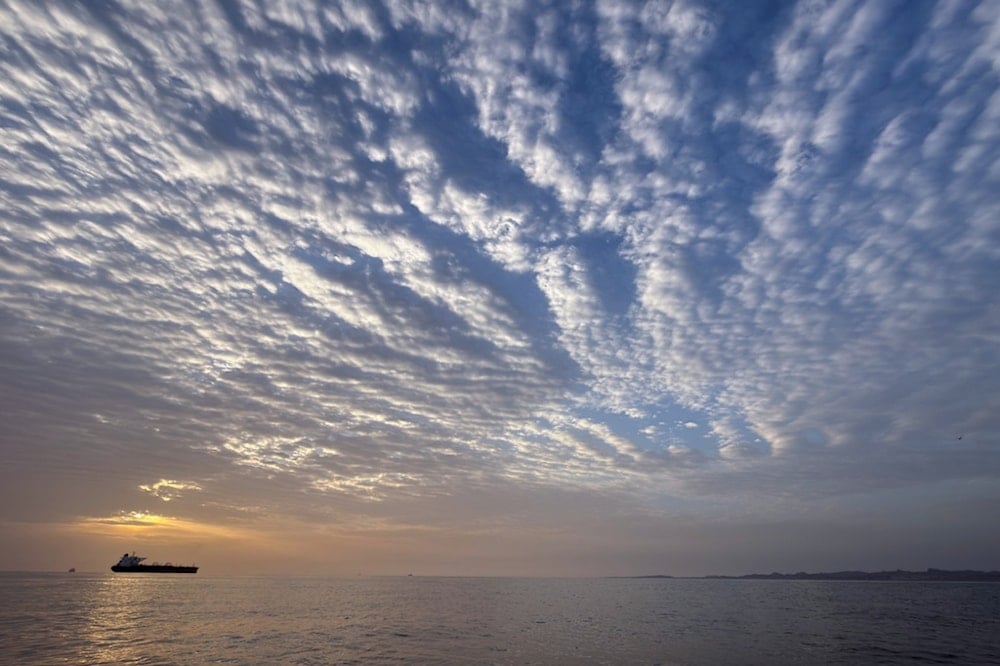
The sun rises behind a tanker anchored in the Strait of Hormuz off the coast of Qeshm Island, Iran, Saturday, April 18, 2026. (AP)
South Korean special envoy for Iran Chung Byung-ha held a meeting with Iranian Foreign Minister Abbas Araghchi in Tehran as part of Seoul's efforts to ensure the safety of its vessels and sailors in the Strait of Hormuz, the South Korean Foreign Ministry said on Thursday.
"Chung Byung-ha called on the Iranian side to continue to pay attention to ensuring the safety of about 40 citizens of the Republic of Korea remaining in Iran, as well as 26 South Korean vessels and their crews," the ministry said in a statement.
The envoy also expressed hope that diplomatic efforts would lead to a definitive end to the war and ensure peace and stability in the region, the ministry added.
Seoul stresses importance of bilateral ties
Chung emphasized the importance of developing relations between Seoul and Tehran, recalled the provision of $500,000 in humanitarian aid to Iran through the International Committee of the Red Cross, and expressed hope for further development of ties between the two countries, according to the statement.
Araghchi, for his part, expressed Iran's readiness to cooperate in this direction and highly appreciated the decision to send a special envoy in the difficult situation Tehran finds itself in, as well as the continuous work of the South Korean embassy in Iran, the South Korean Foreign Ministry said.
He also expressed hope for the stable development of bilateral relations, the statement added. "He assured that he would continue to pay attention to ensuring the safety of South Korean citizens in Iran," the ministry said.
Araghchi defends Iran's Hormuz blockade
Araghchi also commented on Iran's blockade of the Strait of Hormuz, noting that it is aimed at protecting national security and interests, and that responsibility for any resulting consequences lies with the parties committing aggression, referring to the United States and "Israel."
As many as 173 Korean sailors currently remain stuck in the strait on 26 South Korea-affiliated vessels, the Yonhap news agency reported.
Earlier in April, Iranian Parliament Speaker Mohammad Bagher Ghalibaf said that Iran would not open the Strait of Hormuz as long as the US violates the ceasefire, including through its naval blockade.
International shipping crisis leaves thousands trapped
The head of the United Nations' maritime agency has issued an urgent appeal on behalf of roughly 20,000 sailors and 2,000 ships that remain trapped in Gulf ports and anchorages due to the strait's closure.
Over the weekend, Iranian officials acknowledged receiving new written proposals from Washington but indicated that substantial disagreements continue to separate the two sides. Pakistan has attempted to facilitate dialogue between the adversaries, yet a luxury hotel in Islamabad that had been prepared for another round of negotiations stood empty throughout Wednesday. Tehran never formally accepted the invitation to attend, and the American delegation led by Vice President JD Vance never departed from Washington.
A Pakistani official briefed on the preparations told Reuters: "We had prepared everything. We were all prepared for the talks, the stage was set. If you ask me honestly, it was a setback we were not expecting, because the Iranians never refused, they were up to come and join and they still are."
Read More: Iran reopening strait 'impossible' amid US-Israeli ceasefire breaches


