
South Korea joins France-led talks on Hormuz Strait intervention
 3 Min Read
South Korea will join a France-led military meeting regarding military intervention in the Strait of Hormuz, as Seoul expands fuel tax cuts amid rising oil prices.
-
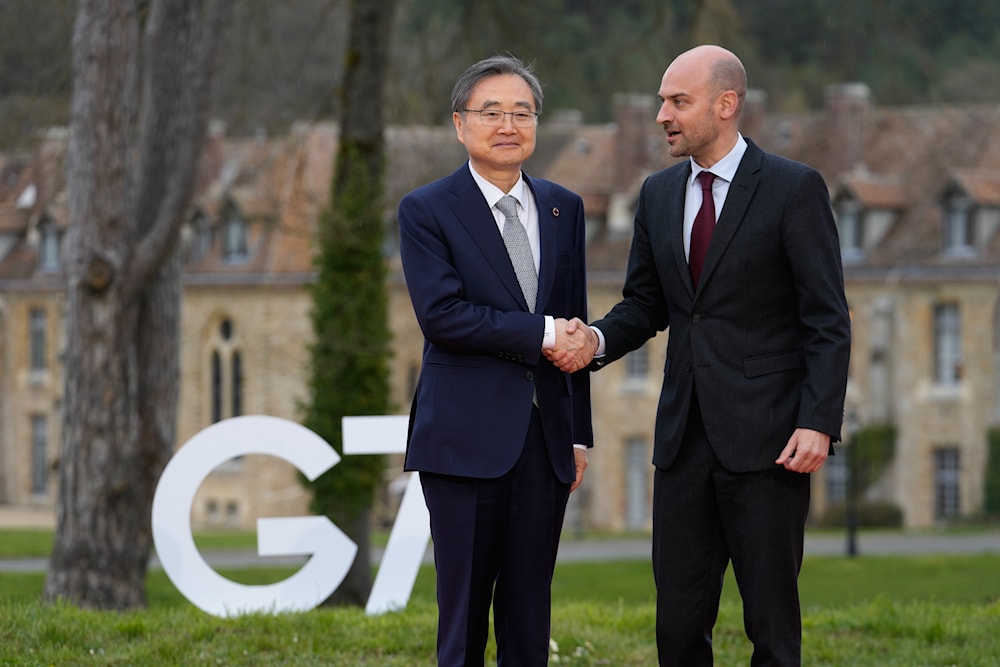
France's Foreign Affairs Minister Jean-Noel Barrot, right, greets South Korea's Foreign Minister Cho Hyun as he arrives at the G7 Foreign Ministers' meeting with partner countries in Cernay-la-Ville outside Paris, France, March 26, 2026 (AP)
South Korea has accepted France’s invitation to participate in an upcoming international military meeting focused on military intervention in the Strait of Hormuz, Yonhap News Agency reported Thursday, citing the South Korean military.
The meeting, announced Wednesday by Reuters, will be led by Gen. Fabien Mandon, chief of the French Armed Forces’ General Staff, who plans to hold a video conference with military leaders from countries aiming to intervene militarily in the strategic waterway. South Korea will be represented by Joint Chiefs of Staff Chairman Jin Young-seung.
Separately, South Korean authorities will further reduce fuel taxes starting Friday in response to price increases caused by the Middle East conflict and the effective halt of shipping through the strait. Current gasoline and diesel tax cuts of 7% and 10% will rise to 15% and 25%, respectively.
While the new rates officially take effect on April 1, they will be applied retroactively from the Friday following government adjustments to retail fuel prices.
The Ministry of Economy and Finance said the measures will be extended from late April to late May. Minister Koo Yoon-chul highlighted that diesel prices typically rise faster than gasoline due to its critical role in industry, transportation, and daily life. Authorities may consider further tax reductions if global fuel prices continue to climb, with South Korean law allowing cuts of up to 37%.
Iran sets conditions for reopening Strait of Hormuz
While the allies of the US are busy scrambling to find ways to open the critical shipping passage, Iran has already set its conditions to reopen the Strait.
On March 25, Iran sent a letter to members of the International Maritime Organization detailing the procedures vessels must follow to pass through the Strait of Hormuz, the Financial Times reported, citing a communication from Iran’s Foreign Ministry.
The letter states that only “non-hostile vessels” will be allowed to transit the strait, and solely “in coordination with Iranian authorities.” The ministry emphasized that Tehran has taken “necessary and proportionate measures to prevent aggressors and their supporters from exploiting the Strait of Hormuz to advance hostile operations.”
The ministry further clarified that vessels affiliated with the United States, "Israel," or “other participants in the aggression” would not be granted the right to “innocent or non-hostile passage.”
The Strait of Hormuz remains a critical maritime corridor, and Iran’s measures signal tighter regulation of vessel movement amid escalating tensions caused by the US-"Israel" aggression on Iran.
Recent developments indicate that the US-Israeli war on Iran has already significantly disrupted commercial shipping through the Strait, with activity falling sharply as major carriers suspend or reroute traffic over security concerns. This disruption has contributed to delays and strain on global energy and freight flows.
Shipping firms have been reported to avoid transits or seek alternate routes, while several vessels are reportedly idle or turning back due to heightened risk and lack of secure passage.
The resulting bottleneck has also pushed up freight costs and insurance premiums, as underwriters classify the waters around the strait as high‑risk, further deterring commercial movement and adding to logistical challenges for global supply chains.


