
South Korea to participate in Cobra Gold 2026 military exercise
 3 Min Read
South Korea will deploy 390 personnel and naval assets to Thailand for Cobra Gold 2026, the largest US-led military exercise outside US territory.
-
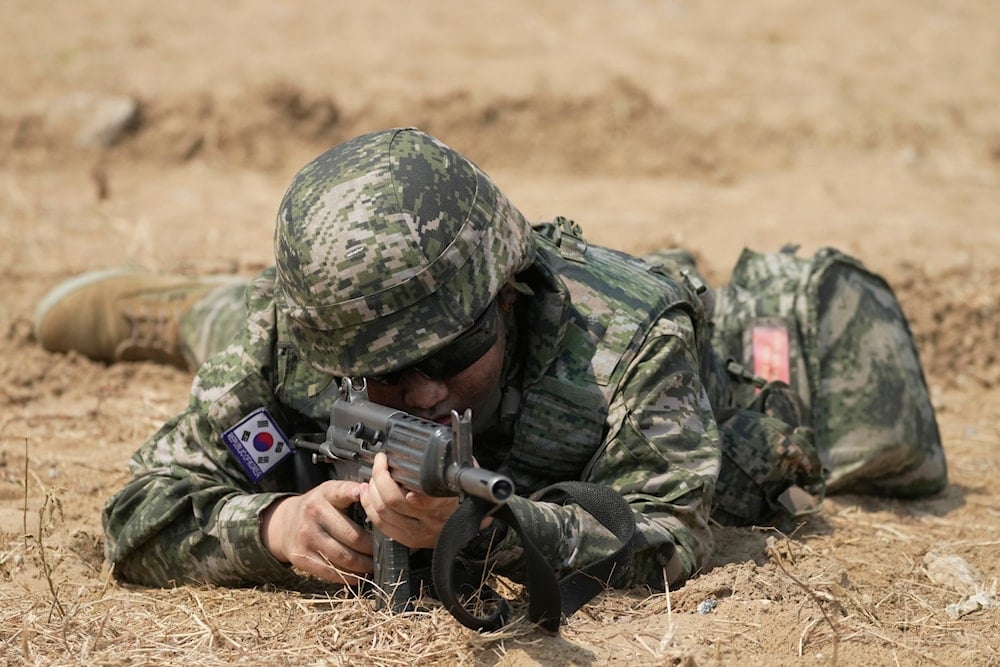
A South Korean soldier aims his gun during the ongoing Cobra Gold joint military exercise on Hat Yao beach in Chonburi province, eastern Thailand, Friday, March 1, 2024 (AP)
South Korea’s navy and marine corps will participate in the annual multilateral Cobra Gold military exercise in Thailand, scheduled from February 23 to March 6, Yonhap News Agency reported Thursday, citing Korean military officials.
Seoul plans to send 390 personnel, along with the Nojeokbong landing ship, five tracked amphibious assault vehicles, two self-propelled howitzers, and a Chunho self-propelled anti-aircraft gun.
Korean forces are expected to take part in amphibious landings, special operations, combined space and cyber drills, as well as humanitarian assistance and disaster relief exercises. Field maneuvers will include joint beach landings, maritime operations, search and rescue missions, and live-fire exercises.
The Cobra Gold drills, launched in 1982 as joint exercises between the United States and Thailand, are the largest US military exercise held outside its own territory. From the mid-1990s, the exercises expanded to include several Asia-Pacific countries, with Russia participating as an observer multiple times in the late 1990s and early 2000s.
This year, the exercise is expected to feature additional participants, including Japan, Singapore, Indonesia, and Malaysia, highlighting the continued regional collaboration and strategic importance of the drills.
US, South Korea alliance intensifies instability
Recent military exercises between the United States and South Korea have drawn criticism for further militarizing an already volatile region. On March 4, 2025, the allies launched the annual Freedom Shield drills, a large-scale exercise that Pyongyang and Beijing view as a direct provocation rather than a defensive measure.
Throughout March 2025, thousands of troops, advanced fighter jets and armored units were deployed near the Demilitarized Zone, accompanied by live-fire training. Critics argue that such displays of force heighten mistrust and risk triggering retaliatory actions from North Korea.
On March 18, 2025, the Democratic People's Republic of Korea condemned the drills as rehearsals for invasion, warning of “serious consequences.” The pattern of exercises followed by missile launches has reinforced a dangerous cycle of action and reaction on the Korean Peninsula.
The timing also coincides with rising tensions across the Asia-Pacific, particularly over Taiwan and contested waters in the South China Sea. China has repeatedly criticized expanded US military coordination with regional allies, describing it as part of a containment strategy.
On September 10, 2025, the United States, South Korea, and Japan conducted the trilateral Freedom Edge exercise near Jeju Island, further institutionalizing military alignment. Observers say the growing trilateral framework signals the consolidation of opposing blocs in Northeast Asia.
China responded by expressing strong opposition to the drills, warning that such trilateral military cooperation undermines regional stability. In a statement issued on September 12, 2025, China’s Foreign Ministry criticized what it described as “exclusive groupings” and urged the parties involved to avoid actions that could intensify confrontation and strategic rivalry in the Asia-Pacific.


