
Starmer defeat as Greens win Gorton and Denton by election
 4 Min Read
UK Prime Minister Keir Starmer faces mounting pressure after Labour lost the Gorton and Denton by-election to the Green Party, marking a historic upset in a long-held Manchester stronghold.
-
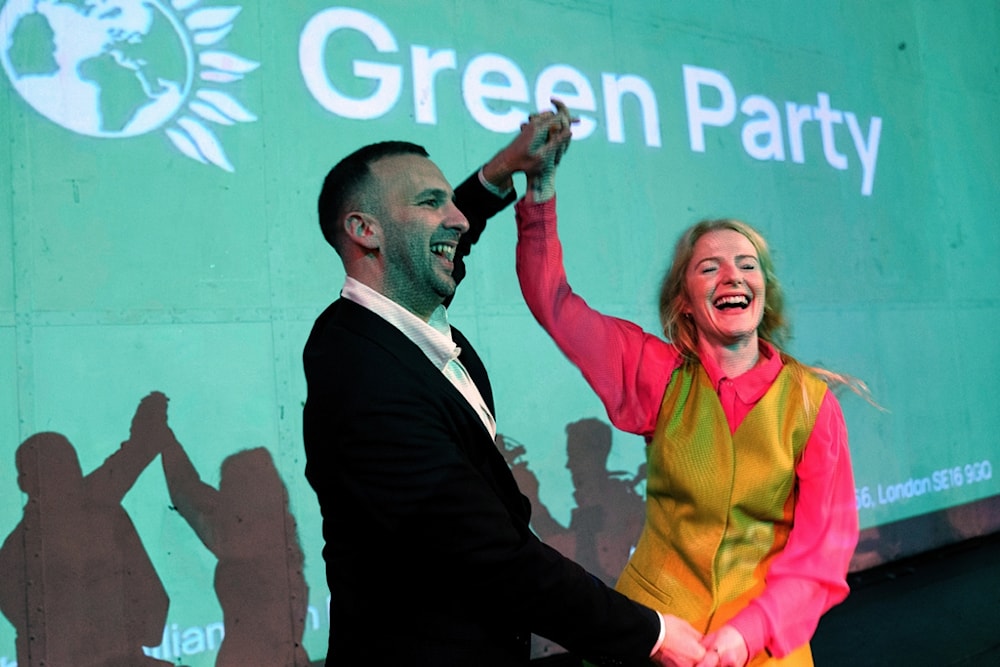
Green Party candidate Hannah Spencer, right, celebrates with party leader Zack Polanski at a volunteer thank you event after winning the Gorton and Denton by-election, Manchester, England, Friday, Feb. 27, 2026. (AP)
Prime Minister Keir Starmer is facing mounting pressure following a significant by-election defeat in Manchester, where the Green Party of England and Wales captured a seat long held by Labour, Reuters reports.
Hannah Spencer won the parliamentary by-election in Gorton and Denton, marking the first time the Greens have secured a one-off parliamentary by-election and their first such victory in the north of England. Analysts describe the result as indicative of as a broader fragmentation of British politics.
The Green Party secured 40.7% of the vote. Reform UK came second with 28.7%, while the governing Labour Party was pushed into third place with 25.4%.
Labour pushed into third place in former stronghold
The constituency, located in Manchester, had been considered one of Labour’s safest seats. The party won just over half the vote there in the 2024 general election. Historically, the area formed part of Labour’s so-called “Red Wall,” industrial constituencies once regarded as electorally secure.
The by-election was triggered by the resignation of Andrew Gwynne for health reasons.
Labour Party chair Anna Turley described the result as “clearly disappointing.”
John Curtice, one of Britain’s leading pollsters, called the outcome a “seismic moment,” stating that the “future of British politics looks more uncertain than at any stage” since the end of World War Two.
Reform UK gains ground in fragmented political landscape
The by-election result highlights increasing volatility among British voters. Five parties, including the Greens, Reform and the Liberal Democrats, are currently polling in double digits nationally, challenging the Labour-Conservative dominance that defined much of the past century.
Reform UK, led by Nigel Farage, has been leading in national opinion polls for more than a year despite holding only a handful of parliamentary seats.
However, Friday’s result suggests Reform may face obstacles in ethnically diverse urban constituencies. Reform candidate Matt Goodwin drew criticism over past comments in which he said millions of British Muslims “are fundamentally opposed to British values and ways of life.”
Farage described the by-election outcome as a “victory for sectarian voting and cheating,” referencing debates in the constituency where some Muslim voters have called for greater support for Palestinians in Gaza.
Pressure mounts on Starmer ahead of May elections
The Keir Starmer by-election defeat represents the most serious electoral setback for the prime minister in almost a year and increases pressure ahead of May’s local and regional elections, including contests in Wales and Scotland.
Starmer had personally invested political capital in the race. He blocked Manchester Mayor Andy Burnham from standing and visited the constituency during the campaign — a move British leaders typically avoid if defeat appears likely.
The loss follows a turbulent month for the prime minister. Some Labour lawmakers recently called for his resignation after his decision to appoint Labour veteran Peter Mandelson as ambassador to Washington, despite Mandelson’s past links to the late sex offender Jeffrey Epstein.
While Labour lawmakers indicated before the vote that Starmer was unlikely to face an immediate leadership challenge, some suggested his position could come under renewed scrutiny if the party performs poorly in May.
British politics faces deepening realignment
Although governing parties often lose by-elections, the scale of Labour’s defeat to the left-leaning Greens points to a broader political realignment.
The Green Party now holds five seats in the 650-member House of Commons. National polling trends suggest that both right- and left-wing insurgent parties are capitalizing on declining voter loyalty and dissatisfaction with mainstream political forces.
The UK by-election 2026 results in Gorton and Denton therefore reflect not only a setback for Starmer personally, but also a wider restructuring of Britain’s political landscape.


