
Sudanese fear army-backed militias could trigger new war: AFP
 6 Min Read
Sudanese civilians fear the army's reliance on powerful militias could repeat the cycle that led to the RSF war and trigger another war.
-
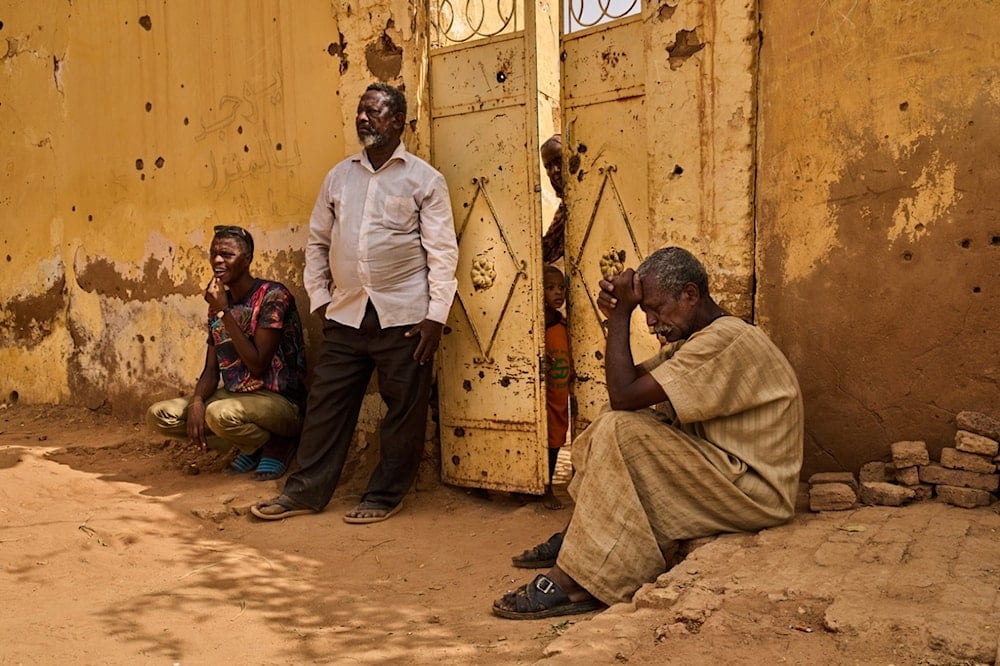
Abubakr Alsawi, right, waits during the exhumation of his brother Mohammed Alsawi, 73, who was killed in 2023 by the paramilitary group Rapid Support Forces in Omdurman, on the outskirts of Khartoum, Sudan, April 20, 2026. (AP/Bernat Armangue)
Sudanese civilians are growing increasingly concerned that the armed groups fighting alongside the country's military could eventually turn into a threat to the army itself, reviving memories of how the current war began, according to the latest report by AFP.
The concern stems from the growing influence of several militias operating in areas under the control of army chief Abdel Fattah al-Burhan. Although they are currently aligned against the paramilitary Rapid Support Forces (RSF), some of these groups have expanded their forces and accumulated significant military capabilities during the war.
The RSF itself was once part of the state's security structure before its rivalry with the army escalated into open warfare in April 2023. The war has since killed more than 200,000 people, according to some estimates, and displaced millions.
"We've seen this scenario over and over. It's the same old mistakes, and it's only a matter of time before they turn on each other," a 30-year-old Sudanese writer told AFP, speaking anonymously over security concerns.
Militias gain influence in army-held areas
Among the most powerful armed groups now operating alongside the military are the Joint Forces, a coalition of former Darfuri rebel factions; the Sudan Shield Forces, led by former RSF commander Abu Aqla Kaykal; and the Baraa ibn Malek Brigade.
The groups have grown in size since the war began and are equipped with heavy weapons, including artillery, anti-aircraft systems, and drones. Their growing presence has become particularly visible in areas held by the army, despite official efforts to restrict the movement of armed fighters.
"The government's technically banned them from carrying weapons, but in the markets, on the streets, you still see them everywhere. It's frightening," a 50-year-old father in Khartoum told AFP.
The Joint Forces have established a visible presence in the capital, while Baraa ibn Malek fighters have also been seen around Khartoum. In al-Jazira state, southeast of the capital, the Sudan Shield Forces have set up checkpoints and asserted control over territory they previously fought to capture alongside the RSF.
Residents say the behavior of some of the groups has deepened concerns over who ultimately controls the areas they hold.
"They act like al-Jazira is theirs," an activist in her twenties told AFP.
"I would never trust any of them. You don't know where their loyalties lie."
Sudan's history of militia empowerment fuels concern
The fears are rooted in Sudan's long history of governments using armed groups as proxies in wars across the country.
Under former president Omar al-Bashir, the government armed the Janjaweed during the Darfur war in the 2000s. The force was later reorganized into the RSF in 2013, giving its commander, Mohammed Hamdan Daglo, widely known as "Hemedti", a powerful position within the state security apparatus.
Daglo eventually broke with Bashir during the 2018-19 uprising and later became an ally of Burhan. Their partnership collapsed as both men competed for control of Sudan's military and political future, ultimately leading to the war that began in 2023.
The breakdown has left many Sudanese wary of the army's current strategy of working with independent armed groups.
Burhan ordered militias to withdraw from Khartoum after the army recaptured the capital from the RSF last year. However, armed fighters remain visible in the city and other areas under military control.
According to AFP, the army has also sought to bring groups such as the Baraa ibn Malek Brigade under greater control. The group is associated with Islamist elements from the Bashir era and has faced US sanctions.
Army officials have repeatedly called for armed factions to eventually join the regular military. Yet, there has been little indication that the groups are prepared to surrender their independent structures in the near future, wrote AFP.
The issue is particularly sensitive because the failure to resolve the RSF's integration into the army was a central factor in the dispute that ultimately erupted into war.
"They're all mercenaries looking out for their own interests," a diplomat in Sudan told AFP.
"If they ever feel short-changed, they're out," the diplomat said, saying that the Joint Forces are "the next Hemedti".
Rivalries could emerge after the war
For civilians, the immediate concern is not only the presence of multiple armed groups but the possibility that their competing interests could eventually lead to a new confrontation.
"People are scared another war between them and the army could break out at any moment," a 40-year-old accountant told AFP, describing the behavior of some fighters who "walk around with their chests puffed out, like they're looking for trouble".
The Joint Forces have also faced suspicion in parts of northern Sudan, where some residents compare their presence to that of the RSF. The group includes fighters from Darfuri communities that have themselves been targeted by RSF violence.
Its leadership includes Darfur governor Minni Minawi and Finance Minister Gibril Ibrahim, both former rebels who fought against Khartoum before joining forces with the army against the RSF.
Sudanese analyst Kholood Khair said that the alliance is a temporary arrangement based primarily on their shared opposition to the RSF.
She warned that the army could eventually face challenges from several of the groups now fighting on its side.
"There are many possible contenders," Khair said.
She singled out Kaykal, the Sudan Shield Forces commander who defected from the RSF in 2024, as a particularly serious concern. According to Khair, he has since established "his own fiefdom where he has unchecked power".
Kaykal's forces now control much of al-Jazira state. A local activist accused him of trying to distance himself from abuses committed while he was aligned with the RSF.
The activist said fighters under his command had participated in attacks on villages during the RSF's advance into the state and later carried out ethnic violence against people accused of supporting the rival force.
Kaykal's growing relationship with Burhan has raised further questions over whether the army is strengthening a potential future rival.
"If anyone is following in the footsteps of the RSF, it's actually Kaykal," Khair said.
"Kaykal and Burhan are on OK terms, but what happens when he decides he wants something Burhan won't give him?"
Read more: Sudan's genocide leaves thousands buried in unmarked graves: AP


