
Tarique Rahman officially sworn in as Bangladesh PM
 4 Min Read
Tarique Rahman was sworn in as the Prime Minister of Bangladesh after the 2024 uprising. BNP wins landslide as the country faces economic and political challenges.
-
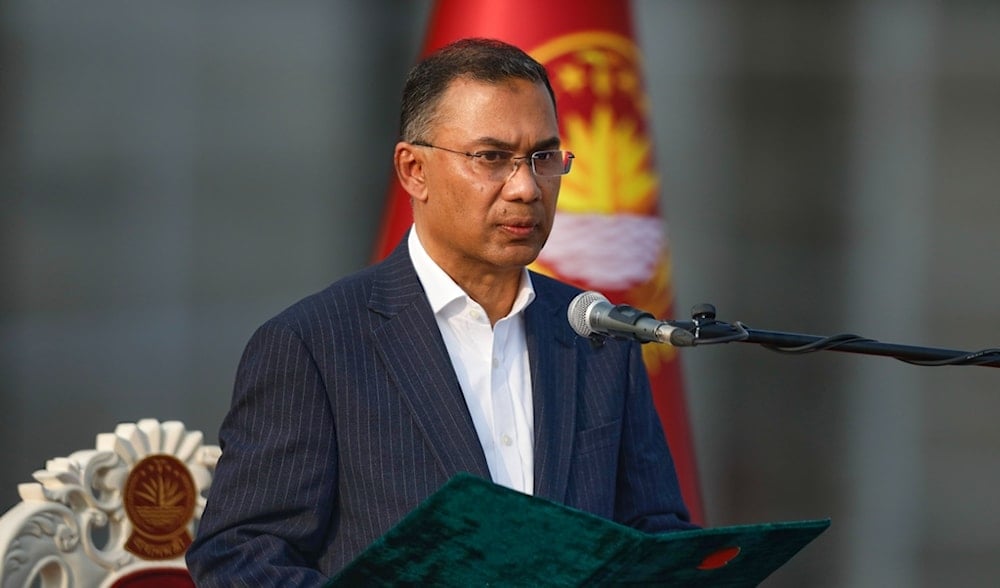
Tarique Rahman, Chairperson of the Bangladesh Nationalist Party, takes an oath as Prime Minister of Bangladesh from President Mohammed Shahabuddin during a ceremony at the National Parliament in Dhaka, Bangladesh, Tuesday, Feb.17, 2026 (AP)
Bangladesh’s incoming leader, Tarique Rahman, was sworn into parliament on Tuesday, becoming the first elected representative to assume office since the 2024 uprising that toppled the government of Sheikh Hasina.
Rahman is set to formally take over as Bangladesh's prime minister, ending 18 months of interim rule in the country of 170 million people following the overthrow of the former administration.
Lawmakers pledged loyalty to Bangladesh during a ceremony overseen by Chief Election Commissioner A M M Nasir Uddin. The president, Mohammed Shahabuddin, was scheduled to administer the oath of office to Rahman and his cabinet later in the day.
First elected government since 2024 uprising
The swearing-in marks a significant milestone in Bangladesh’s political transition after the violent unrest of 2024 led to Sheikh Hasina’s removal from power.
Rahman, 60, leader of the Bangladesh Nationalist Party (BNP) and a prominent political figure from one of the country’s most influential families, returned to Bangladesh in December after 17 years in exile in Britain.
His rise to office follows a decisive electoral victory that reshaped the country’s political landscape. The Bangladesh Nationalist Party (BNP) victory in the February 12 parliamentary elections secured 212 seats for the BNP-led coalition.
The Jamaat-e-Islami-led alliance won 77 seats, with Jamaat itself securing more than a quarter of the parliamentary seats, a fourfold increase from its previous best performance. The party has challenged results in 32 constituencies.
Despite contesting some outcomes, Jamaat leader Shafiqur Rahman, 67, said the Islamist party would “serve as a vigilant, principled, and peaceful opposition”.
The Awami League party of Sheikh Hasina was barred from participating in the elections.
Rahman’s victory speech and democratic pledge
Following the landslide result, Rahman declared, “This victory belongs to Bangladesh, belongs to democracy,” he said in his victory speech on Saturday. “This victory belongs to people who aspire to and have sacrificed for democracy.”
At the same time, he acknowledged the difficulties facing his administration.
“We are about to begin our journey in a situation marked by a fragile economy left behind by the authoritarian regime, weakened constitutional and statutory institutions, and a deteriorating law and order situation”, he added.
Rahman has urged political parties to “remain united” in a country deeply polarized by years of rivalry.
Economic and political challenges ahead
The new prime minister takes office amid significant economic strain. Bangladesh, the world’s second-largest garment exporter, has faced declining investor confidence following months of instability.
Rahman has pledged to restore stability, strengthen institutions, and revive economic growth after the turmoil that followed the Sheikh Hasina overthrow.
His administration is expected to prioritize economic reform and improvements in governance as it seeks to stabilize the country after a prolonged political crisis.
Hasina slams elections as 'illegal'
Sheikh Hasina, 78, who was sentenced to death in absentia for crimes against humanity and sought refuge in India, described the vote as an “illegal” election. India, however, praised the BNP’s “decisive win,” signaling a shift after previously strained relations.
Only seven women were directly elected to parliament. However, an additional 50 seats reserved for women will be distributed among parties in proportion to their share of the vote.
Four members of minority communities won seats, including two Hindus, who make up roughly 7% of Bangladesh’s predominantly Muslim population.
Read more: China’s role in Bangladesh grows as Dhaka-Delhi ties fray


