
Trump advisers to meet Zelensky in Berlin as US pushes peace plan
 4 Min Read
Trump advisers Steve Witkoff and Jared Kushner will meet Zelensky and European leaders in Berlin to discuss a US peace plan for Ukraine, amid pressure over territorial concessions and proposed security guarantees.
-
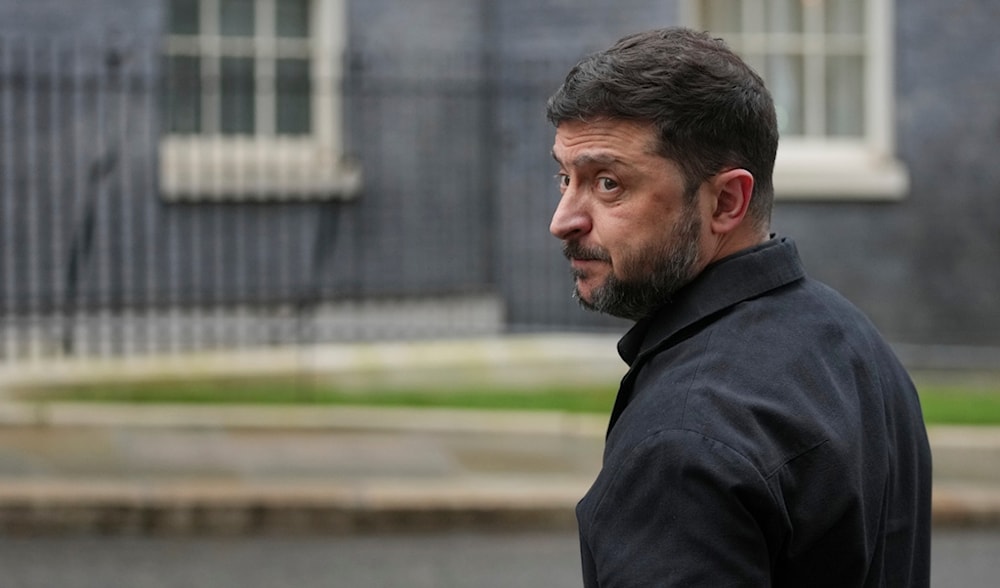
Ukrainian President Volodymyr Zelensky, looks back at the media in Downing Street, London, Monday, Dec. 8, 2025. (AP)
President Donald Trump’s advisers, Steve Witkoff and Jared Kushner, are expected to meet with Ukrainian President Volodymyr Zelensky on Monday in Berlin, alongside leaders from Germany, France, and the UK. The meeting aims to push forward the US-backed peace plan for Ukraine, according to two White House officials who spoke to Axios.
The discussions come as the White House intensifies pressure on Ukraine to accept the proposal, though major obstacles remain, chiefly the issue of territorial concessions.
In the same context, Zelensky stated the meeting aims to discuss the "foundations of peace," stressing Kiev's need for "dignified peace" and security guarantees that would prevent another conflict with Russia.
Territorial concessions remain a sticking point
While US officials believe most areas of disagreement have been resolved, the status of territory remains deeply contentious. According to one official, Zelensky hinted during public remarks last Thursday that a peace agreement could potentially be put to a referendum, an idea viewed by the US as a positive step.
In his recent comments, Zelensky expressed skepticism over the US proposal to establish a "free economic zone" in Donbass and called for revisions and clarifications on various elements of the plan. He said the fairness of the proposed compromises should ultimately be determined by the Ukrainian people, either through a referendum or election.
Challenges to a vote, European involvement
Holding a national referendum amid ongoing conflict would be highly complex. However, a US official stated that European leaders signaled their support for such a move during a Friday meeting, should Zelensky move forward with the proposal.
In that virtual session, Witkoff and Kushner discussed the demilitarized zone plan with national security advisers from Ukraine, Germany, France, and the UK. The meeting built on progress made during Thursday’s US-Ukraine talks, which ultimately led President Trump to authorize sending his advisers to Europe.
“They believe there could be a chance at peace, and the President trusts them,” said a second White House official.
Security guarantees and reconstruction package
Negotiations over long-term security guarantees for Ukraine have reportedly advanced significantly. A senior US official said the Trump administration is willing to offer Ukraine a legally binding security agreement modeled on NATO’s Article 5. The deal would be submitted to Congress for approval.
“We want to give the Ukrainians a security guarantee that will not be a blank check on the one hand but will be strong enough on the other,” the official explained.
The current peace framework includes three separate agreements covering peace terms, security guarantees, and post-war reconstruction. According to Axios, for the first time, US negotiators say Ukraine has been presented with a comprehensive "day-after" vision.
Zelensky obstructing a deal: Trump
Trump claimed Thursday that both Russia and Ukraine are nearing an agreement to end the war, suggesting that most Ukrainians support the idea of peace, except Ukrainian President Volodymyr Zelensky.
Speaking to reporters at the White House, Trump said, "I thought that we were very close with Russia to having a deal. I thought we were very close with Ukraine to having a deal."
In a pointed remark, Trump claimed that most Ukrainians support a deal with Russia, except for the country’s president.
"In fact, other than President Zelensky, people love the concept of the deal," he said.
The comments reflect Trump’s ongoing criticism of Zelensky and echo his past claims that the conflict could have been avoided or resolved earlier through direct negotiations, an approach that contrasts with the current US administration's military and financial backing of Kiev.
Read more: Putin vows to see ‘special military operation’ through to its end


