
Trump blames Democrats' win for Iranian retaliatory strikes
 4 Min Read
US President Trump claimed on Truth Social that Iran escalated after the Democrats' midterm win.
-
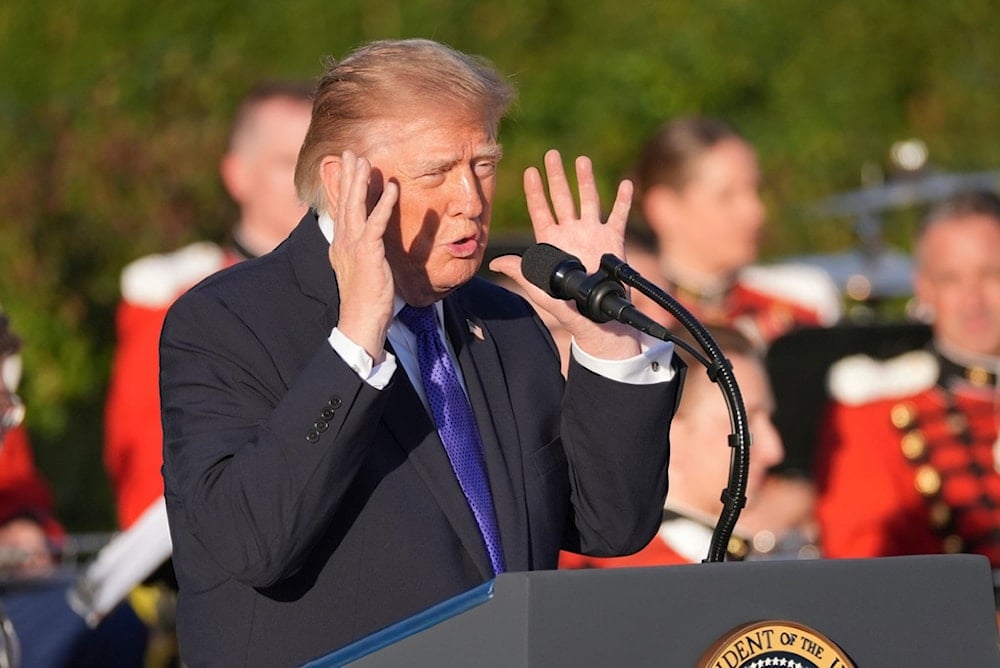
United States President Donald Trump speaks during an event on the helipad on the South Lawn of the White House, on November 20, 2026, in Washington. (AP)
United States President Donald Trump claimed on Sunday that Iran has grown "more aggressive" by the Democratic Party's sweeping midterm victories, in a post on Truth Social.
"Iran has launched more drones and missiles in the last week than at any time for over a year," Trump wrote, claiming, "Don't worry, they've all been knocked down, and done no damage."
He added that "Iranian leaders consider the Democrats weak, ineffective, and country destroying, but I won't let that happen!"
Trump said he made two predictions before the November 3 election, that stocks would fall if Democrats won and that Iran would escalate.
The Nasdaq turned negative for the year and the S&P 500 entered correction territory last week.
Trump also said that "both the Dems and Iran fought like hell to keep the oil price up as long as possible," and that since the election the price "has dropped by a record level."
He lamented that voters "didn't understand this before they pulled the trigger, but the whole election was very strange," and closed with the words "In the end, America will win!" In the same post, Trump claimed in September that the war would end quickly after the midterms, a promise that has not held.
What the record shows
Iranian forces have launched retaliatory drone strikes on US bases in Bahrain and Kuwait in recent days. Footage showed multiple hits in both countries in the overnight strikes.
The National News Desk, citing officials, reported that Tuesday's attack on a radar at Sheikh Isa Air Base in Bahrain was Iran's third in five days after a roughly two-month lull in strikes on US bases in Gulf states. That record does not match Trump's claim of the heaviest barrage in over a year. Iran fired 132 missiles and 234 drones at Bahrain alone between February 28 and March 18, according to reported figures.
Attacks on tankers in the Strait of Hormuz have also escalated, with Iranian naval forces heavily resisting US efforts to smuggle oil through the waterway.
Oil prices
Brent crude did fall sharply after the election, but analysts tied the drop to expectations of de-escalation after the Republican defeat, not to anything the Democrats or Iran did.
Brent fell 8 percent on the Wednesday after the vote and dropped roughly 13 to 17 percent that week, its steepest weekly percentage fall since the start of the Covid pandemic and its biggest in absolute terms in LSEG data going back to 1988, Reuters reported. Ben Cahill, a senior fellow at the Atlantic Council, told Axios the decline reflected a belief that Trump would de-escalate on Iran.
Brent ended last week near $91 to $92 a barrel, down about 21 percent from its October high of $117.
The political backdrop
Democrats won both the House and the Senate in the November 3 vote, which analysts widely read as a rebuke of the decision to launch the war on Iran, on February 28.
US Vice President JD Vance stressed in a post-election social media post that the war, cost of living, and US-Israeli relation led to the Republican defeat. Meanwhile, Trump defended the aggression on Friday as necessary to stop Iran from acquiring a nuclear weapon, which Iranian officials have repeatedly insisted they have no intention of doing.
Talks to end the war, which the United States and "Israel", remain stalled. Trump told Axios last week he will not decide on his next step until the new year.
Iranian Foreign Minister Abbas Araghchi stated that Tehran remains open to diplomacy to end the current state of "neither war nor peace," provided Washington offers confidence-building guarantees to prove its seriousness. Following the breakdown of earlier talks, Araghchi emphasized that Iran is seeking a permanent, dignified agreement that protects its national interests rather than a temporary truce.


