
Trump defends WH ballroom project as matter of national security
 4 Min Read
The US president's administration says the White House ballroom construction is essential for US "national security" amid a lawsuit by a historic preservation group.
-
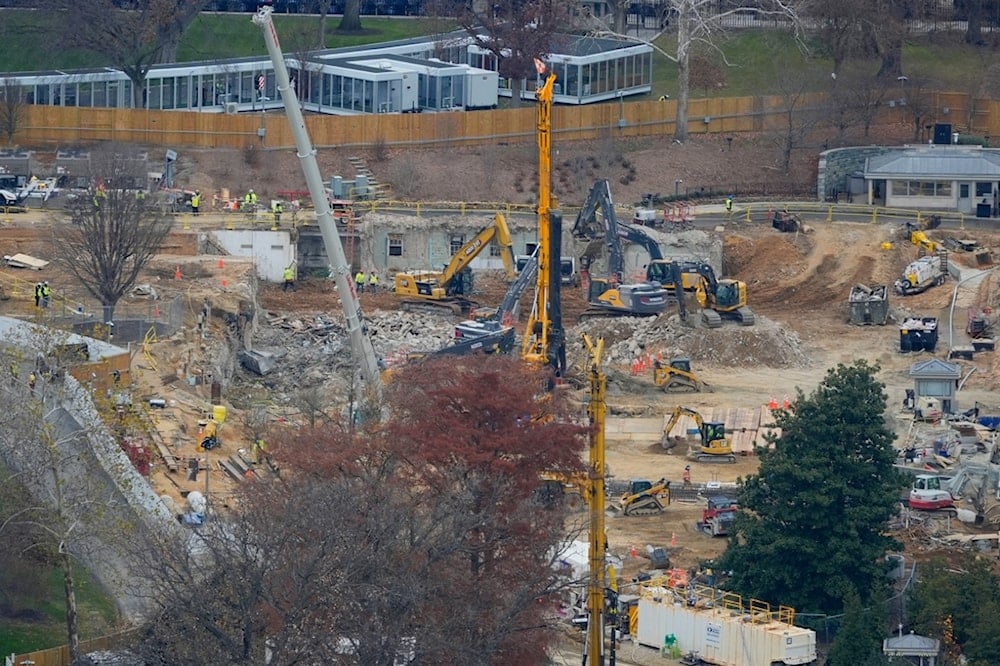
Work continues on the construction of the ballroom at the White House, Tuesday, December 9, 2025, in Washington, where the East Wing once stood. (AP)
US President Donald Trump's administration has argued that the ongoing construction of a new White House ballroom must proceed for reasons related to US national security, The Guardian reported.
The statement came on Monday in a court filing responding to a lawsuit aimed at halting the project.
The legal challenge was filed by the National Trust for Historic Preservation, which has asked a federal judge to stop the construction until it undergoes public reviews, environmental assessments, and congressional approval.
In its filing, the administration included a declaration from the deputy director of the US Secret Service, citing the need for continued work on the former East Wing site to meet “safety and security requirements.”
The Trump administration also offered to present classified details about the project to the judge in a private setting, without the plaintiffs present.
Read more: Trump builds ballroom as US families go hungry without food aid
Lawsuit challenges project on historic preservation grounds
The National Trust for Historic Preservation filed the lawsuit just days earlier, arguing that the 90,000-square-foot addition must be subject to multiple layers of independent review.
The group is seeking to block further construction until design plans are finalized and reviewed by oversight bodies, such as the National Capital Planning Commission and the Commission of Fine Arts.
The filing represents the most direct legal effort yet to halt Trump’s $300 million project, which would nearly double the size of the White House prior to the demolition of the East Wing in October.
Government says lawsuit is moot, premature
The Trump administration’s legal team countered that the plaintiff's claims regarding the East Wing demolition are now “moot", as the structure has already been torn down. It also argued that the lawsuit is “unripe", since the final plans for the ballroom have yet to be completed.
According to John Stanwich, the US National Park Service’s liaison to the White House, below-ground work is ongoing, with foundation work scheduled to begin in January. “Above-ground construction is not anticipated to begin until April 2026, at the earliest,” he wrote.
The administration further stated that the legal challenge fails to show “irreparable harm", as the reviews sought by the plaintiff are expected to move forward without court intervention.
“Even if plaintiff could overcome the threshold barriers of mootness, ripeness, and lack of standing, plaintiff would fail to meet each of the stringent requirements necessary to obtain such extraordinary preliminary relief,” the administration said.
Read more: Trump appears in several Epstein photos released by Democrats
Timeline, scope of White House ballroom construction
The Trump administration began demolition of the East Wing in October 2025, initiating the early stages of a plan to construct a large ballroom addition on the White House grounds.
Trump initially stated that the White House requires a larger event space because the existing room can only accommodate around 200 people, noting that it is too small for large state dinners and official functions.
Despite criticism from preservationists and political opponents, the administration has pushed ahead with site preparation work while claiming the project is essential for security-related functions.
The ballroom will span approximately 90,000 square feet and cost an estimated $300 million. It is scheduled for completion before the end of Trump’s term in 2029.
Broader reactions from preservation, political communities
The project has drawn significant backlash from experts in historic preservation and architectural design, many of whom argue that such a drastic alteration to the White House demands full public scrutiny.
Critics also view the project as part of Trump’s broader pattern of bypassing traditional oversight mechanisms.
Tuesday's court hearing in Washington is expected to offer more insight into how the administration plans to move forward amid ongoing legal resistance.


