
Trump does not rule out war with Venezuela as US pressure grows
 5 Min Read
Despite campaign promises to avoid foreign wars, Trump hints at military action in Venezuela while facing criticism over healthcare costs and misused military funds.
-
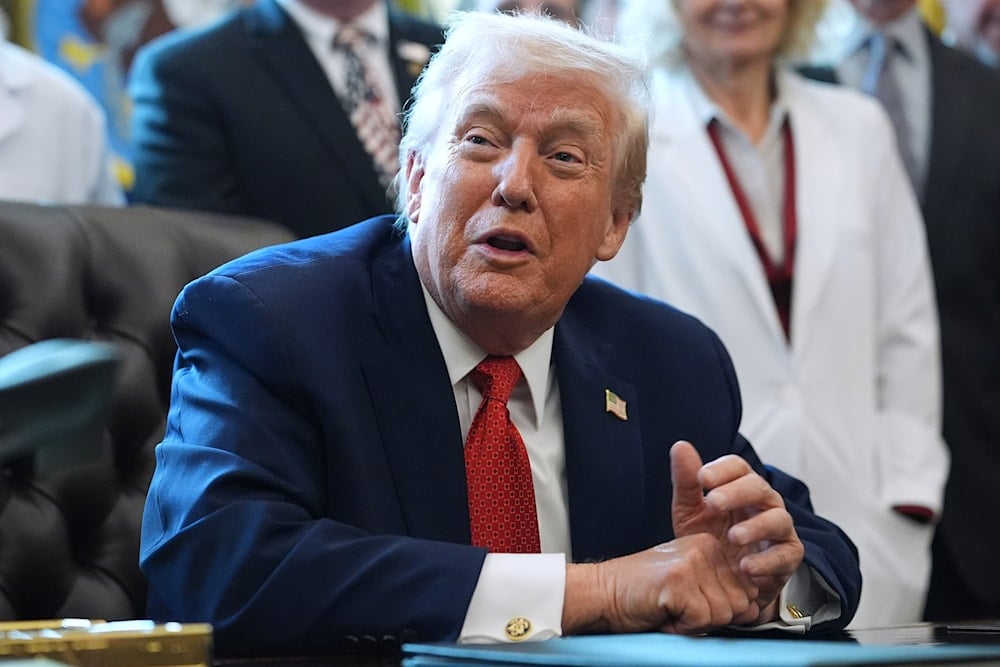
US President Donald Trump speaks to reporters after signing an executive order reclassifying marijuana as a less dangerous drug in the Oval Office of the White House, Thursday, Dec. 18, 2025, in Washington. (AP)
US President Donald Trump said Thursday that the possibility of military conflict with Venezuela remains on the table, as his administration escalates pressure on the government of President Nicolas Maduro.
“I don’t rule it out, no,” Trump told NBC News in a phone interview.
Earlier this week, Trump ordered what he described as a “blockade” of sanctioned oil tankers traveling to and from Venezuela, a move aimed at tightening economic and political pressure on Caracas. US authorities have also recently seized an oil tanker near Venezuelan waters.
That campaign has already included 28 maritime strikes that have killed more than 100 people, according to reports, among them a so-called “double tap” strike that is now facing scrutiny in Congress.
Asked whether such actions could spiral into war, Trump initially demurred, saying, “I don’t discuss it.” When pressed, however, he acknowledged escalation was possible and said additional tanker seizures were likely.
“It depends,” Trump said when asked about timing. “If they’re foolish enough to be sailing along, they’ll be sailing along back into one of our harbors.”
Trump also declined to clarify whether removing Maduro from power remains his ultimate objective.
“He knows exactly what I want,” Trump said. “He knows better than anybody.”
The remarks are notable given Trump’s long-running effort to distance himself from the more hawkish wing of the Republican Party. During the 2024 campaign, he repeatedly argued that he could keep the United States out of foreign wars.
In his victory speech after the election, Trump said he was “not going to start a war; I’m going to stop wars.”
The administration maintains that its maritime strikes have targeted alleged drug-trafficking vessels and claims Venezuela is using oil revenues to finance what it calls “drug terrorism".
Domestic focus: economy, military pay, and health care
Trump also sought to defend his economic agenda in a national prime-time address on Wednesday, as voters continue to express concern about the rising cost of living.
During the speech, he announced a $1,776 “warrior dividend” for nearly 1.5 million service members, timed to mark almost 250 years since the nation’s founding.
Trump told NBC News that payments would begin "very soon."
“I would say within the next few days, it’ll all be out,” he said, adding that the funds would come from the One Big Beautiful Bill and revenue generated by tariffs.
“We're making so much money with tariffs that we are able to do that and have plenty left over,” Trump said.
However, a senior administration official said the one-time bonus would cost about $2.6 billion and would be paid for using military housing funds authorized under the legislation Trump signed in July. A Senate appropriations source also said the money would come from those allocations, not tariffs, and that the Defense Department opted for a one-time payment rather than setting a longer-term precedent for housing benefits.
Trump also addressed health care, sharply criticizing “gigantic health insurance companies that have gotten rich on billions of dollars of money that should go directly to the people.”
He argued that Americans should be allowed to “buy their own health insurance, which will give far better benefits at much lower cost. It will be far better health insurance.”
Wider context
Millions of people who rely on coverage through the Affordable Care Act are expected to see higher premiums next year after House Republicans declined to vote on extending subsidies. Trump said he does not believe repealing the law, often referred to as Obamacare, is necessary.
“I don’t have to do anything, because Obamacare would just repeal itself automatically because nobody’s going to want to use it. Too expensive,” he told NBC News.
He added that he has no plans to roll out a broader health care overhaul.
“As far as I’m concerned, I rolled it out last night,” Trump said. “It’s very simple. It’s a very simple plan. The insurance companies have become totally rich and beyond any comprehension. They get billions and billions of dollars a year, and we’re not going to let that happen."
“We’re going to pay the money directly to the people,” he added. “They can use health care accounts. They can use, you know, there are many ways of doing it, but we’re going to let them buy their own health care. They’ll get much better health care at a much lower price.”
With November’s midterm elections approaching, control of Congress remains a central concern for both parties. Republicans are acutely aware that losing either chamber could open the White House to investigations and legislative gridlock.
Asked whether he believes Republicans will retain control of both chambers, Trump replied, “I think so. I certainly hope so.”


