
Trump faces stark choice as war on Iran enters third week
 6 Min Read
US President Donald Trump faces mounting pressure as the war on Iran expands, with rising casualties, energy market disruptions, and a possible naval coalition in the Strait of Hormuz.
-
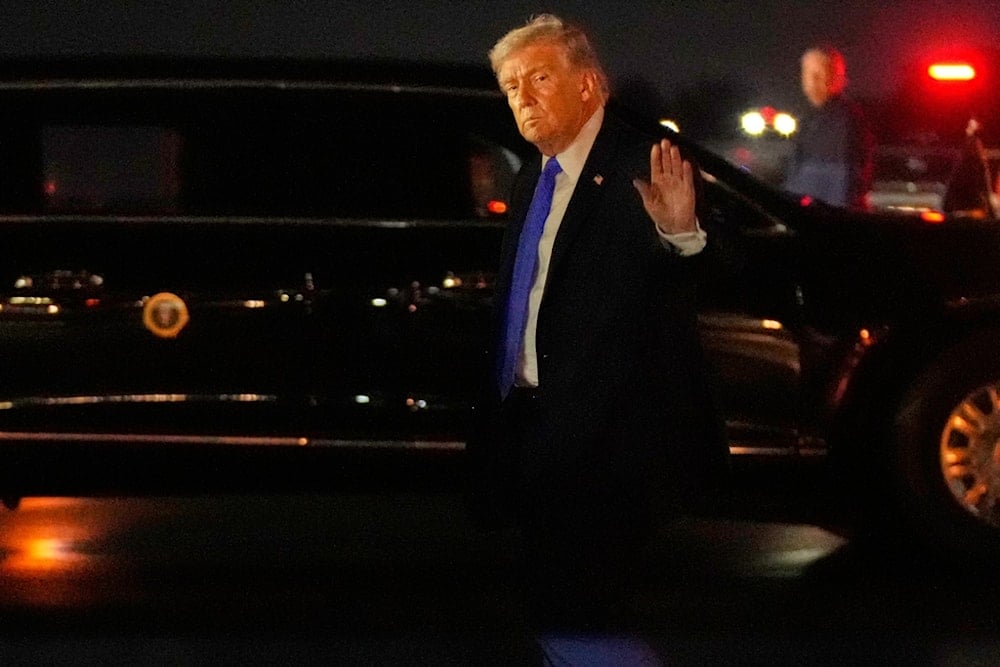
President Donald Trump waves after arriving on Air Force One, on March 13, 2026, at Palm Beach International Airport in West Palm Beach, Fla. (AP)
Two weeks after launching a war on Iran, US President Donald Trump faces a stark choice: remain in the war to pursue the "highly ambitious goals" he set or attempt to withdraw from a widening confrontation that is generating powerful military, diplomatic, and economic shockwaves.
The Trump administration has quickly discovered that both options carry significant risks. Each path is fraught with consequences that Trump and his team appear to have underestimated when they brought the United States, alongside Israeli forces, into the largest war in West Asia in nearly a quarter-century.
The war has already produced growing casualties, rising oil prices, and escalating regional instability, forcing Washington to weigh whether to deepen its military campaign or seek a path toward de-escalation.
Trump could choose to continue fighting an adversary that has demonstrated a capacity to impose rapidly growing economic and strategic costs on the United States and its allies. However, prolonging the war would expose more American personnel to danger, increase financial burdens, and risk further strain on international alliances. The war has already resulted in the deaths of 13 American service members and more than 2,100 people overall since the beginning of the war.
On the other hand, Iran’s representative to the United Nations has said that more than 1,300 civilians have been killed inside the country since the start of the war.
At home, concerns are also growing among Trump’s political base, many of whom supported his earlier pledge to avoid entangling the United States in new overseas wars.
Withdrawal could leave key objectives unmet
Alternatively, Trump could begin scaling back US involvement, even though many of the administration’s objectives remain incomplete.
Among the most important goals is preventing Iran from ever developing a nuclear weapon. Officials say that despite the damage inflicted during joint US-Israeli operations, Iran’s nuclear infrastructure and enriched uranium stockpiles remain a major concern.
Despite repeated suggestions by Trump that the war may be nearing a resolution, Washington and "Israel" have continued intensifying their military attacks while deploying additional resources to the region. That said, the buildup suggests the United States is preparing for a prolonged confrontation.
US and Israeli officials claim the war has severely weakened Iran’s conventional military forces. But despite the martyrdom of the leader of the Islamic Revolution, Sayyed Ali Khamenei, Iran’s governing system remains intact and continues to direct military operations. The Iranian leadership has pledged to expand asymmetric warfare tactics, including cyberattacks, missile strikes, and maritime disruptions.
The Islamic Revolution Guards Corps remains operational despite heavy losses.
Strait of Hormuz disruptions shake global energy markets
One of the most immediate global consequences of the war has been the disruption of shipping through the Strait of Hormuz, one of the world’s most critical energy corridors. Tanker traffic through the waterway has slowed dramatically following a series of attacks on commercial vessels. Oil prices have surged to around $100 per barrel as shipping companies and insurers grow increasingly reluctant to operate in the area.
Iran’s ability to threaten maritime trade has emerged as one of its most effective strategic tools in the war.
US officials say the Trump administration is now expected to announce that several countries have agreed to form a coalition to escort commercial vessels through the Strait of Hormuz. The maritime protection initiative would aim to secure the vital shipping route along Iran’s coast. However, officials said discussions are still ongoing about whether escort operations would begin only after fighting subsides.
The White House declined to comment on the anticipated announcement, and several countries have publicly remained noncommittal about participating, citing the risks of operating in an active war zone.
Tensions surface between Washington and 'Israel'
The war has also exposed differences between Washington and "Israel" over military strategy.
US officials reportedly warned Israeli leaders against attacking major oil storage facilities near Tehran, fearing such strikes would trigger retaliatory attacks against regional energy infrastructure. "Israel" nevertheless carried out strikes on Iranian oil depots, causing large fires and contributing to a surge in oil prices.
The disagreement reflects broader strategic tensions, including "Israel's" decision to expand its aggression on Lebanon. US officials worry that opening additional fronts could widen the war and divert resources from the central objective of weakening Iran.
Two major decisions now face the Trump administration as the war enters its third week.
One option under discussion is the seizure of Kharg Island, Iran’s main oil export hub. Capturing the island would give Washington control over a large share of Iran’s oil exports but could require a prolonged military presence, something Trump previously claimed would avoid.
Another potential operation would target Iran’s stockpile of highly enriched uranium stored in underground facilities in Isfahan. Officials say retrieving the material would likely require a complex special operations mission inside Iranian territory, posing significant operational risks.
War with long-term consequences
Even if US military objectives are achieved, analysts warn the war’s impact could shape regional politics and global markets for years.
Former Iraqi foreign minister Hoshyar Zebari described the martyrdom of Sayyed Khamenei as the “end of an era,” but cautioned that Iran’s political system has shown resilience. “They are resisting, they are resilient,” Zebari said. “This is a war between technology and ideology.”
According to reports, Trump must weigh decisions that could determine not only the outcome of the war but also the future balance of power across West Asia.


