
Trump has to accept defeat or endure it: Iran Leader advisor
 3 Min Read
Iran’s Mokhber warns that US actions in the Strait of Hormuz could trigger a wider conflict, saying Trump will be forced to accept defeat.
-
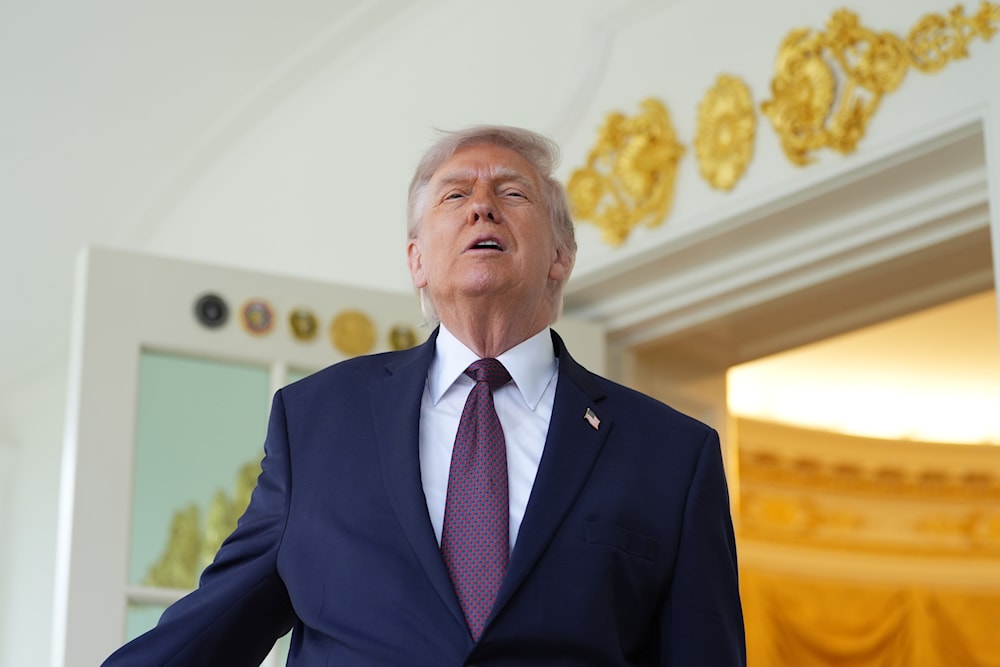
US President Donald Trump speaks outside the Oval Office of the White House, Monday, April 13, 2026, in Washington (AP)
US President Donald Trump is forced either to accept defeat or endure it, Mohammad Mokhber, advisor to the Leader of the Iranian Revolution and Islamic Republic, said, warning that attempts to envision a blockade of the Strait of Hormuz would lead to wider regional and global consequences.
In a post on X, Mokhber wrote that “Trump’s confusion is the prelude to another mistake,” suggesting that US policy decisions could lead to unintended consequences. He specifically rejected the notion of surrounding the Strait of Hormuz, stating that such an idea “is not only unachievable, but will lead to new surprises.”
حیرانی #ترامپ، مقدمه اشتباهی دیگر است. تخیل محاصره تنگه هرمز نهتنها دستاوردی ندارد، که منجر به غافلگیری دوباره و گشوده شدن جبهههای جدید علیه نظام سلطه و افزایش فشارهای اقتصادی بیشتر روی منطقه، جهان و متحدانشان خواهدشد.
— محمد مخبر (@MokhberOfficial) April 14, 2026
این #مردبازنده ناچار به پذیرش شکست یا تحمل شکست است .
Mokhber asserted that such actions would result in “the opening of new fronts against the arrogant system,” adding that the scenario would also bring “greater economic pressure on the region, the world, and their allies.”
Concluding his remarks, Mokhber referred to Trump as a "losing man" at a crossroad: "either to accept defeat or to endure it," underscoring the confrontational tone of the message.
Mokhber’s depiction of Trump as a “losing man” comes as an assessment that gains sharper edge amid remarks by Iran’s First Vice President Mohammad Reza Aref, who criticized Israeli Prime Minister Benjamin Netanyahu’s statement that US Vice President JD Vance reports to him daily on negotiations with Iran, raising questions about Washington’s independence and amplifying perceptions of Trump’s weakened and subordinate posture.
Aref sharply criticized Netanyahu's remarks in a post on X, saying that this unprecedented admission exposes a "structural humiliation", arguing that "for the first time in history, a senior official of a government is providing 'daily briefings' to the head of another state!"
Netanyahu: "Vance reported to me on his way back from Islamabad, as he does every day."
— Aref| First VP Iran (@fvpresidentiran) April 14, 2026
For the first time in history, a senior official of a government is providing "daily briefings" to the head of another state!
The issue is not us; it is a matter of structural humiliation.…
He stressed that "the issue is not us," but rather the implications for the US itself, questioning whether Americans realize that "the White House has effectively turned into a 'reporting branch' for another regime."
US escalations face significant risk of backfire: FT
Washington appears to be facing narrowing strategic options in its confrontation with Iran, as diplomatic engagement tentatively resumes alongside warnings that military and economic pressure may fail to achieve its stated objectives, according to the Financial Times.
FT reported that the United States’ naval embargo strategy is aimed at restricting Iran’s oil exports in an effort to limit its defense financing.
However, analysts warn that such measures risk destabilizing global energy markets and pushing oil prices higher, while also threatening a fragile ceasefire framework between Washington and Tehran. Trump confirmed the approach, stating that Washington is pursuing “a complete blockade” to prevent Iran from selling oil.
He compared the policy to US action against Venezuela, saying, “You saw what we did with Venezuela. It’ll be something very similar to that, but at a higher level.”
Despite the pressure campaign, skepticism remains among analysts. Iranian expert Vali Nasr told the Financial Times that such measures may have a limited immediate impact on Iran, arguing that Tehran could instead respond by leveraging global maritime chokepoints to increase pressure on the international economy.
From the outset of the war, Iran has framed the confrontation as an existential struggle, with a strategic objective of raising costs for the United States and the global economy, according to the report.


